
We will now look at Instalment warrants. Instalment warrants give the holder the right to buy the underlying share with the payment of two or more instalments during the life of the warrant. They are similar to buying shares on lay-by. Instalment warrants are issued over 56 different shares (and securities) that are listed on the ASX.
Instalment warrants differ from normal equity warrants in that the underlying share is held in trust for the benefit of the holder. As a result of this they do not suffer from time decay. The holder is also entitled to any dividends or franking credits that are paid by the underlying share during the life of the warrant.
Instalment warrants are call warrants by nature. This means that you should only hold them while the price of the underlying share is rising. Instalment warrants can be either American or European in exercise style. They usually have a life span of between one to three years, although newer rolling instalment warrants (see below) have a life span of between five to ten years.
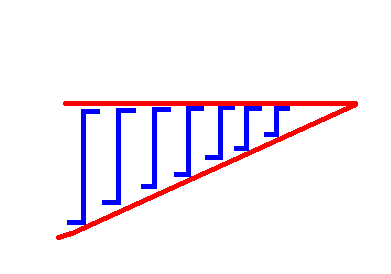
Rolling instalment warrants differ from normal instalment warrants, in that their exercise price may be reset each year by the issuer. At the end of each year, on the warrant's annual reset date, the holder has three options.
-They can pay the exercise price and take delivery of the underlying share.
-They can sell the warrant.
-They can roll the warrant over into the next year.
If they choose to do nothing the warrant will automatically be rolled over into the next year. Rolling the warrant over into the next year means that you accept the new exercise price and you may have to pay an additional amount to the issuer.
Rolling instalment warrants are looked upon as being a series of consecutive one-year instalment warrants with the exercise price being reset each year.
Normal instalment warrants have a gearing level of about 50%. This means that you pay 50% up front and the issuer lends you the remaining 50%(plus interest, although this is usually paid up front with the first instalment). Some new instalment warrants have a higher level of gearing (50%-100%). They are often called "Hots".
There are many different instalment warrants issued by many different issuers. From a trader's point of view there are two different series of rolling instalment warrants (series IMC and IMD) issued by Macquarie Bank that really stand out from the rest. They are by far the most popular instalment warrants that are traded on the ASX.
As premium traders, it is our intention to trade Macquarie's IMC and IMD series of instalment warrants on the ASX. The leverage that they provide and their trading volume make them very good medium to long term trading candidates.
I will now list out the terms of our two instalment warrant series' and the shares that they are issued over. See Tables 4.1 & 4.2 below.
Table 4.1 Terms of Series IMC & IMD
| Terms | Series IMC | Series IMD |
|---|---|---|
| Expiry Date | 19th MAY 2006 | 19th MAY 2006 |
| Annual Reset Date | 20th MAY | 20th MAY |
| Gearing | 40% - 70% | 70% - 95% |
| Exercies Style | American | American |
| Conversion Ratio | 1:1 | 1:1 |
Table 4.2 Shares Issued Over
| Series IMC | Series IMD |
|---|---|
| AMP, ANZ, BHP | AGL, AMP, ANZ |
| CBA, CML, CSR | ASX, BHP, BIL |
| FGL, FXJ, LLC | CBA, FGL, LLC |
| MAY, MIG, NAB | NAB, NCP, QAN |
| NCP, NRM, ORI | RIO, STO, SUN |
| QAN, RIO, SGB | TAH, TLS, WBC |
| SRP, STO, TLS | WMC, WPL |
| WBC, WMC, WOW |
We do not worry about terms like at-the-money, out-of-the-money etc. with instalment warrants. Most of them are deep in-the-money anyway.
We also do not worry about time or intrinsic value. We just look on the instalment warrant premium as a whole.
The delta of an instalment warrant represents the change in value of a warrant compared to its underlying share. It can be presented as a decimal number between 0.00 - 1.00 or it can be presented as a percentage between 0% - 100%. (Please note that with most instalment warrants being deep in-the-money they usually have a delta of between 0.50 - 1.00 (50% - 100%).
An instalment warrant that has a delta of 1.0 (100%), means that if the value of the underlying share rises or falls by one cent, the value of the warrant will also rise or fall by one cent. An instalment warrant that has a delta of 0.5 (50%), means that if the value of the underlying share rises or falls by one cent, the value of the warrant will rise or fall by half a cent.
At the time of writing all instalment warrants have a conversion ratio of 1:1, so this factor doesn't effect the delta of an instalment warrant.
I will briefly describe the other factors that can effect the premium of an instalment warrant.
Volatility
Volatility is the measure of the variation in price, of the underlying share, over time. If the price of an instalment warrant's underlying share increases by an abnormal amount, the volatility of the share increases, causing then premium of the instalment warrant to also increase. It is not necessary to know how to calculate volatility, only to know that it exists.
Dividends
When the underlying share of an instalment warrant goes ex-dividend the value of the warrant will decrease.
To work out how much the warrant premium will decrease when its underlying share goes ex-dividend, find out how much the dividend payment is and then find out the delta of the warrant. It is simply a matter of multiplying the dividend payment by the delta of the warrant. The answer should equal the amount that the warrant premium will decrease by.
One thing to remember about instalment warrants is that all the dividends and franking credits from the underlying share are passed on to the holder of the warrant. So even though the premium will decrease at this time, the dividends that will be paid to you will make up for this.
Leverage is a major factor in trading instalment warrants. Leverage tells us, how much the warrant premium will rise (or fall), compared to a 1% rise (or fall) in the value of the underlying share. The answer is expressed as a percentage. It is also a useful way of comparing different warrants, to find out which ones offer better returns. Leverage is calculated as follows:
Leverage = (Underlying Share Price / Warrant Premium) x Warrant's Delta
Using two example warrants NABIMC & NABIMD, we will work out the leverage that they both offered on the 10th September 2001.
Leverage = (Underlying Share Price / Warrant Premium) x Warrant's Delta
In the above example NABIMC offers a 2.14% rise (or fall) compared to a 1% rise (or fall) in the price of NAB shares. Another way of putting it is, buying $1000 of NABIMC warrants gives the same exposure as buying $2140 of NAB shares.
Leverage = (Underlying Share Price / Warrant Premium) x Warrant's Delta
In our example NABIMD offers a 3.69% rise (or fall) compared to a 1% rise (or fall) in the price of NAB shares. Another way of putting it is, buying $1000 of NABIMD warrants gives the same exposure as buying $3690 of NAB shares. Also NABIMD offers 70% more leverage than that offered by NABIMC.
One thing that differs between equity and instalment warrants is that with instalment warrants the dividends paid by the underlying share get passed on to the warrants holder. The instalment warrant offers a far greater dividend yield than the underlying share.
During the past year (at the time of writing) NAB paid its shareholders a total of $1.31 in dividends. At the 10th September 2001, NAB shares were priced at $30.20.
Dividend Yield = (Dividends / Underlying Share Price) x 100
Dividend Yield = ($1.31 / $30.20) x 100
Dividend Yield = 4.33%
The effective dividend yield for NAB shareholders was 4.33%.
If you bought NABIMC warrants you received the same dividend for a far less outlay. At the 10th September 2001 NABIMC warrants were priced at $13.94.
Dividend Yield = (Dividends / Underlying Share Price) x 100
Dividend Yield = ($1.31 / $13.94) x 100
Dividend Yield = 9.39%
The effective dividend yield for the holders of NABIMC warrants was 9.39%. More than twice the yield offered by ordinary NAB shares.
On the 10th September 2001 NABIMD warrants were priced at $5.40.
Dividend Yield = (Dividends / Underlying Share Price) x 100
Dividend Yield = ($1.31 / $5.40) x 100
Dividend Yield = 24.25%
The effective dividend yield for the holders of NABIMD warrants was 24.25%. More than five times the yield offered by ordinary NAB shares.
A lot of investors buy instalment warrants just before the underlying share pays a dividend, to take advantage of the increased dividend yield. The increased yields offered by instalment warrants often make the strategy worth while.
Table 4.3 below is an example of the price matrix for the instalment warrant NABIMD
NABIMD
| Warrant Type | Rolling Instalment |
| Exercise Price | $27.50 |
| Exercise Style | American |
| Expiry Date | 19th MAY 2006 |
| Ratio | 1:1 |
| Delta | 0.66 |
| Yield | 30.23% |
Table 4.3 Example of Price Matrix for NABIMD
| Basis | Bid | Ask |
|---|---|---|
| $28.50 | $4.26 | $4.27 |
| $28.70 | $4.37 | $4.38 |
| $28.90 | $4.48 | $4.49 |
| $29.10 | $4.60 | $4.61 |
| $29.30 | $4.72 | $4.73 |
| $29.50 | $4.84 | $4.85 |
| $29.70 | $4.97 | $4.98 |
| $29.90 | $5.10 | $5.11 |
| $30.10 | $5.23 | $5.24 |
| $30.30 | $5.36 | $5.37 |
| $30.50 | $5.49 | $5.50 |
Information on warrant premiums and terms can generally be found on the website of their issuer. See the page Warrant Issuers for a list of warrant issuers and their websites.
I will now summarise the different factors that have an effect on the value of an Instalment warrant.
| Underlying Share Price Increases | Instalment Warrant Premium Increases |
| Underlying Share Price Decreases | Instalment Warrant Premium Decreases |
| Volatility Increases | Instalment Warrant Premium Increases |
| Volatility Decreases | Instalment Warrant Premium Decreases |
| Underlying Share Goes Ex-Dividend* | Instalment Warrant Premium Decreases |
| Interest Rates Increase | Instalment Warrant Premium Increases |
| Interest Rates Decrease | Instalment Warrant Premium Decreases |
*Please note that the instalment warrant holder receives the dividend payment.