Theater -
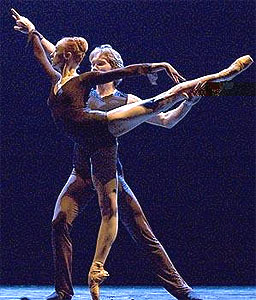 The
Mariinsky Theater in St. Petersburg hosts the Mariinsky 5th international ballet
festival from March 24 to April 3. This is the only classical dance festival in
Russia gathering the leading ballet dancers of the world. The festival
traditionally opens with premieres, the press service of the Mariinsky Theater
told RIA Novosti. The full version of "Two Ballets in the Late 20th
Century" choreographed by William Forsythe will be presented at the
festival. Moreover, the world premiere of the ballet "Reverence" will
be shown in St. Petersburg. Acclaimed European choreographer David Dowson staged
this performance especially for the Mariinsky festival. "The programs of
benefits of the Mariinsky Theater's ballerinas show their repertoire from
classical dances to choreographic innovations, as well as the cardinal
repertoire changes in the Mariinsky Theater in the latest years," the press
service reported. The festival's program includes performances of the Mariinsky
Theater's repertoire starring the leading ballet dancers of the world. Nikolai
Tsiskaridze, Svetlana Lunkina and Dmitry Gudanov (the Bolshoi Theater, Moscow),
Alina Cojocaru, Johan Kobborg, Roberta Marquez (The Royal Ballet), Agnиs
Letestu, Jean-Guillaume Bart, Manuel Legris, Laurent Hilaire (Opera de Paris)
and Roberto Bolle (la Scala) will arrive in St. Petersburg. The Mariinsky
festival will traditionally close with a gala of all stars based on the 20th
century's choreographic trends.
The
Mariinsky Theater in St. Petersburg hosts the Mariinsky 5th international ballet
festival from March 24 to April 3. This is the only classical dance festival in
Russia gathering the leading ballet dancers of the world. The festival
traditionally opens with premieres, the press service of the Mariinsky Theater
told RIA Novosti. The full version of "Two Ballets in the Late 20th
Century" choreographed by William Forsythe will be presented at the
festival. Moreover, the world premiere of the ballet "Reverence" will
be shown in St. Petersburg. Acclaimed European choreographer David Dowson staged
this performance especially for the Mariinsky festival. "The programs of
benefits of the Mariinsky Theater's ballerinas show their repertoire from
classical dances to choreographic innovations, as well as the cardinal
repertoire changes in the Mariinsky Theater in the latest years," the press
service reported. The festival's program includes performances of the Mariinsky
Theater's repertoire starring the leading ballet dancers of the world. Nikolai
Tsiskaridze, Svetlana Lunkina and Dmitry Gudanov (the Bolshoi Theater, Moscow),
Alina Cojocaru, Johan Kobborg, Roberta Marquez (The Royal Ballet), Agnиs
Letestu, Jean-Guillaume Bart, Manuel Legris, Laurent Hilaire (Opera de Paris)
and Roberto Bolle (la Scala) will arrive in St. Petersburg. The Mariinsky
festival will traditionally close with a gala of all stars based on the 20th
century's choreographic trends.
Anastasia Volochkova
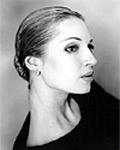 Ballet soloist of the Bolshoi Theatre.
Anastasia Volochkova was born in 1976 in Saint-Petersburg. In 1986 she
entered Russian Academy of Ballet named after Vaganova, the class of professor
N.Doudinskaya, and in 1994 she graduated from it with honours. Being a student,
she performed the part of Odetta-Odillia from the ballet "The Swan
Lake".
In 1996 she took first place and became gold medallist at the Second
International Ballet Competition in Kiev.
From 1994 to 1998 she danced in the ballet company of the Mariinsky Theatre,
where she was taken on immediately after her graduating from the Academy. Her
repertoire comprised the parts of Odetta-Odillia ("The Swan Lake"),
Nikia ("Bayaderka"), Giselle ("Giselle"), Aurora ("The
Sleeping Beauty"), Ckitri ("Don Quixote"), Medora
("Corsair"), Raymonda ("Raymonda"), Clara
("Nutcracker"), Shekherezada ("Shekherezada"), Soloist
("Pakhita"), Zarema ("The Fountain of Bakhchisarai") and
many other parts in performances, staged by M.Fokin, D. Noimayer, A.Smirnov,
L.Oursulyak.
In 1998 she began to dance in the ballet company of the Bolshoi Theatre under
the guidance of Y.Maksimova. Her repertoire includes the parts of Princess Swan
("The Swan Lake", staged by V.Vasiliev), Raymonda
("Raymonda", staged by Y.Grigorovich), Nikia ("Bayaderka",
staged by Y.Grigorovich) and others.
She toured with the ballet company of the Mariinsky Theatre and other
companies through The United States of America, Great Britain, Japan, Korea,
France, Germany, Austria, Denmark, Spain, Italy, Greece, Belgium.
Anastasia Volochkova dreams of performing parts from "Spartack",
"Romeo and Julliette" and enriching her repertoire with modern
choreography. In her spare time she likes to walk through the city, to read
books, to listen to music, both classical and modern. Her favourite composers
are Bach and Vivaldi and she is fond of reading poems by Tsvetaeva, Akhmatova
and Block. She thinks, that ballerina must be a woman and a mother first of all,
must have a family. She likes ice-cream very much.
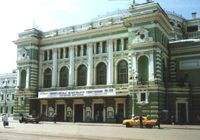 In
1783 the Grand Stone Theatre has been established on the Theatre Square. This
date is accepted as the Mariinsky Theatre's foundation date. It is considered
second in importance among Russia's theatres, after the Bolshoy Theatre in
Moscow.
In
1783 the Grand Stone Theatre has been established on the Theatre Square. This
date is accepted as the Mariinsky Theatre's foundation date. It is considered
second in importance among Russia's theatres, after the Bolshoy Theatre in
Moscow.
Ballet, opera and drama troupes have all performed on this stage (the drama
troupe has become independent in 1803). The famous Russian ballet dancer
A.I.Istomina, to whom Pushkin has devoted poetry, has also danced here. In 1836
M.I.Glinka's opera "Life for the Czar" (or "Ivan Susanin",
as it was renamed after the revolution) premiered here, and this event has
marked the beginning of classical Russian opera.
The first presentation of a new theatre built on the other side of the square
in 1859-1860 was also "Life for the Czar". The theatre was designed by
the architect A.K.Kavos and reconstructed in late 19th century under the
leadership of V.A.Shreter. It was named after Alexander II's wife Mary. The
artistic development of the Mariinsky theatre is associated with performances
(often premieres) of operas by the great Russian composers such as
N.A.Rimsky-Korsakov, P.I.Chaikovsky, S.S.Prokofyev, D.D.Shostakovich and others,
as well as foreign classical composers. The theatre has always had eminent
conductors, and the troupe has consisted of world-famous opera and ballet stars
such as F.Shalyapin, A.Pavlova, V.Nizhinsky, G.Ulanova and M.Baryshnikov.
Since 1935 until recently the theatre has borne the name of Leningrad's
communist leader S.M.Kirov. It has received high national awards. The hall holds
1,625 people, and one can scarcely find any vacant seats at any performance.V.
Gergiev currently conducts the theatre's orchestra. The Kirov Ballet troupe, as
it is called abroad, is often on tours.
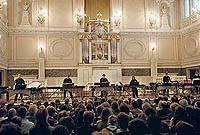 A
concert hall specializing in classical vocal and chamber instrumental music.
A
concert hall specializing in classical vocal and chamber instrumental music.
In 1479 the Singing Dyaks Choir has been established in Moscow. In 1703 it
was moved to the nascent city of St. Petersburg, and in 60 years' time it became
the Court Kapelle. It has been headed by prominent Russian musicians, such as
D.S. Bortnyansky, M.A. Balakirev and M.I. Glinka. The composers N.A.
Rimsky-Korsakov and A.K. Lyadov have taught here.
The hall possesses excellent acoustic properties, which attracts many
connoisseurs. The Kapelle building has been reconstructed in 1887-1889 by the
architect L.N. Benois in the Neoclassical style
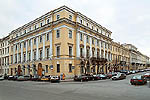 One
of the largest musical centers in the world, the St. Petersburg Philharmonic was
established in 1921. In 1940 the Philharmonic was awarded the Red Banner of
Labour order. In 1975 it has been named after D.D. Shostakovich. The
Philharmonic comprises two orchestras, the S.I. Taneyev Quartet and a library.
I.I. Sollertinsky, the Philharmonic's artistic director in 1940-44 has played a
major role in its activities during that period. The Major Philharmonic Hall is
housed in the former Assembly Hall for the Nobility (architect P. Jacquot,
design by K. Rossi, 1834-1839), which is a part of the Mikhailovskaya Square
(now called Square of the Arts). The building has been reconstructed at the turn
of the 20th century, a new storey has been added. The auditorium admits 1,318
people and possesses very good acoustic properties. A pleiad of illustrious
conductors and musicians have performed here, including Mravinsky, Oistrakh,
Svetlanov, Temirkanov, Richter and Rostropovich. On August 9th, 1942 the
Philharmonic's Symphonic Orchestra led by K. Elliazberg has performed
Shostakovich's 7th "Leningrad" Symphony.
One
of the largest musical centers in the world, the St. Petersburg Philharmonic was
established in 1921. In 1940 the Philharmonic was awarded the Red Banner of
Labour order. In 1975 it has been named after D.D. Shostakovich. The
Philharmonic comprises two orchestras, the S.I. Taneyev Quartet and a library.
I.I. Sollertinsky, the Philharmonic's artistic director in 1940-44 has played a
major role in its activities during that period. The Major Philharmonic Hall is
housed in the former Assembly Hall for the Nobility (architect P. Jacquot,
design by K. Rossi, 1834-1839), which is a part of the Mikhailovskaya Square
(now called Square of the Arts). The building has been reconstructed at the turn
of the 20th century, a new storey has been added. The auditorium admits 1,318
people and possesses very good acoustic properties. A pleiad of illustrious
conductors and musicians have performed here, including Mravinsky, Oistrakh,
Svetlanov, Temirkanov, Richter and Rostropovich. On August 9th, 1942 the
Philharmonic's Symphonic Orchestra led by K. Elliazberg has performed
Shostakovich's 7th "Leningrad" Symphony.
HOME
PAGE