Nieuws - News - Новости
Nederlands, Russian and Englisch.
|
St. Petersburg is een majestueuze stad met vele mooie
kathedralen, unieke musea veelal samengesteld door Tsaar Peter
de Grote zelf en het Hermitage als pronkstuk.
Deze 300-jaar oude stad is gebouwd op 42 eilanden, en wordt
ook wel het 'Venetië van het Noorden' genoemd. De stad is
gesticht door Tsaar Peter de Grote en was tot 1918 de hoofdstad
van Rusland. In 1914 werd de naam gewijzigd in het meer Russisch
klinkende Petrograd. En vanaf 1924 was de stad bekend als
Leningrad. Pas in 1991 werd de oorspronkelijke naam St.
Petersburg weer aangenomen.
Het Hermitage is de belangrijkste toeristische attractie van
St. Petersburg. Dit enorme museum bestaat uit zes gebouwen,
waarvan het Winterpaleis het belangrijkste is. De collectie
bestaat uit meer dan 3 miljoen kunstwerken, uiteenlopend van
stukken uit het stenen tijdperk tot kunst uit de 20e
|
|
 General
Motors CEO Rick Wagoner on Tuesday broke ground at the company’s first Russian
factory at Shushary, near St. Petersburg, while at the city’s economic forum
Nissan CEO Carlos Ghosn was signing an investment deal to build another plant
nearby.GM and Nissan will invest $115 million and $200 million, respectively,
into their St. Petersburg plants.“St. Petersburg is often called the Venice of
the North,” Wagoner said at the Shushary ceremony. “It may soon be called
the Detroit of the North — and believe me, I know Detroit.”Wagoner, whose
last visit to Russia was in 2001, when he signed up for a $300 million venture
with AvtoVAZ, delivered a short speech, answered a few questions and then dashed
off to meet with President Vladimir Putin.Wagoner said that he had listened to
Putin’s comments at the economic forum earlier Tuesday and said he “shared
his vision of a strong and growing economy for Russia and the Russian people.”Carl-Peter
Forster, president for GM in Europe, said after the ceremony that GM hoped to
grow its partnership with AvtoVAZ and that the introduction of new models was
“possible.” But he added that GM had not received any “immediate answers”
on its proposals.Flanked by First Deputy Prime Minister Dmitry Medvedev, St.
Petersburg Governor Valentina Matviyenko said at the ceremony that the GM
project was “a good indicator of Russian-U.S. relations,” and that it was
bound to succeed now that Medvedev had become its “godfather.”Shushary is
also the site for a Toyota factory due to open next year, while a Ford plant in
Vsevolozhsk, also near St. Petersburg, opened in 2002.GM’s Shushary plant is
expected to go into production in late 2008. The plant will initially produce
25,000 Chevrolet Captiva sport utility vehicles per year and will later begin
producing a next-generation compact car.While the plant is being built, GM has
rented a factory in northern St. Petersburg at which it will initially produce
more than 4,000 cars from kits beginning this September.GM is already assembling
some of its brands, including Hummers and Cadillacs, at a private Russian
carmaker’s factory in Kaliningrad and is making Chevy Nivas and Vivas at
Tolyatti with AvtoVAZ. Earlier this year, GM-AvtoVAZ halted production amid a
pricing dispute between the partners.Asked whether the joint venture was more of
a liability than an asset for GM, Forster said: “I don’t see the liability
there yet.” Forster said he had met with AvtoVAZ’s new general director,
Igor Yesipovsky, for the first time two weeks ago. Late last year, the Kremlin
sent in a team of managers from state arms trader Rosoboronexport to turn around
the ailing carmaker.Forster praised the new managers, calling them “good
businessmen.” But he said that since the new team had little experience in the
car industry “it takes a bit longer” to negotiate.At the Nissan signing
ceremony, Ghosn said the firm would start building its factory in spring 2007,
with the first cars expected by early 2009.At the forum, Economic Development
and Trade Minister German Gref said he was in talks with five other carmakers on
building new factories in Russia. By the end of the year, “I think that three
out of five will be more than possible,” he said.
General
Motors CEO Rick Wagoner on Tuesday broke ground at the company’s first Russian
factory at Shushary, near St. Petersburg, while at the city’s economic forum
Nissan CEO Carlos Ghosn was signing an investment deal to build another plant
nearby.GM and Nissan will invest $115 million and $200 million, respectively,
into their St. Petersburg plants.“St. Petersburg is often called the Venice of
the North,” Wagoner said at the Shushary ceremony. “It may soon be called
the Detroit of the North — and believe me, I know Detroit.”Wagoner, whose
last visit to Russia was in 2001, when he signed up for a $300 million venture
with AvtoVAZ, delivered a short speech, answered a few questions and then dashed
off to meet with President Vladimir Putin.Wagoner said that he had listened to
Putin’s comments at the economic forum earlier Tuesday and said he “shared
his vision of a strong and growing economy for Russia and the Russian people.”Carl-Peter
Forster, president for GM in Europe, said after the ceremony that GM hoped to
grow its partnership with AvtoVAZ and that the introduction of new models was
“possible.” But he added that GM had not received any “immediate answers”
on its proposals.Flanked by First Deputy Prime Minister Dmitry Medvedev, St.
Petersburg Governor Valentina Matviyenko said at the ceremony that the GM
project was “a good indicator of Russian-U.S. relations,” and that it was
bound to succeed now that Medvedev had become its “godfather.”Shushary is
also the site for a Toyota factory due to open next year, while a Ford plant in
Vsevolozhsk, also near St. Petersburg, opened in 2002.GM’s Shushary plant is
expected to go into production in late 2008. The plant will initially produce
25,000 Chevrolet Captiva sport utility vehicles per year and will later begin
producing a next-generation compact car.While the plant is being built, GM has
rented a factory in northern St. Petersburg at which it will initially produce
more than 4,000 cars from kits beginning this September.GM is already assembling
some of its brands, including Hummers and Cadillacs, at a private Russian
carmaker’s factory in Kaliningrad and is making Chevy Nivas and Vivas at
Tolyatti with AvtoVAZ. Earlier this year, GM-AvtoVAZ halted production amid a
pricing dispute between the partners.Asked whether the joint venture was more of
a liability than an asset for GM, Forster said: “I don’t see the liability
there yet.” Forster said he had met with AvtoVAZ’s new general director,
Igor Yesipovsky, for the first time two weeks ago. Late last year, the Kremlin
sent in a team of managers from state arms trader Rosoboronexport to turn around
the ailing carmaker.Forster praised the new managers, calling them “good
businessmen.” But he said that since the new team had little experience in the
car industry “it takes a bit longer” to negotiate.At the Nissan signing
ceremony, Ghosn said the firm would start building its factory in spring 2007,
with the first cars expected by early 2009.At the forum, Economic Development
and Trade Minister German Gref said he was in talks with five other carmakers on
building new factories in Russia. By the end of the year, “I think that three
out of five will be more than possible,” he said.
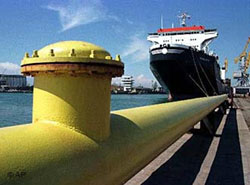 Energy
discussions were the main focus for talks at an economic forum in St.
Petersburg, Russia's industry and energy minister said Thursday.Viktor
Khristenko said the forum provided "a good platform for positioning energy
as one of the most high-tech sectors of the Russian economy," adding that a
modern economy must be energy-efficient.Khristenko said saving energy and its
more prudent use were important factors for economic growth, and the new energy
technology exhibited at the forum showed that Russian companies were already
leaders in developing and using innovative solutions."I am convinced that
Russia's energy industry can become an even more powerful driver for the
country's development, generating demand for production in all sectors. In
particular, products in the machine and ship building and metals sectors,"
he said.The minister, along with Russia's Natural Resources Minister Yury
Trutnev, chaired a roundtable meeting at the forum, Energy Strategy: Resources
and Risk Management.Khristenko said energy strategy affects the interests of all
parties at the forum. Dialogue on a global level should be carried out in the
language of strategy, since exchanging long-term plans is needed to ensure
mutual trust in energy issues, he said.
Energy
discussions were the main focus for talks at an economic forum in St.
Petersburg, Russia's industry and energy minister said Thursday.Viktor
Khristenko said the forum provided "a good platform for positioning energy
as one of the most high-tech sectors of the Russian economy," adding that a
modern economy must be energy-efficient.Khristenko said saving energy and its
more prudent use were important factors for economic growth, and the new energy
technology exhibited at the forum showed that Russian companies were already
leaders in developing and using innovative solutions."I am convinced that
Russia's energy industry can become an even more powerful driver for the
country's development, generating demand for production in all sectors. In
particular, products in the machine and ship building and metals sectors,"
he said.The minister, along with Russia's Natural Resources Minister Yury
Trutnev, chaired a roundtable meeting at the forum, Energy Strategy: Resources
and Risk Management.Khristenko said energy strategy affects the interests of all
parties at the forum. Dialogue on a global level should be carried out in the
language of strategy, since exchanging long-term plans is needed to ensure
mutual trust in energy issues, he said.
 In
2003, 2 million 600 thousand flowers are to be planted in the streets and parks
of St. Petersburg. According to the Landscaping Committee of the St. Petersburg
City Administration, flowers have already been planted in some of the city’s
districts, but new flowers will be added in summer.
In
2003, 2 million 600 thousand flowers are to be planted in the streets and parks
of St. Petersburg. According to the Landscaping Committee of the St. Petersburg
City Administration, flowers have already been planted in some of the city’s
districts, but new flowers will be added in summer.
The total of 4,622 trees and 49, 210 bushes are to be planted in 2003. Last
spring, 2,840 trees and 33, 520 bushes were planted. According to specialists
from the city’s Garden and Park Department, sponsors’ activities and
presents from abroad significantly contributed to the landscaping of the
Northern Capital in the year of its anniversary
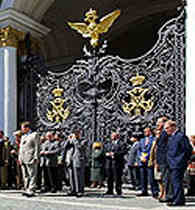 On
27 May the Winter Palace courtyard and the new entrance to the Hermitage from
Palace Square were opened after restoration.Since the time of its creation, the
Winter Palace Courtyard of about 11,000 sq.m served as entrance to the Imperial
Residence. In summer it received carriages, in winter, sledges. In the age of
Francesco Bartolomeo Rastrelli, the architect of the Winter Palace, the
Courtyard accommodated both carriages and the Imperial Guards. It is known that
for almost a century the Courtyard was paved with cobble-stones, like Palace
Square. In the second half of the 19th century, when the Palace was redesigned
by architect N.A. Gornostayev, the Courtyard was reconstructed. The wooden gate
facing the square was replaced with a metal one and trees were planted in the
center. The rectangular garden with rounded corners was surrounded with a
granite socle with four staired entrances. Trees lined the longer sides. The
Finnish-granite fountain at the crossing of the basic and auxiliary axes was
designed by sculptor G.I. Botta. After the 1917 revolution, the Courtyard, which
no longer played its part in the Imperial Family’s ceremonial life, fell into
neglect.The idea of the main entrance to the museum from Palace Square through
the Winter Palace Courtyard was first voiced in 1994. The project of the Main
Entrance reconstruction and restoration was ready in 2000, including works at
the Winter Palace gate, courtyard and garden. The reconstruction project for the
Courtyard which took into account this area’s new functions was prepared by
Danish architect Professor Sven-Ingvar Andersson, landscaping specialist.
According to the project, the basic function of the Winter Palace Courtyard is
both to provide a convenient passage from the Palace Square gate to the new
entrance at the opposite (northern) courtyard side and serve as a venue for
concerts and performances for an audience of up to 5 thousand.The Courtyard
level has been lowered, two flagstone-paved pathways have been made, and
rainwater ducts were paved with cobble-stones. The area between the granite curb
and flagstone pathways is paved with cobble-stones, between the granite pathways
and the facades, with cobble-stones; the surface between the facades and the
rainwater ducts is slightly inclined; the areas between the main entrance and
the granite pathways are coated with smaller granite plates. Contours of the
foundations of the palaces which stood there in the past can now be seen in the
Winter Palace Courtyard.The reconstruction of the Winter Palace Courtyard was
sponsored by DANSEE representing the Danish Ministry of Environment and Power.
The Danish contribution to this project is Denmark’s official gift to the
Hermitage for the Jubilee of St. Petersburg. Manager of the project was Ye.A.
Obolentseva of the Hermitage Construction Department.
On
27 May the Winter Palace courtyard and the new entrance to the Hermitage from
Palace Square were opened after restoration.Since the time of its creation, the
Winter Palace Courtyard of about 11,000 sq.m served as entrance to the Imperial
Residence. In summer it received carriages, in winter, sledges. In the age of
Francesco Bartolomeo Rastrelli, the architect of the Winter Palace, the
Courtyard accommodated both carriages and the Imperial Guards. It is known that
for almost a century the Courtyard was paved with cobble-stones, like Palace
Square. In the second half of the 19th century, when the Palace was redesigned
by architect N.A. Gornostayev, the Courtyard was reconstructed. The wooden gate
facing the square was replaced with a metal one and trees were planted in the
center. The rectangular garden with rounded corners was surrounded with a
granite socle with four staired entrances. Trees lined the longer sides. The
Finnish-granite fountain at the crossing of the basic and auxiliary axes was
designed by sculptor G.I. Botta. After the 1917 revolution, the Courtyard, which
no longer played its part in the Imperial Family’s ceremonial life, fell into
neglect.The idea of the main entrance to the museum from Palace Square through
the Winter Palace Courtyard was first voiced in 1994. The project of the Main
Entrance reconstruction and restoration was ready in 2000, including works at
the Winter Palace gate, courtyard and garden. The reconstruction project for the
Courtyard which took into account this area’s new functions was prepared by
Danish architect Professor Sven-Ingvar Andersson, landscaping specialist.
According to the project, the basic function of the Winter Palace Courtyard is
both to provide a convenient passage from the Palace Square gate to the new
entrance at the opposite (northern) courtyard side and serve as a venue for
concerts and performances for an audience of up to 5 thousand.The Courtyard
level has been lowered, two flagstone-paved pathways have been made, and
rainwater ducts were paved with cobble-stones. The area between the granite curb
and flagstone pathways is paved with cobble-stones, between the granite pathways
and the facades, with cobble-stones; the surface between the facades and the
rainwater ducts is slightly inclined; the areas between the main entrance and
the granite pathways are coated with smaller granite plates. Contours of the
foundations of the palaces which stood there in the past can now be seen in the
Winter Palace Courtyard.The reconstruction of the Winter Palace Courtyard was
sponsored by DANSEE representing the Danish Ministry of Environment and Power.
The Danish contribution to this project is Denmark’s official gift to the
Hermitage for the Jubilee of St. Petersburg. Manager of the project was Ye.A.
Obolentseva of the Hermitage Construction Department.
News from the past
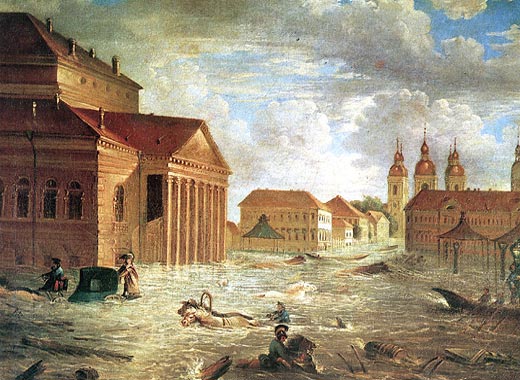
St. Petersburg is often threatened by floods as most of its downtown
territory is located just several feet above sea level. The founder of the city,
Peter the Great,
had chosen a very low-lying area on which to build St. Petersburg and from its
very foundation, floods were a major problem. In August 1703, three months after
the city was founded, the waters of the Neva River rose 6 feet above normal
levels and washed away construction materials for the Peter
and Paul Fortress. The city has experienced over 270 major floods since then.
The largest flood occurred on November 19 1824, when the river reached
13.5 feet (410 centimeters) over the usual level. On that day most of the
city was flooded, between 208 and 569 people were drowned and 462 houses were
destroyed. The second severest flood (over 12 feet high) was in 1924. In
some areas of the city the water flowed to a height of 7-8 feet and many of the
ships in the port were washed ashore.
Interestingly and rather surprisingly, St. Petersburg’s flooding patterns
are closely connected with the movement of low-pressure air masses over the
Atlantic. Low-pressure air moves in from the West, creating so-called "long
waves" that bring extra water into the Gulf of Finland and the mouth of the
Neva River.
Strong Westerly winds then effectively block the flow of water from the mighty
Neva into the Gulf of Finland, and the river level is forced to rise and spill
the excess water over its banks and onto the city.
Most of the floods take place in the fall and early winter when all the above
negative factors combine. Since the 18th century the level of the city’s
streets has been increased significantly, but some of the areas close to the
rivers and canals can still be seriously damaged during major floods. In the
1970s the decision was taken to build a long dam across the Gulf of Finland
(west of St. Petersburg), which would protect the city from the affects of the
floods. However, the project was not completed due to a huge environmental
controversy and a lack of funding. Meanwhile, the problem is far from solved and
the city awaits the next major flood with a distinct air of apprehension.
HOME
PAGE