Taj Mahal
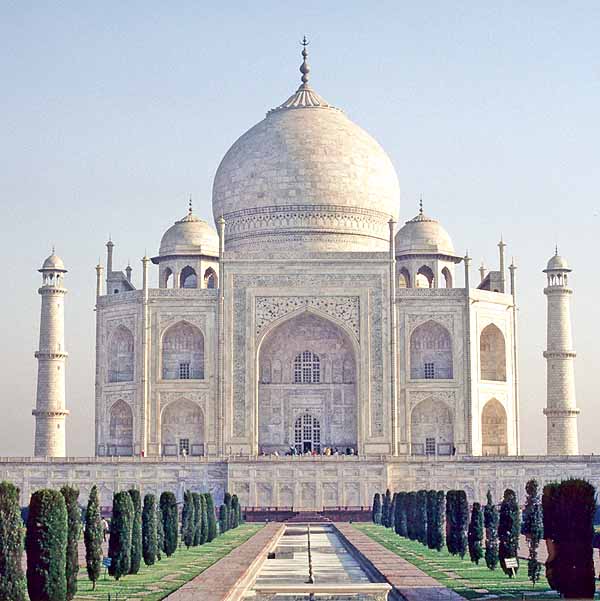
The Taj Mahal is a mausoleum located in
Agra, India. It is one of the most recognizable structures in the world. It was
built by Mughal emperor Shah Jahan in memory of his third wife, Mumtaz Mahal. It
is widely considered as one of the most beautiful buildings in the world and
stands as a symbol of eternal love.
Taj Mahal is the finest example of Mughal architecture, a style that combines elements from Persian, Islamic and Indian architectural styles.
In 1983, the Taj Mahal became a UNESCO World Heritage Site. While the white domed marble mausoleum is the most familiar component of the Taj Mahal, it is actually an integrated complex of structures. The construction began around 1632 and was completed around 1653, employing thousands of artisans and craftsmen. The construction of the Taj Mahal was entrusted to a board of architects under imperial supervision, including Abd ul-Karim Ma'mur Khan, Makramat Khan, and Ustad Ahmad Lahauri Lahauri is generally considered to be the principal designer.
In 1631, Shah Jahan, emperor during the Mughal empire’s period of greatest prosperity, was grief-stricken when his third wife, Mumtaz Mahal, died during the birth of their fourteenth child, Gauhara Begum. Construction of the Taj Mahal began in 1632, one year after her death. The court chronicles of Shah Jahan's grief illustrate the love story traditionally held as an inspiration for Taj Mahal. The principal mausoleum was completed in 1648 and the surrounding buildings and garden were finished five years later.
The marble dome that surmounts the tomb is the most spectacular feature. Its height of around 35 metres (115 ft) is about the same as the length of the base, and is accentuated as it sits on a cylindrical "drum" which is roughly 7 metres (23 ft) high. Because of its shape, the dome is often called an onion dome or amrud (guava dome). The top is decorated with a lotus design, which also serves to accentuate its height. The shape of the dome is emphasised by four smaller domed chattris (kiosks) placed at its corners, which replicate the onion shape of the main dome. Their columned bases open through the roof of the tomb and provide light to the interior. Tall decorative spires (guldastas) extend from edges of base walls, and provide visual emphasis to the height of the dome. The lotus motif is repeated on both the chattris and guldastas. The dome and chattris are topped by a gilded finial, which mixes traditional Persian and Hindustani decorative elements.