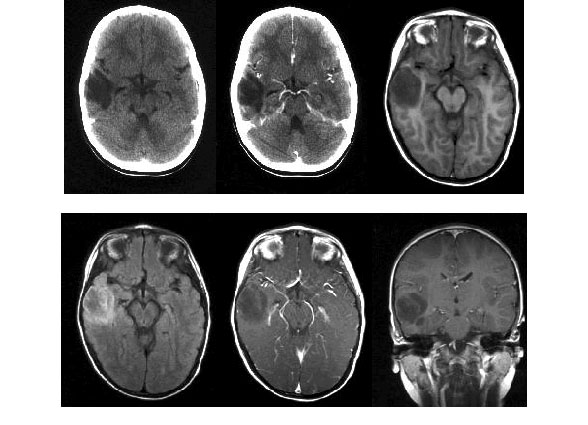
Clinical History: Four-year-old boy with partial complex seizures.
Findings: Axial CT images demonstrate a 4 cm. non-enhancing hypodensity involving the lateral right temporal lobe without notable mass effect on the adjacent temporal horn of the right lateral ventricle. There is, however, expansion of the surrounding gyri in the temporal lobe. The MRI scan of the head demonstrates this mass centered on the right middle temporal gyrus, extending to involve the right superior temporal gyrus, with a small strand extending inferiorly and medially towards the hippocampus. The hippocampus itself appeared spared. This lesion is very high in signal on T2 weighted images and relatively low on T1 weighted images, without enhancement and only very mild local mass effect.
Diagnosis: Dysembryoplastic neuroepithelial tumor (DNET).
Discussion: DNET is a relatively newly described benign tumor arising within the supratentorial cortex and almost always associated with partial complex seizures. These lesions may occasionally appear cystic and show one of the three characteristics which include: a) specific glioneuronal element, b) nodular component, or c) association with cortical dysplasia. MR scan usually demonstrates a focal cortical lesion most commonly in the temporal lobe that is hypodense on T1 and hyperintense on T2 weighted studies. It is not uncommon for a small subset of these tumors to resemble benign cysts with slightly increased signal or proton density-weighted sequences. Post-contrast enhancement and calcification may also occur occasionally.
References:
Osborn AG. Diagnostic Neuroradiology. Mosby, St. Louis; 1994:579-582.
Koeller KK, Dillon WP. Dysembryoplastic Neuroepithelial Tumors: MR Appearance, AJNR 1992;13:1319-1325.