 |
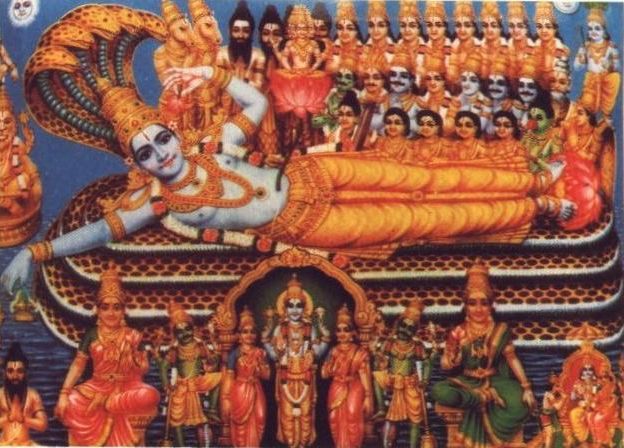
| Sri Anantha Padmanabha Reclining on Adi Sesha(Place :ThiruAnanthapuram) |
Sri Vaishnavam is the worship of Lord Vishnu & his consort Sri Lakshmi. Sri Vishnu or Naarayana is the protector of all the worlds.There are lots of Vedic & Puranic works in praise of Lord Narayana. Among the Vedic works Purusha Sooktham in Krishna Yajur Veda is the most eminent one. Among the Puranic works, Sri Vishnu Sahasranamam from MahaBharatha is revered.
Sri Vishnu Sahasranamam describes the 1000 names of Lord Vishnu & glorifies his beauty. Lord Narayana reclines on the celestial serpent Adi Sesha in the milky ocean, which is also called as "Ksheerabhi".All the worldly souls or the "Jeevathmas" live in close vicinity to him, enjoying the endless beauty.Things or people who are in close association with the Lord are called "Nithya sooris". People who are involved in worldly activities & money-minded are called as "nitya-samsaris", who become nityasooris by meditating on the Lotus feet of the Lord Narayana.Mere chanting of Sri Vishnu Sahasranamam helps us in getting the traces of sins on our souls & paves way for the attainment of salvation. Sri Vishnu Sahasranamam could be chanted anywhere & at any time as it is a Purana Bhagam unlike the Vedic works, which should be chanted only in the mornings.
The gem called Vishnu Sahasranamam was brought to this world by Sri Bheesma. Bheesma was the son of Mother Ganges & had the boon of controlling the time of his death. Sri Bheesma was lying in the war field on a bed of arrows waiting for the "Utharayanam" to come. At that time he was chanting Sri Vishnu Sahasranamam . But, none of the Pandavas or the Kauravas knew Sri Vishnu Sahasranamam. After Pandavas won the war with the help of Lord Krishna, they found a necklace of a special type of beads called, "Spatika", which was worn by Bheesma. They preserved that bead necklace in their home. Spatika has the divine power of absorbing the sound & re-emitting the same. So Pandavas learnt Sri Vishnu Sahasranamam from the mala & we are all able to chant it until today. We all are in debted to Bheesmacharya for this great work.
Sri Vishnu Sahasranamam was actually composed by Veda Vyasa. That's why after doing Ganapathy Dhyanam & Vishwaksena Vandanam, prayers are offered to Veda Vyasa in the Poorva Bhagam of Sri Vishnu Sahasranamam.
Description : The above verses describe the greatness of VedaVyasa & glorify the lineage of Acharyas. Vasista,Shaktha,Parashara are the forefather, grand father & father of Saint Vyasa respectively. Sri Suka, who wrote Bhagavatha Puranam is his son. It adds that, Lord Vishnu is in the form of Veda Vyasa & Vyasa himself is in the form of Lord Vishnu!! Such is the greatness of Veda Vyasa.
|
| Sri Anantha Padmanabha Reclining on Adi Sesha(Place :ThiruAnanthapuram) |
After elaborating the greatness of the Slokam, we go to Dhyanam. The Dhyanam is very important as we need to meditate on this form through out the chanting. Chanting any sloka, with meditating the corresponding Devatha Swaroopam would be more effective that mere chanting.
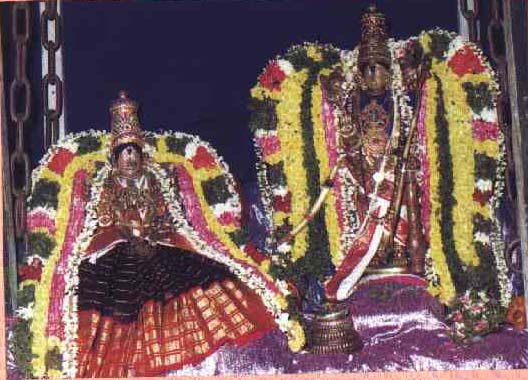 |
| Lord Sarangapani holding Panchayudhams with his consort Komalavilli (Place:Kumbakonam) |
After that comes the Raksha.
In Kali Yuga where people are totally immersed in the ocean or worldly activities , mere chanting of Lord Vishnu's names would take us to salvation. This is called as "Nama Sankeerthanam".People who have surrendered themselves to Sriman Narayana are called as "dasa"s. There are lots of Dasas of Lord Vishnu through out our sub-continent like Meera, Tulsi Das, Saint Thukaram,Kabeer Das. Needless to say, in South India devotees of Lord Vishnu have sung wonderful songs in carnatic music. People like Purandara dasa,Badrachalam Ramdas,Kshetragna, Narayana Theertha, Annamacharya, Thyagaraja & Maharaja Swathi Thirunal have become immortal by their devotion to Sriman Narayan & their heart-melting musical compositions on Lord Narayana.
In Tamilnad a group of devotee saints carried over the mission of Nama Sankeerthanam, by singing wonderful hymns in Tamil on Lord Narayana. Their hymns are in simple verses & glorify the greatness or Lord Vishnu. The head of all the Alvars is Swami Nammalvar, who is supposed to have translated the Vedas to Tamizh. There are 12 alvars in total & all of their hymns are collectively called as "Divya Prabandham" & count tp 4000 in number. Even until date these verses are chanted with devotion in the Vishnu temples in Tamilnadu.Long after the time of the Alvars, came a great soul called Sri Ramanuja, who developed a commentary on Bhramha Sutra based on the theology of Nammalvar.
Finally comes the samarpanam, where we offer all our things to Sriman Narayana & do complete surrender of all our senses & belongings to him.
| |
|
|


