|
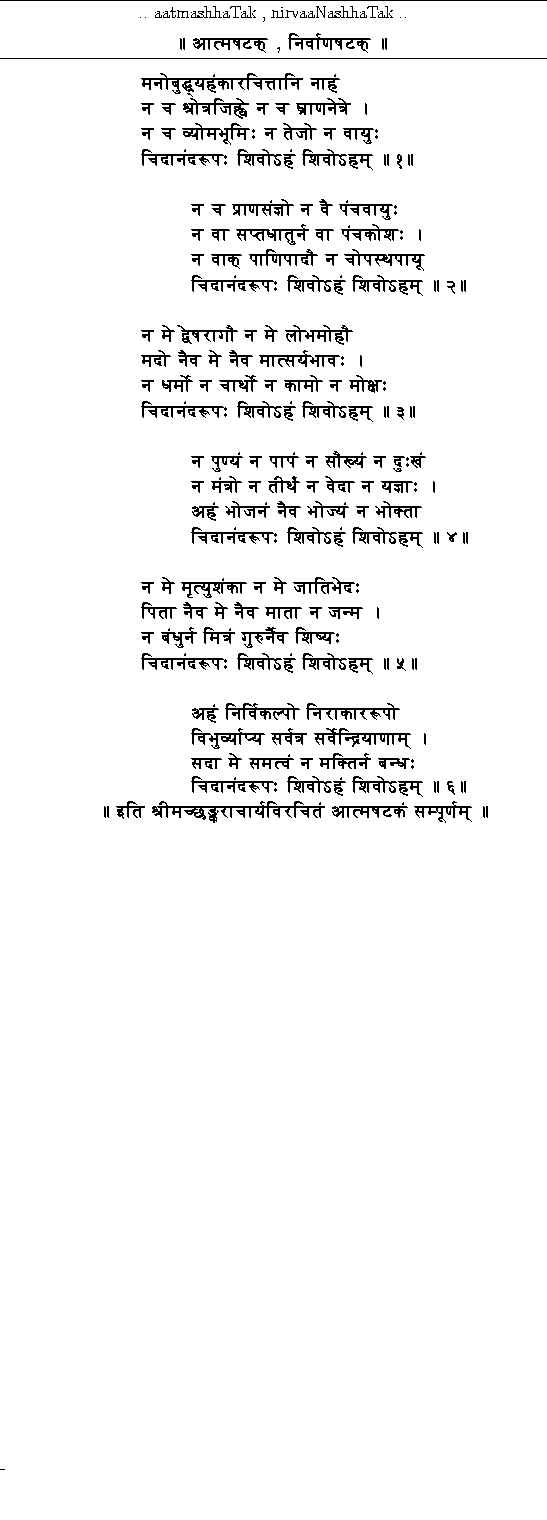
Deva Naagari Script of Sri Nirvaana Shatkam |
|
|
|
|
Introduction:
Bhrahmanandam
bursts out in various forms for different anuboothimaans. Sri Arunagiri nathar
had poured out his Bhrahmanubhoothi in the form of Thirupukazh, Kanadar
Alankaram... and has attributed it to Lord Subhrahmanya. Sri VishnuChittha
Muni(Periazhwar) expressed his Bhrahmanandam in the form of his Thiru Pallandu,
when the had a vision of Sri Sriyapathi with his divya mahishis flying on
Pakshiraja, when Sri Periyazhwar was taken on a royal procession in the holy
city of Madurai. Maha Kavi Kalidasa has poured out his Bhrahmanubhoothi in the
form of Syamala Dandakam, and described Sri Matha and her anantha kalyana
gunas. In all the above cases, the Anubhoothi has been of the Bhrahmam, with
attributes or Saguna Saksathkaaram. Sri Bagavathpaadha was enlightened with the
wisdom of Self Consciousness by birth. This is revealed to us by his deed of
composing the KanakaDhaara Stahavam at a very tender age of eight. Moreover,
when he had met his Guru Sri Govinda Bagavathpadha, at the banks of
Although Brahma Gnanam was like karamalakam (gooseberry on the hand) to Sri
Bagavathpadha, he had expressed the same to this Universe in his various works,
which he had composed in praise of various Deities on his grand way of
Kshethratanam. Sometimes, people confusingly associate the non-duality with
Nastheeka Dharmas like Shakyam. But actually, the non-dualism is the pinnacle
of Bakthy, as the bhaavam is gone and they do Bakthy in ananya bhaavam. All the
Vedic, Puranic, Upanishadic scriptures... convey the message of non-duality.
Sri Bagavathpadha has blessed verses or slokas for all categories of people -
Gnana, Bakthy and karma margis, although Sri Bagavathpaadha had deeply hidden
the ever-sweet fruit of Non-duality in his works. Some of the important works
of Sri Bagavathpaadha convey his message to this Universe very clearly.
Sometimes, conveying the message in a hidden manner might cause confusions. So,
Sri Bagavathpaadha states his message or his Anubhoothi very clearly. These are
called as Vedanthic works of Sri Bagavathpaadha.
There are lots of such works by Sri Bagavathpaadha, which express his superior
state of realization directly. One of such is Nirvana Shatak. The word,
Nirvana, means getting detached from all the worldly things, mind , the body,
the intellect and just immersing into the ocean of pure consciousness, which is
full of bliss. There are so many misleading sampradayas, which give wrong
interpretations for the word Self Realization and have malicious definitions
for the word perfection or moksham. Any other state of self, other than the
pure conscious state would not lead to complete unity with the Brahman, which
in turn is not moksham. So, all other sampradayas and the Siddhanthas, which
misinterpret the Sruti and Smriti is not the true path for liberation and the
state the astheekas attain by following those flawful margas is not the real
Moksham. Sri Aacharya very clearly conveys his message of non-duality and the
true nature of the Self in these verses.
The name of this stothram is Nirvana Shatak, and Sri Aacharya hasn�t used that
word in any of his verses. So we should understand that, Sri Aacharya explains
to us, what is meant by Nirvana or the purest state of this self. Moreover Sri
Aacharya uses the word "Shivoham" repeatedly throughout his slokas. Some people
interpret this as Sri Aacharya being an incarnation of Lord Shiva. But actually
Sri Aacharya conveys the message that, one's own Self if pure and auspicious.
The word Shivam in Sanskrit meant mangalam or auspiciousness. So Sri Aacharya
conveys the message that, one's own Self if full of the bliss of Shuddha
Chaitanyam (Chidamrutham) and is very auspicious. This commentary is being
compiled and offered to the divya Padhuka of Sri Aacharya , with the idea of
bringing out his actual Anubhoothi and wipe off any misinterpretations on this
glorious verse. Common astheekas have a tendency to see great people as Lord
Shiva, Lord Vishnu, etc. But Upanishads state that, all the jeevas (Souls),
which have come from that infinite and complete Supreme, are all complete in
all ways. The Self is nothing by a reflection of the Supreme itself. The Self
has all the anantha kalyana Gunas like its source, which is the Brahman. Sri
Bagavathpaadha conveys this message in the following verses.
Sri Aacharya walks all or us (the readers) step by step, to show the actual Swaroopam of the Self. Sri Aacharya, out of his endless anciety and deep compassion for the man kind, had shown the true Swaroopam of Self, as against the Agnana vadhis, who actually show the vignana maya and the mano maya as the actual Swaroopam of the Self. These verses are universally applicable for all of the human beings and one doesn�t necessarily be a bhrahmana (by birth) or a Hindu. Staying at the same level, state, caste of birth, race of birth, as one was born, one can still realize the actual Swaroopam of the Self. Although Charanagathy takes us to the same revelation (after a lots of hardship), this philosophical way of the determination and realization of the Self is the true Vaidheeka way of doing it. Our Self(s) tend to be tainted with different moods or states of the mind, mistakenly we thinks those forms as the actual form(s) of the Self. So, in all those moods, we might have to think through very deeply about Sri Achaarya's verses, so that we are out of that illusive states or Maya and "come back" to the actual state of the Self, which Sri Aacharya describes as Chidananada, Nirvikalpa and Nirakara. Bearing the Lotus feet to Sri Aacharya and Bagavan Ramana, this effort of the compilation of the commentary for the six verses on Nirvana or Nirvana Shatak has been under taken, to convey Sri Achaarya�s message to the mankind. Sri Aacharya has taken six verses to explain the Swaroopam, probably to represent the six darshanas (Mimamsa, Vedantha, Sankhya, Yoga, Nyaya, and Vaisheshika) or Sri Aacharya thought that, just six verses are enough for any common man, to understand, see and realize the Swaroopam of the Self, as its actual Swaroopam in Achaarya�s words is nothing but Nirakara.
|
Deva Naagari Script of Sri Nirvaana Shatkam |
|
|
|
|
|
Sri Nirvana Shatka Recitation (by Myself) |
|
Sloka
I
Mano budhya ahankara chithaa ninaham
Na cha srothra jihwe na cha graana nethrer
Na cha vyoma bhoomir na thejo na vayu
Chidananada Roopa Shivoham, Shivoham
Sri
Aacharya starts this glorious sloka by describing the nature of One's own self.
Here we tend to have a habit to misinterpret the word Aham as, Sri
Bagavathpaadha's Aham. But Sri Aacharya states to us about the nature of the
Self or the Soul and not his Self or his Soul. Sri Aacharya states that the
Self or the Soul is not the mind, not the intellect, not the Ego, not the ears,
not the tongue, not the nose and not eyes. He further states that, One's own
self is not the earth, not the land, not the light and not the wind too. But
One's own self is in the form of the bliss of the Chaitanyam or Shuddha
Chaitanyam, which is very auspicious. (Shivam) Sri Aacharya starts his sloka by
listing out all the abstract entities - the mind, the ego, the intellect and
the sense. Sri Aacharya filtered out the five things, which are invisible and
which we could confuse One's Self or the Athman as. Next Sri Aacharya covers
the pancha indriyas--> sight, smell, hearing and speech (in fact these are
the four of the 5 indriyas). Now that Sri Aacharya has filtered out the 5 seen
and the four out of five seen parts (associated with the 5 indriyas). Then Sri
Aacharya has filtered off the sky and the land. Everything in-between is ether
and the light. (Matter... is a part of the earth & water becomes vapor as
the vayu). Sri Aacharya had covered 4 (in fact 3) of the five pancha bhoothas
(light could be associated with fire, as light is caused by fire). Sri Aacharya
finally bursts out with his Bhrahmanandam and explains us the true nature of
the Self. Sri Aacharya identifies the Athman with the Chidananada or the bliss
of pure consciousness and is very auspicious.
Sloka
II:
Na cha praana samgno na vai pancha vaayur
Na vaa saptha dhathur na va pancha kosa
Na vak pani padam na chopa stha payu
Chidananada Roopa Shivoham, Shivoham
Sri
Aacharya now covers the 5th indriayam (shareeram) and the 5 pranans, the seven
elements (of life). Sri Aacharya starts with the result of the praanam or life,
which are the physical movements. We see a new born baby moving the hands and
legs as a result of the life. Sri Aacharya states that, that movement is not
the Self. Then Sri Aacharya states that the Self in not the five pranans too.
Vedas and Shaasthras elaborate five different kinds of paranms --> Pranam,
Apaanan, Vyanam, Udhaanam, and Samanan.
Although
Praana is the activating energy behind this sthoola shareeram, for governing
the life this praanam has been divided into the above mentioned five parts.
Each of the five parts of the praanam are said to be operating in the 5
different regions of the body. Bhrahmam, the Supreme Energy is the energy that
activates these 5 airs or pranams. Next Sri Aacharya declares that One�s Self
is not any of the seven kinds of tissues inside the body. The seven kinds of
tissues, as identified by the Vedas (and the Upa Veda of Ayur Vedham) are as
follows:
Now Sri
Aacharya visits the 5 states of existence of the Self, as explained by the
Taithreeya Upanishad. The five different kosha or the states of existence are
as follows:
Sri
Aacharya now, clearly states that, the actual Swaroopam of the Aham is even far
beyond these five different states of the Athman, as specified in the
Upanishads. Sri Aacharya states that, the Self is in the form of Nija Bodham or
Shuddha Chaitanyam, where actually, the entity of Aham is absent. Although the
Nija Bodham Swaroopam could be well explained as the AnandaMaya Swaroopam, Sri
Aacharya declares the Self to be even atheetham to that state, as even in the
dream when all other 4 states are absent, the Self could be blissful. So, the
blissful state, caused as a result of pure consciousness of Ananda
Bodhramrutham is what the actual state of the Self is. Sri Bagavathpaadha
further continues to declare the Self as being much higher and further from the
Words or Vaagh, the hands the feet or any of the other external or the internal
organs. Then, Sri Aacharya declares that, the Yathartha Swaroopam or the actual
form of the Athman or the Self is the blissful from, which is attained as a
result of Shuddha Chethanam and One's Self is undoubtedly auspicious. Sri
Aacharya emphasizes on the fact that, the Self is very auspicious, to reveal
the prama managalam of the Bhrahmam. The Self, which had come from the Bhrahmam
ahs the same� nature" of auspiciousness as it's origin. Reflecting the Nirguna
Swaroopam of the Brahman, the Self or the Athman is also attribute less, as
it's final and unchanging form, which is it's actual Swaroopam is the Shuddha
Bodha Maya Swaroopam. Sri Aacharya cautiously filters the Anandamaya Swaroopam,
as the feelings of Anandam, Sukam, Dhukka, etc... are all caused only by the
existence of the mind. In the actual Swaroopam, the Athman has suppressed all
the thoughts and hence the mind and is like a stationary mountain (Achalam).
So, Shuddha Bodhramrutham is compared to both Ananda Amrutham and also the
Shoonya Stithi, because in the Bhaavatheetha Stithi Shoonyam and Anandam are
all the same due to the lack of the mana or the mind (& the thoughts).
Sloka
IV
Na me dwesha raghou na me lobha mohou
Madho naiva me naiva matsarya bhava
Na dharmo na cha artha na kamo na moksha
Chidananada Roopa Shivoham, Shivoham
Sri
Aacharya now states that his Self is not the six different kinds of the
feelings or the Bhaavas:
Various
scriptures sugar coat this Chidananada maya form of Self with the attributes
and express the same fact indirectly. For example in Sri Lalitha Sahasranamam
Sri Lakshmi Hayagreeva describes Sri Lalithambika as the one, who was born in
the chidagni guntam with four hands. When we carefully analyze the birth place
of Sri Matha, it is called as, Chidagni Guntam, which is the birth place of the
same Chidananada too. Sri Hayagreeva further adds to it by saying that, Sri
Matha was born as a result of the Deva Kaaryam or the fire sacrifice done by
the Devas. Devas represent the indriyas and all other kinds of thoughts. So,
when all the thoughts are suppressed, the Self Realization occurs and the
actual form of the Self is revealed. Sri Hayagreeva further describes Sri
Lalithambika as having four hands. Each of the hands bears the Paasham,
Ankusham, the sugarcane bow and five arrows. Once again, these four weapons
four different entities inside the Self. The Ankusham represents the krodham or
the anger, Paasham represents the raagam or personal desire, the sugarcane bow
represents the mind and the five arrows the pancha indriyas. Thus Sri Matha has
been identified as once own Aathma Chaitanyam which is born in the Chidagni
Guntam, after all kinds of thoughts, the mind and the five senses are all
suppressed in the Aathma Sthaanam. This is a Saguna form of realization. In the
Nirguna Upaasana, Sri Matha would be replaced with the Nija Bodham or the
Shuddha Bodham. In that case, the actual Swaroopam of the Self is much away and
much higher from all the inferior thoughts like kaama, krodha, lobha, moha,
mada and the Matsaryam. Sri Aacharya declares that One's Self is neither of the
above mentioned qualities as they are like the worms that arise on a corpse.
When the mind, which is like a corpse is burnt to ashes, all the germs and
other worms in the corpse is also burnt. The same way, when the mind is
suppressed under the Aathma Sthaanam, all these emotions or bhaavas, which are
caused with a malicious combination of the five senses and the mind, are also
burnt. That's why Sri Bagavathpaadha explicitly states that, One's Self is none
of the above mentioned states. Sri Aacharya explicitly uses the word Bhava or
the state of mind, to indicate the fact that, the Self is much above or much
higher than the tasteful mind. This is called as Bhaavatheetham. Sri Aacharya
now comes to the four purusharthas or the four main objectives of the life. The
four main objectives of life, as explained by the scriptures are:
The main
aim or ambition of each human's life has been divided into four parts, which
are called as the four purusharthas. The word purusha is being used here, to
indicate that, the Purusha or the Man would do the deeds or karma in order to
achieve his (four) objectives. Sthree or Women would be Maha Pathivrathas, and
would be the back bone(s) in the household, helping out the men in completing
their duties successfully. Without the support of women, men can�t be
successful in achieving the four objectives of their lives. So, no special
nista is being specified for women in the scriptures, other than helping out
the men in achieving their objectives. Such women become perfect, just by
helping and serving their men and the children and they attain moksham just for
helping out the men in achieving the same. A person, who helps a dharmanista
would get the fruit of the dharmam, more easily than the Dharmanista himself,
because the without the latter's help the Dharmanista wouldn�t have been
successful. Helping out the men in carrying out the dharmam is the main dharmam
for women. Such is the glorious status, given for women in the Vaidheeka
religion. The four main purusharthas or objectives are righteousness, wealth,
desire (for moksham) and the moksham itself. The first and foremost of the four
purusharthas is the Dharmam. Dharmam means following the Vedic religion and
living a 9simple) life as per the Dharma Shaasthras. Dharma Shaasthras have
elaborated the standards of life for each person based on the
Sloka
IV:
Na punyam na paapam na soukhyam na dukham
Na manthro na theertham na veda na yagna
Aham bhojanam naiva bhojyam na bhoktha
Chidananada Roopa Shivoham, Shivoham
Sri
Aacharya goes one step ahead now lists several kinds of karmas and their fruits
in this verse.
Sri
Aacharya states that One's Self in not the punyam (good deeds), paapam (sinful
deeds), Sukham (happiness) and Dhukkam (sadness). The Self must finish enjoying
all its karmas both good and bad by enjoying the fruit of the same. All the
good deeds done, needs to be enjoyed as pleasure and the sinful deeds as pain.
But these have nothing to do with moksham. Moksham is attained and experienced
only by attaining a state when there are no karmas done (both good & bad).
This also applies to the karmas, which are done by the mind through the
thoughts. After attaining the Bhaavatheetha Stithi, all these are gone and just
the consciousness of the Self remains. That's what is the true Swaroopam of the
Self and any other states (like happiness...) are all illusive ones. Sri
Bagavathpaadha further goes one step ahead, explaining that, the true nature of
the Self is not any of the following divine items.
Sri
Bagavathpaadha starts his second line with the Manthram. Some of the sadhakas
have a great interest for chanting mantras and consider chanting the manthras
would grant them moksham. Next Sri Aacharya says that, the actual nature of the
Self is much higher than that of the Theertham. People undergo Theerthatanam,
with an objective of burning their karma vasanaas, when the visiting one's own
thoughts and cleanse the mind and intellect with the experience of Nija Bodham
is a true Theerthatanam. Sri Aacharya next states that, One Self is not the
Vedic scriptures too. Although Vedic scriptures are the Universal source of the
moksham and describes various ways to attain perfection, Vedas themselves
cannot the true nature of the Self. Instead the experience of the Vedic Maha
Vaakhyam would reveal the true nature of One's Self, which happens only with
the Sambandham of the Lotus feet of Sri Aacharya. Finally Sri Aacharya says
that, one's own Self ins not the Yagna too. Philosophically, yagnas are called
as Deva kaaryam. That's the act of feeding the Deva, the Pithru Devathas by
adding the food and other edibles to the fire. Philosophically, a true Yagnam
would be the "act" of One's Self adding all kinds of thoughts and hence the
mind and the five senses to the Aathma Aging, which also called as Chid Agni.
So, physical yagnas done by the karma margis would not lead to the revelation
of the actual Swaroopam, as only attaining enlightenment enables one to get the
philosophical meaning or the nature of each of the physical deeds.
Now Sri
Aacharya conveys his message of non-dual nature of the Self. For any deed,
there are three entities involved. The doer of the work, the work that's being
done and the act of doing the work. Only when the work that's being done is
different from the one who does that, these entities exist. Or only if the
Bhedhaas exist these differences exist. When the doer of the work becomes, one
with the work what is being done all these three entities vanish and just the
work exists. Likewise, when the Self becomes NijaBodhaSwaroopam itself, then
nothing but Shuddha Caithanyam exists. Sri Aacharya explains the same by saying
that, he is neither the food that's eaten, nor the eater and the act of eating.
Having stated the non-dual nature of the Self, now Sri Aacharya says that, the
true nature of the Self is full of bliss caused by the Nija Bodham, which is
extremely auspicious.
Sloka
V:
Na mruthyur na sankha na me jathi bhedha
Pitha naiva me naiva matha na janma
Na bhandhur na mithram gurur naiva sishya
Chidananada Roopa Shivoham, Shivoham
Sri
Aacharya with his vast wisdom or akanda gnanam now lists more items or
entities, which could be wrongly associated with the Self.
Sri
Aacharya now goes very close to the AnadaBodhamrutha Swaroopam and describes
the Soul as not attached and the un-destroyable one, reflecting the
characteristics of the Brahman, which the Soul had emanated from. The Soul,
which passes through various transitions, of lives and the different koshas
doesn�t have a birth or death. Just like the origin of the Soul, which is the
Brahman, that doesn�t have any birth or death, the Soul doesn�t have one too.
Aacharya further adds that the Soul doesn�t have any
Sri
Aacharya now enlists all the relationships (to the body), which are not the
relatives or are not attached to the Soul. Maatha, Pitha, Guru, Mithra &
Bandhu(s) are the general order of the close relatives or close people to any
human being. Maatha or the mother gives birth to the child and takes care of
the help-less baby, until the child becomes physically independent. Through the
Mother, Father is introduced tot he child and the father takes the child to an
appropriate Guru, after the performance of the Upanayanam and the Bhrahma
Upadesham. In the supervision or Adhyaksham of the Guru, the child reads
various scriptures. Finally the Guru gives the Maha Vaakhya Upadesham and
enlightens the child with the Jeeva-Eshwara Vivekam and blesses the child. Once
the enlightenment is reached the Athman attains the lakshyam or objective for
the birth (of the body). From then onwards the Athman, enjoys the bliss of
Bhrahmanandam without an end and stays in the actual Swaroopam of Self. In this
meta-morphosis of the Athman from one birth to another, all the mortal
connections happen to the Soul from birth to birth. But the Soul just
traverses, without getting entangled in all those things. Finally when the true
Swaroopam is attained, the Self enjoys the bliss of consciousness and realizes
that, the Self as the Brahman is also a swayambhuva and does not have any
relatives. The physical Guru actually represents the Brahman and the bhedham of
the Guru and Shishya is gone in the non-dual state of pure consciousness. Sri
Aacharya further explains the true Swaroopam of the Self as the one filled
with, Chidanandamayam and full is auspicious qualities. Sri Aacharya describes
here that, the Self doesn�t have any duality of God-Soul, Guru-Shishya as all
these entities represent the same Brahman. This should not be wrongly
interpreted as the rejection of Guru or the parents.
Sloka
VI:
Aham nirvi kalpi
nirakara roopi
Vibhuthwascha sarvathra sarvendriyanaam
Na cha sangatham naiva mukthir na meya
Chidananada Roopa Shivoham, Shivoham
Sri Bagavathpaadha finally reveals the actual form of the Self to the whole Universe. Sri Aacharya starts this final verse with the word Aham or the Self and states that, the true form of the Self is the Nirvikalpa or the one without any kind of differences or the Bhedhaas. The word Nirvikalpa has a very deep meaning and is also closely attached to the Bhashyam written by our Aacharya for the stothram in the Phala Adhyayam of the Bhrahma Soothras. Sri Aacharya says in his Bhashyam that, one Who realizes the Bhrahmam as the Nirguna form attains absolute perfection as his Praana or the Life or the Soul get absorbed in the Nirguna Bhrahmam at the very moment of the death of the physical body and thus the Soul attains perfection. The word Nirvikalpa literally means something that doesn�t change or undergo transition due to the kalpa or time. Thus the Self-Conscious state of bliss of the mind is independent of time and space. Because those two exist only with the existence of the mind. In the Bhaavatheetha Stithi, the virtual entity of mind is suppressed and destroyed, and the all blissful Self Conscious prevails in one. In the case of people, who worship the Bhrahmam with attributes, they reach a stage called SaVikalpa. As the name explains, this is a stage, which is subjected to transition by the course of time or kalpa. In Sri Achaarya�s Siddantham, anyone who worships a Saguna Bhrahmam reaches the lokam or the territory of that specified Deity and stays there. Upon the end of the kalpas, the Ati manushya Purusha, or the Devatha, whom they have been worshipping and meditating would amalgamate all such Souls in the Nirguna Bhrahman. Thus Saguna Upaasana leads to an inter-mediate stage of moksham as against the absolute moksham, which is explained by Sri Aacharya. In this order, all the people, who worship Lord Vishnu reach Sri Vaikuntam, all the people, who worship Lord Krishna reach Goloka Brindavanam, all the people who worship Lord SuryaNarayana reach Surya lokam, and all other who worship Lord Ganesha or Lord Shanmuka or Lord Shiva reach Kailasham and all those who worship Sri Maatha as the Para Devatha reach Sree Puram. These four destinations are based on the shanmathas established by Sri Aacharya. In addition to those, people who worship the ancestors or Pithrus reach the Pithru Lokam, and people who do yagnas to please the Devas reach the deva lokam, which is also called as Suwargam. Reaching these lokas, is much inferior to reaching the punya lokas like Kailasham, Vaikuntam, etc. as these souls could be present there only until their balance of the punyam is there and again they would be force to be reborn (based on their karmas). In the case of the Souls, which depart to lokas like Vaikuntam, Kailasham, Sree Puram and Surya Lokam, Goloka Brindavanam they have a remote chance to attain moksham at the end of the kalpas as the God or Goddess, whom they have been meditating might give tham Nirvikalpa Samadhi. But Nirguna Upaasana and the ever blissful form of Self-Consciousness id much higher than all these lokas, because, one attains instant Mukthi, at the time one's own ignorance and illusion are lost. The soul gets absorbed directly into the Nirguna Bhrahman, without any inter-mediate stages of moksham. But only the ones, who have cleansed their souls with the Aathma Gnanam, can even understand this tathvartham. others just keep conflicting with the concept of Nirvikalpa Samadhi. Upanishads, very clearly state this state. But some of the astheekas from the Sri Vaishnavite or the Gaudiya or the Madhva sampradayas have raised their oppositions about the very concept of Nirvikalpa Samadhi. Since they are in very lower planes of realization, they continue to believe that, attaining the punya lokas is the ultimate perfection and the Bhrahman, which they worship, has attributes. They all fit into the 3 and 4th levels of the pancha koshas. The Visista Advaithins are described as VignaaanaMayam where, the Ahankaaram or the (refined) ego and the Chethanam or the intellect. This state of the Soul doesn�t correspond to the Nirvikalpa Swaroopam, as these two entities are subjected to transition. The Dvaithins, fit into the definition of the Manomayam, where the Souls have a mind and the 5 senses. They are one level inferior to the Visita Adavithins. Both of these categories state that, the Bhrahman is with the qualities and only attain SaVikalpa Samadhi. But the Advaithins are in a much higher plane of realization as their Souls are much higher than even these pancha koshas and they represent the bliss of Shuddha Bodham. Sri Aacharya, denied the Swaroopam of the Self as Ananda Mayam, because the word Anandam or bliss could be misinterpreted to be the pleasure attained by the physical pleasures, sleep, etc... So, the Anandamaya Swaroopam needs to be "re-stated" as Ananda Bodhamrutha Mayam, which is the actual Swaroopam of the Self, and which is not vulnerable to the attoricities of the maya or the time and space. Next Sri Aacharya proceeds to explaining the nature of the Self as Nirakara or the form-less and the impersonal one. We see that, in the case of the various flavors of the Vaishnava Sampradayam (like Sri Vaishnavam, Gaudiyam, etc...) or the Koumaaram etc... the Supreme Reality or the Bhrahman is seen as the personal God or Goddess to. When a God is described as a Personal God, it means that the person has a mind, which is not a good qualification for the Nirvikalpa, as the mind is subjected to transition by time and space. When the Bhrahman and in turn the Self, which had arose from the Bhrahmam are impersonal, form-less and not subjected to transition by time, the ignorance and illusion lead to various confusing realizations (as seen by the Visista Advaithins or the Dvaithins). How could the Self have different qualities than it's originator, which the Bhrahmam? Since the Bhrahmam is Nirakara and Nirvikalpa, the Athma or the Self to has those qualities. But due tot he presence to various vasanaas, illusion and ignorance, the actual Swaroopam of the Self is not realized. Then Sri Aacharya says that, the Self, which has the Shuddha Bodhamrutha Maya Swaroopam as it's actual Swaroopam, is in a state of Jeevan Mukthi for ever. Such gnanis, who have attained Jeevan Mukthi are glorified as Jeevan Mukthas. As the name explains, the word Jeevan stands for the life or the Jeevan (consisting of the 5 senses, 5 pranans, the mind and the ego or Ahankaaram). So, one who has realized one's own Swaroopam as the Shuddha Bodha Swaroopam, has one's own mind, the moods or Bhaavas, ego or Ahankaaram, five senses or the 5 indriyas all suppressed and has one's Self totally absorbed into the Bhrahma Swaroopam, which is Shuddha Chaitanyam. The word Mukthi means liberation or freedom. Thus a Jeevan Muktha is liberated, even when one is alive, while all others (Visistadvavaithins, Dvaithins) are liberated only after their Soul departs the mortal body. Such Jeevan Mukthas, became a form of that Bhrahmam, and whatever they say, think and write are all direct messages from that Bhrahman. Such glorious Jeevan Mukthas enlighten the whole Universe. One more important fact is that, only a Jeevan Muktha could understand the state of another Jeevan Muktha and their teachings. Needless to say, Sri Bagavathapaadha his self is a Jeevan-Muktha. Sri Aacharya further states that, one's Self is not connected to the senses or the organs of the body. Once again, Sri Aacharya declares that, the actual from of the Self is full of bliss or Chidananada, which is also very auspicious.
Vyakyaanasaaram
Sri Bagavathapaadha, has composed this hymn to explain the actual Swaroopam of
the Self very precisely and also very concisely. Sruti is like an ocean
and reading, understanding, and realizing all the statements of Sruti might be
very difficult for a common samsaaris. So, Sri Bagavathpaadha, had written
commentaries for the Sruti based on the MahaVakhyam, which is the base for the
Sruti. Due to the end-less compassion for all the sinners and astheekas of this
Universe, Sri Aacharya also composed various other granthas like Viveka
Choodamani, Nirguna ManasaPooja, Nirvana Manjari, etc.., which were reflecting
Sri Achaarya�s wisdom. Lots of Sri Achaarya�s works were very huge with
hundreds of verses, although they conveyed his message of non-duality very
clearly. But Sri Aacharya had composed this hymn to explain the actual nature
of Self in a very precise form. This is called as Swaroopa Vivaranam or the
explanation of one's own Swaroopam. In this age of Kali, several sampradayas
have sprouted and they mislead the astheekas by stating the wrong forms (like
we are slaves of God, etc..) as the Swaroopam of the Self. Sri Aacharya due to
extreme mercy or parama kaarunyam, have taken all the pains to explain the
actual form of the Self to this entire Universe. Sri Aacharya follows an
approach like the mathematical approach of derivation of the least common
multiple. Sri Aacharya starts form the mind, which is the source of all the
thoughts ( and hence the karmas) and rejects several things or entities as the
actual from of the Self or the Swaroopam. Finally after removing all those
entities, the only thing that remains is the Nirakara , which is actually
un-affected by time. (Nirvi kalpi). Sri Aacharya rejects the following items as
the actual from of the Self:
Having discussed an elaborate list of items, which are not the Swaroopam of the
Self,, Sri Aacharya now explains the nature of the actual Self. Having removed
all the things, which we know and which, we tend to consider we are, the only
thing remaining would be "nothing" or Shoonyam or vacuum, which Sri Aacharya
explains in his last verse. Although Sri Aacharya explains this in the last
verse, Sri Aacharya has been stating the precise deifnition of the Swaroopam of
the Self in each of the verse in the last line as Chidananada roopam and
Shivam.
After having, denied several things, which is not the actual form of the Self,
Sri Aacharya very clearly states that, the actual from of the Self is the
Nirakara Swaroopam, which is from-less and which is also un-changed by
time. Sri Aacharya also explains that, the Nirakara, Nirvikalpa Swaroopam is
full of bliss caused by Nija Bodham, which he callas as Chidananda. The word
Chit stands for the Soul or intellect. When the Soul realizes it's actual from,
which is Nija Bhodha Swaroopam, it results in end-less bliss. This is called as
Chidanadam or SathChidanam or Ananda Bodhamurtham. This is caused by the union
of the Sath or the Bhrahmam and the Self or Chid. So, it's also called as
SathChidanandam. Sri Aacharya thus, blessed all the Souls of this world by
showing the true nature of the Self and thus showing the actual path of
Vedaantha.
Various kinds of situations seem to fill the inner mind, with different kinds of
moods or Bhaavas. In those times, Our Inner Self is also totally covered with
all those Bhaavas in the Mano maya Kosham. But Sri Aacharya here uses the
Dandapoopa Nyayam , to indicate the fact that, the actual Swaroopam of the Self
in neither the mind, nor the Bhaavas, which are caused by that mind. Dandapoopa
Nyayam, as the name indicates could be explained as follows. Let's assume that
that, a man had put the mashaapoopam or the vadas in a stick and kept it aside,
for eating them later. In the night, some rat to a cat had stolen those edibles
along with the stick. Next day morning, the man finds that, neither the stick,
which was holding those bakshanam nor those edibles were found. Here, since the
stick was holding the vadas, when the stick was not found, it implies that,
those edibles would not be found there certainly. Similarly, the mind, which
controls the five indriyas, and which is the sole generator of all the thoughts
and which also causes different moods or Bhaavas, is denied as the actual
Swaroopam of the Self, which implies that, all the items, which were caused by
or contained in the minds are also certainly not the Swaroopam of the Self. Now
having denied the Mind and all the other moods and the indriyas as the actual
Swaroopam of the Self, Sri Aacharya proceeds further, denying the Janma as the
true form of the Self. Once again, the Dandapoopa Nyayam could be applied here.
Birth causes one to be bound to one's mother or Janani. Through the mother, one
knows one's father, and through him one gets the sangham or graces of a Guru,
who in turn initiates, One with the Upadesham of the Maha Vaakhyam. Once one's
Self realizes it's true form, he starts enjoying the bliss of SathChidanandam.
But, since here Sri Aacharya denies the janma or birth as the Swaroopam of the
Self, all other wordly mortal beings, like father, mother, friends, relatives
& Guru are also implicitly denied as the actual Swaroopam of the Self. A
Sadguru, the Self and the Bhrahman all represent the same bliss of NijaBhodham.
But it doesn�t have to do anything with the mortal body of a Guru. Since Sri
Aacharya denies birth as the actual form of the Self, thus the different stages
of life (Balaka, Bhramhacharya, Garhaspathya, and Vanaprastha & Sanyasa) or
the ashramas also cannot be the actual from of the Self. Similarly Sri Aacharya
denies the four varnas of Bhrahma, Kshathriya, Vaishya, Shoodra as the actual
from of the Self. This should not be wrongly interpreted as Sri
Bagavathpadha, denying the Dharma Shaasthras or the Smriti. Let's take a small
example. Let's assume that, a man was prescribed by the doctor to take a
pin-killer cum sedative pill, as he had a large wound. One fine morning, the
doctor decides to do a surgery to fix the wound permanently, so that he doesn�t
undergo any pain in the future. So the doctor advises him to stop all the
painkillers and the sedatives, a couple of days prior to the surgery, as the
doctor thought that, the patients, blood needs to be clean, so that the
anesthesia, which the doctor would be giving during the surgery, takes
full effect. Then the patient undergoes the surgery & the wound heals and
he lives happily from then. The same way, Sri Aacharya preaches us the actual
from of the Self, as not being all the things like the mind, bhaavas, etc..,
because he is going to perform an ultimate Upadesham, which would take the Soul
form the endless cycles of births and death(s) and thus reveal the actual
Swaroopam of the Self. If One takes Sri Aacharya in the right spirit, and
realizes the true from of the Self as explained by Sri Aacharya only it is
fruitful. Leaving all the karma, bahkthi and Gnana margas, and denying the
varnashrama dharmas, etc.. and not realizing the actual Swaroopam of the Self
as the Ananda Bodhamrutha Bharitha, Nirakaara, Nirvikalpa Swaroopam, and
actuallly does no good tot he Sadhaka and those kinds of people are
opportunists and Non-duality, can only be understood, and revealed only
by the virtue of experience. Just by by-hearting the scriptures or wearing the
marks of divinity or doing ritualistic poojas, etc.. with the realization of
the Swaroopam of the Self , would lead one to end up in the punya lokas as
explained earlier.
Sri Aacharya further extends his denial to the four purusharthas of dharma,
artha, karma & moksham , karmas, yagnas, Vedas, Manthas and the Theerthas.
This again should not be misinterpreted as Sri Aacharya rejecting the Vedas.
Sri Krishna himself preaches in Bagavath Gita to leave all to her dharmas and
thus take refuge in his feet or in the Self. Sri Geethachaaryan, did Upadesham
to a great baktha, who was Arjuna. Bagavan preached him all the 18 yogas and
then asked him, if he had understood all of them. But, Sri Bagavathpaadha, has
taken the essence of Bagavaan's preaching, and the Sruti and given the crux of
it and made sure that, One attains Anubhoothi, by the time, the applies each
and every word or line of his Upadesham. All of the above things like the
Kshethras, Sruti, Yagnas., the four ambitions of life are all for the
attainment of absolute perfection with the Supreme Bhrahman. When the upaayam
for attaining that Bhrahman, is like a karamalakam, with the Sambandham of the
divine feet of Sri Bagavathpadha, all these would hinder one from that
Bhrahmanubhoothi, rather than helping one. So, Sri Aacharya asks us to realize
the fact that, all of these divine things, are not the actual Swaroopam of the
Self.
Sri Aacharya explains the concept of drug-drushya (the Seer and the Seen) in a
separate grantha called Drug-Drushya Viveka. Sri Bagavathpaadha, encapsulates
that whole , big concept by denying the Self as neither the food that's being
eaten (Bhojanam) nor the action of eating or Bhojyam and the enjoyer of the
food (Bhoktha). For any of the actions (karma) the Jeeva does there are two
entities - the doer and the done. The relation-ship between the doer and
the done (kartha and kaaryam) is inter-changeable. As explained by Sri
Aacharya, the food that's being eaten by the Jeeva remains as a consumed for
ever and the Jeeva remains as a consumer for ever. The Bhojanam or the food
cannot become the Bhoktha and the vice-versa. The action of seating (Bhojyam)
is what, causes this discrimination. Sri Aacharya declares that, the Self is
neither of these three, implicitly giving the message that, the Self is an
eye-witness or Sakshi Bhoothas for all the deeds or the karmas one's mortal
body does and the virtual, illusive mind does. Following this Nyayam, when a
Jeevan-Muktha sleeps, his Self acts as an eye witness for his Sthoola Shareeram
or the mortal body taking rest. Like wise the Self, which is in the
super-conscious state of the Nija Bodham, stands like a mountain (Achalam) and
witnesses the deeds , which are performed by the kaayam or body, with which,
the Soul is attached to at that (birth) moment of time. That's why, Sri
Aacharya denies all these entities as the true from of the Self. In some of the
other Siddhanthas, (like the Visista Advaitham) the Saguna Bhrahman is
considered as the Bhoktha and the individual jeevas (which still have the
bhedas) are considered as the Bhojanam or the food for the Saguna Bhrahman and
the act of attaining moksham, by reaching the punya lokams (like SreePuram,
Shivalokam, Goloka, Sri Vaikuntam, Surya Lokam, etc..) as the Bhojyam, which
enables the Saguna Bhrahman, to "consumes" the Jeevas again. Since this concept
is flawful as it does not preach the Abedham or non-distinction, and introduces
the three differences, Sri Aacharya denies this as the actual Swaroopam of the
Self, as Sri Aacharya grants the "best form" of perfection, where one does not
have to shed one's mortal coils or does not have to travel to different
lokas, but has to realize that, one's true from is Nirvikalpa and
Nirakara.
Sri Aacharya generously uses the terms Chidananada and Shivam to identify the
true from of the Self. Various Siddha and the yogic works, define the word
Shivam as absolute silence and shoonyakaara Stithi, which is actually the Nija
Bodha Mayam as explained by Sri Bagavathpaadha. In literal terms, Shivam means
extremely auspicious. The word Chidananada consists of two parts - Chit and
Ananda. The word Chit here means the consciousness or Bodham and Anandam the
bliss. Thus the word Chidananada literally beans, Ananda Bodhamurtham, which
Sri Bagavathpadha had repetitively stated (6 times) as the true form of the
Self. As seen earlier, the Anandam or bliss that is caused because of the Nija
Bodham is much superior or higher even than the 5 different koshas or state of
the Self, which makes one as a true Jeevan Muktha. This word, Chidananada is
very popularly used along with another word called Sath or the truth as
Sacchidananda. Here the truth represents the Bhrahman, as the Upanishads
declare the Bhrahman as "Sathyam Gnanam Anantham Bhrahma" and the Chit
represents the Self and thus the three-fold word represents the bliss caused by
the union of the Supreme and the Self. Since Sri Aacharya is explaining the
true Swaroopam of the Self and not the nature of the Bhrahman in this Grantham,
Sri Aacharya has very carefully selected his words to convey his message in a
very simple and a precise manner. Not only in this verse, , but through out the
whole Shatak or the six verses, Sri Aacharya has carefully selected an
excellent combination of padhams, to make the reader, realize the actual from
of the Self or the Aathma Swaroopam.
Sri Aacharya further continues to preach the actual Swaroopam of Self, which is
the crux of all the scriptures. Although, scriptures explain the 5 states of
the Self and Anandamayam of blissful form could be well said as the actual
Swaroopam, Sri Aacharya denies even that as the Swaroopam, as that is just one
of the five transitional forms of the Self. So, in the Self-Conscious state,
one doesn�t differentiate between bliss and sadness as only the presence of a
mind causes one to differentiate between the happiness and pains(s). Thus Sri
Aacharya explains the actual Swaroopam of the Self as Chidananada Mayam as the
actual Swaroopam of the Self, which is not subjected to any kinds of changes by
time(Nirvikalpa) and is also impersonal and form-less(Nirakaara) and the Soul
thus, stays permanently as a Jeevan-Muktha. Sri Aacharya grants the divine
perfection of the Oneness of the Self and supreme , like a gooseberry on the
forehand (hasthamalakam). Other Aacharyas ask one to take deeksha, or do
surrender physically or do Bakthy throughout the life or do severe yogas,
etc.., but Sri Aacharya preaches us to just keep on removing all the items,
which we wrongly identify as the true from of the Self and then finally
asks us to identify the nirakara and the Nirvikalpa, which remains as the true
form of the Self. All the Jeevan Mukthas are related to Sri Bagavathpaadha,
although they might not be a direct Shishya of Sri Aacharya, because they
attain Jeevan-Mukthi only by following the way, which our Aacharya, who is an
ocean of mercy and compassion has shown to the man kind.
|
|
|
|