Steinbrenner Goes Senile
Perhaps the first thing that comes to mind when someone mentions the New York Yankees is spending. This is the one team (although Boston is approaching their territory quickly) that has unlimited resources and an owner (George Steinbrenner, of course) willing to make any move necessary to get the best available talent, no matter what the cost. The other thing that comes to mind when the Yankees are mentioned? World Championships. The Yankees have 27 of them, more than any other team in Major League Baseball. Particularly in the past decade, these two Yankee hallmarks, spending and winning, have coincided perfectly, with Steinbrenner shelling out millions to anyone who will increase the likelihood of another flag flying in the Bronx. So in a way it really wasn’t much of a surprise when “The Boss” started throwing cash everywhere this past winter. How much cash? Enough to dramatically increase the Yankees’ payroll to heights never before seen. The problem is that this time Steinbrenner may not have done his job with the same precision he normally does. Yes, it helps to be aggressive and spend money, but some of the contracts doled out by Steinbrenner and general manager Brian Cashman border on April Fool’s day jokes.
Tony
Womack
2
years / $4 million
| BA | OBP | SLG | |
| 2004 | .307 | .349 | .385 |
| Career | .274 | .319 | .362 |
We’ll begin with Tony Womack, the second baseman who was a member of the Cardinals’ World Series team a year ago. Womack will turn 36 in 2005, and he had a 2004 season that he’s almost assured to never repeat again. Womack hit .307/.349/.385 and stole 26 bases in 31 attempts. Now, it’s important to realize that these numbers aren’t even very impressive in the first place, and the fact that they represent Womack’s career year should bring up a big, red warning sign for the Yankees. Leadoff men with on base percentages of .349 just aren’t that hot of a commodity, but apparently the Yankees front office really thinks this one is. He never draws walks (only 36 in 553 at bats a year ago) and he offers no power (12 homers in past three seasons combined). Despite all of the information to the contrary, Brian Cashman pulled out Steinbrenner’s checkbook and wrote one that’ll give Womack $4 million over the next two seasons. Given that it isn’t a very large contract in Yankee terms (albeit a huge one in Tony Womack terms), this might be the least shocking of New York’s off-season signings.
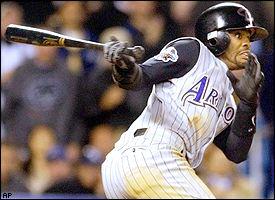
Tony
Womack is just as bad as he looks here.
Jaret
Wright
3
years / $21 million
| ERA | K/9 | K/BB | |
| 2004 | 3.28 | 7.68 | 2.27 |
| Career | 5.09 | 6.75 | 1.54 |
Jaret Wright had what is clearly his career year for the Atlanta Braves, an organization that always finds ways to have pitchers in their career years, in 2004. Wright, who had been written off by pretty much everyone after nearly a decade of failing to deliver on his former prospect tag, posted a 3.29 ERA with 159 strikeouts and 70 walks in 186 1/3 innings. Wright’s career features no other season even closely resembling this one, and he’s now 29 years old. Despite this, the Yankees are set to pay him $21 million over the next three seasons. Odds are this could look almost as bad as Jeff Weaver’s few months in pinstripes. Wright has always struggled with his control, but was able to curb his problems while a Brave. It’s possible he’s really turned over a new leaf, but doubtful. Wright could find the confines of New York and absence of famed Atlanta pitching guru Leo Mazzone to be unsettling, and at any rate will have trouble finding a way to earn his $21 million.
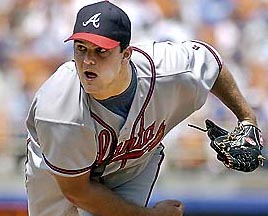
Looking
at Wright makes you wonder just how the
Braves had the NL's best ERA in 2004.
Carl
Pavano
4
years / $39 million
| ERA | K/9 | K/BB | |
| 2004 | 3.00 | 5.63 | 2.84 |
| Career | 4.21 | 5.92 | 2.28 |
Then there’s Carl Pavano, who also turned in the best season of his career in 2004, going 18-8 with a 3.00 ERA, 139 strikeouts, and 49 walks in 222 1/3 innings. Pavano, now 29 as well, has had his share of problems staying healthy, and doesn’t really strike out a lot of people. Fortunately for him (and the Yankees) he throws strikes enough to get guys out, and he’s a good bet to be above average for the Yankees in 2005. Unfortunately for the Yankees (and fortunate for Pavano), they’ve elected to pay Pavano $39 million over four seasons, which is a little more than you’d want to be giving a middle-of-the-rotation guy. Pavano isn’t going to keep his ERA that low without the pitcher’s haven that is Pro Player Stadium and the help he received from a stellar Marlins defense. While Pavano will probably be helpful, he’s not worth $39 million in anyone’s book.
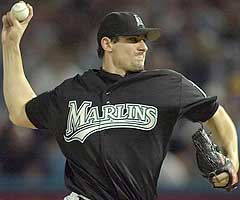
Let's
not forget who gave up McGwire's 70th
home run in 1998.
Of course any discussion
about the Yankees’ off-season moves would have to involve their acquisition
of Randy Johnson, still one of the dominant pitchers in the game at age 41.
Steinbrenner rightfully chased Johnson after a 2004 season marred with poor
pitching, and eventually landed him in January. The Yankees dealt starting
pitcher Javier Vazquez, minor league starter Brad Halsey, minor league catcher
Dioner Navarro, and $9 million to Arizona for Johnson, who put up a 2.60 ERA
with 290 strikeouts in 2004. Regardless of how successful the lot traded to
Arizona becomes, this move was a good one by Cashman. Johnson is the frontline
starter they lacked in 2004, and will almost certainly (barring injury) be
dominant in pinstripes. After the deal, the Yankees gave Johnson a two-year,
$32 million extension, which despite his age is still probably the most reasonable
contract New York gave out all winter.
The trend here is obvious; the Yankees sought out the free agents who looked
the shiniest after 2004 and gave them enough money so that they wouldn’t
look elsewhere. Why New York didn’t look for cheaper, equally viable
options is a good question, but not one that Steinbrenner concerned himself
with. Even if Womack, Wright, and Pavano play close to par for 2004, the $19
million they’ll be collectively earning this season will look a little
bit outlandish. Perhaps the most telling way to look at the Yankees’
free agent signings is to imagine how much money you would’ve given
any of these players before 2004. This free agent market is a forgiving one,
concentrating far too much on single-season statistics, and the Yankees are
its ringleader.