Misplaced Nostalgia: My Love for the '94 Cards
I can remember when I first really fell in love with baseball. It all started with me watching games with my dad in the early 1990s, and I have vague memories of the ’91 and ’92 Cardinals. In 1993 I started paying more attention, learning about all of the good players in the league and becoming more interested in the sport in general. Then came 1994, the year I fully immersed myself in nothing but baseball. While many have incredibly sour memories of baseball in 1994 (due to the infamous strike), I was still just nine years old during the season, and I wanted baseball to come back. I wasn’t bitter, and I wasn’t going to stop watching. I wanted to watch Tony Gwynn make his run at hitting .400, see if Matt Williams or Ken Griffey Jr. could break Roger Maris’ single-season home run record, and most importantly, watch my beloved 1994 Cardinals. What’s funny about the 1994 Cardinals is that they weren’t very good at all; they finished 53-61 in their 114 pre-strike games. The 1995 Redbirds would fare even worse. None of that had anything to do with my love for them. They were the first team I ever really got to watch play with extreme frequency, and I got a feel for the roster. There were players I loved and ones I wanted traded. I don’t think I really knew how hopeless this team was, but even if I did, I didn’t care.
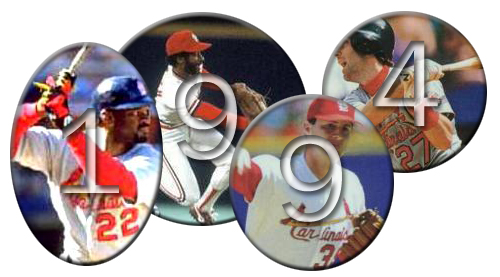
This wasn’t necessarily an offense to fear, either. Todd Zeile (then a ripe 28) and Cardinal superstar Ray Lankford tied for the team lead in home runs with a mere 19. Behind them was good ol’ “Hard-Hittin’” Mark Whiten, best known for hitting four homers in a game against the Phillies a year earlier. In 1994, though, he managed only 14 long balls.
The ’94 Cards relied more on guys like All-Star Greg Jeffries, who had a stellar 1994. Jeffries hit .325 with 12 homers, and finished the year with a .391 on-base percentage. He was the heart and soul of this team. Little did I know what would become of Jeffries’s career. I remember guys like Tom Pagnozzi, who had a strong defensive reputation, but did very little with the bat. For whatever the reason, probably his offensive deficiencies, I remember resenting Pagnozzi. It always seemed like he was coming to the plate in clutch situations. I can remember making snide little remarks to my dad about him, but my dad would just keep telling me that he really wasn’t all that bad a player. Truth be told, he really wasn’t that bad in 1994, but I sure thought so.
I also remember Geronimo Pena, the ’94 Cards’ starting second baseman. Pena would later fall off the face of the earth, but he showed a little pop that year. He ripped eleven homers in his 213 at bats that season. Also getting at bats at second base was Luis Alicea, who just looked really pathetic at the plate. If there was ever someone who would never strike fear into an opposing hurler, it was Luis Alicea. Alicea did draw some walks (in retrospect), but he showed little power and always appeared frightened.
Of course there was Ozzie Smith, whose poster used to faithfully cover the back of my bedroom door. Smith was a tremendous defender, and he’s in the Hall of Fame because of it. In 1994 he was 39 years old, though, and he really was terrible with the bat. He hit .262 with 3 home runs in his 381 at bats. The fans (myself included) loved Ozzie, though, and he was voted into the All-Star game. Beside him at third was the aforementioned Zeile, who pounded 19 homers and had a team-high 75 RBIs. He only hit .267, but those power numbers looked good to me in 1994.
Along Lankford and Whiten in the outfield was Bernard Gilkey, who would later have a couple of nice seasons. Not in 1994, though. In ’94 he hit .253 in 380 at bats, showing very little power. Then there were all of those outfielders off the bench. NFL pro-bowler Brian Jordan would be one of the driving forces behind the 1996 Cards, but his bat was pretty anemic in those days. John Mabry was a 23 year old up-and-comer with a line drive bat. I remember, with a straight face, promising a friend that Mabry would win a batting title some day. He would become a useful utility player, but that was about it. Then there was Jose Oquendo, now a team coach. Oquendo was best known for playing every position, including pitcher, and having a gross beard. He just always looked like a shower would be very beneficial. Oquendo had about as little power as possible; he made Ozzie Smith look like Barry Bonds.
Gerald Perry, who had plenty of gray in his sparse facial hair, was always on hand to pinch hit. I remember the Cards’ announcers, namely the incompetent Al Hrabosky, always commenting on Perry’s uncanny ability to deliver with a pinch hit in the clutch. Hrabosky (nicknamed “the mad Hungarian”) always made quite the production whenever Perry would arise from the bench and stride toward home plate. You would’ve thought he was Stan Musial or something.
As bad as the lineup was sometimes, it was a lot stronger than the pitching. Vicente Palacios, then 30, anchored a dismal St. Louis staff. Palacios led the team with a sparkling 4.44 ERA and an utterly dominating 95 strikeouts. The second best ERA on the staff belonged to Bob Tewksbury, who at times in his career was effective. Not in 1994, though. “Tewks” had an ERA of 5.32, but he did have a team-high 12 wins. He didn’t ever walk anyone, but he sure did get hit hard. He surrendered 190 hits in his 155 2/3 innings. Allen Watson, a better hitter than pitcher, finished with a 5.52 ERA in his 22 starts. Let’s also not forget about Rick Sutcliffe (then 38), who was downright terrible (6.52 ERA, 26 K, 32 BB in 67 2/3 IP). Or how about Omar Olivares, who was just 26 at the time, and had a gross 5.74 ERA.
The bullpen was fortified by Mike Perez, the flame-throwing, unstoppable closer everyone seeks to have. Perez had a ghastly 8.71 ERA in his 31 innings of work, but did record a team-high 12 saves. One can only assume that he was going to lose his job to a much more dangerous hurler, such as Rob Murphy or the ghostlike-pale John Habyan. Cuban defection pioneer Rene Arocha was in the ‘pen as well, and teamed with Rich Rodriguez to form a highly-feared Latin duo of destruction. Guys like Rheal Cormier and rookie hopefuls Tom Urbani made a few appearances as well, solidifying the fact that this team really had no hope when on the mound. At least we were a good year away from the terror that was Mark Petkovesek.
Yes, the 1994 Cardinals truly were terrible, but I loved them to death. I couldn’t wait for the strike to end and for 1995 to begin. Little did I know that the 1995 version of this team would actually be even worse. In future years I would witness the Cardinals achieve much higher degrees of success, but this 1994 team will always have a special place in my heart. In the event that any reader out there is actually as sentimental about this team as I am (as impossible as that might seem), baseballreference.com has an excellent amount of statistical information on this horrible team. You can find out all sorts of interesting factoids, such as Jose Oquendo’s frighteningly large 1994 salary ($2.15 million). As much as I love this team, I’m glad it’s 11 years later, and the Cardinals are actually good.