to view my portfolio at istockphoto.com
For more information on stock photos by Peter Spiro available for downloading from istockphoto.com, please click here.
To view some of my recent digital photographs, available for stock photography purchase, please click on this icon
to view my portfolio at istockphoto.com
To help speed things up, I am using this opening page to catalogue the pictures, so you don't have to load a lot of large images to start with. For the most part, I have scanned them in from 4x6 inch prints at 100 DPI or less, with 30 times jpeg compression. This keeps the files down to under 70K, but of course you can't expect them to be as sharp as the original print. Click on the word links to see a picture; or where a "thumbnail" picture with a blue border appears, click on it to view the larger version.
Toronto Street Scenes
Toronto has a greater diversity of things to see and do than most any other place I have every been. It isn't an old city, being not much more than 200 years old, but it cherishes its past and has preserved more of it than most other North American cities. It isn't always elegant; in fact, some of it is downright tacky, but it is vibrant, with one of the most diverse ethnic mixes and some of the best (and cheapest) shopping in the developed world. It is a city of little houses even in the core, a city full of trees and greenery. There is a considerable tolerance for odd behaviour, and very little attempt to force everybody to conform. It is a place of great climate extremes. It is a little known fact that Toronto's latitude actually puts it slightly south of Florence, Italy or Nice, France. However, because it has no mountains around it, the weather depends on where the wind blows from, and it can have Arctic cold one day, and be 20 degrees celsius warmer the next day if warm air comes up from the Gulf of Mexico.
 A
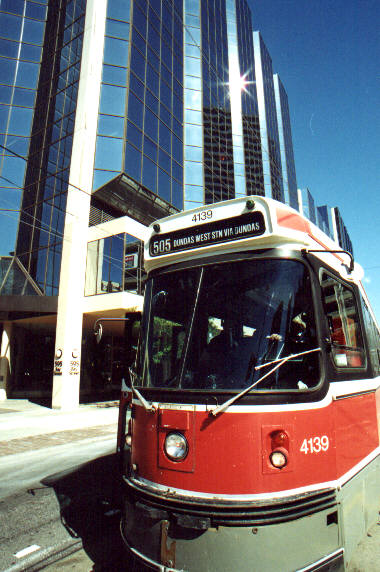
street car (the Canadian term for what is called a tram in England) at Bay and
Dundas streets (taken with Phoenix 19-35mm zoom at 19, at f/16). Toronto
and San Francisco are the only two cities in North America that still use
these. They are lots of fun, and they help keep the diesel fumes down.
A
street car (the Canadian term for what is called a tram in England) at Bay and
Dundas streets (taken with Phoenix 19-35mm zoom at 19, at f/16). Toronto
and San Francisco are the only two cities in North America that still use
these. They are lots of fun, and they help keep the diesel fumes down.
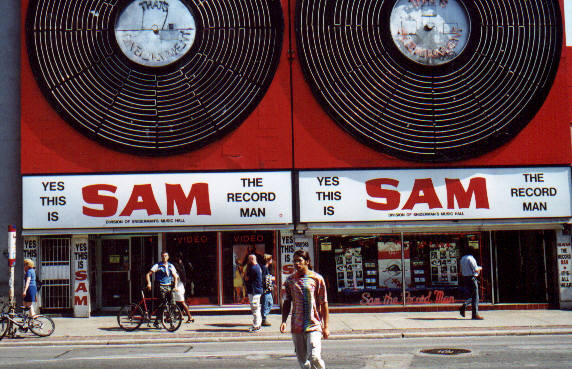 Sam the
Record Man, a Yonge Street institution that's a maze of rooms with one of the
best selections of records anywhere. This was the start of a chain, but this
flagship store has not yet felt the cookie cuttter -- they still use old
fashioned, hand lettered signs. (Taken with Pentax 40mm at f/5.6, Kodak 100
film).
Sam the
Record Man, a Yonge Street institution that's a maze of rooms with one of the
best selections of records anywhere. This was the start of a chain, but this
flagship store has not yet felt the cookie cuttter -- they still use old
fashioned, hand lettered signs. (Taken with Pentax 40mm at f/5.6, Kodak 100
film).
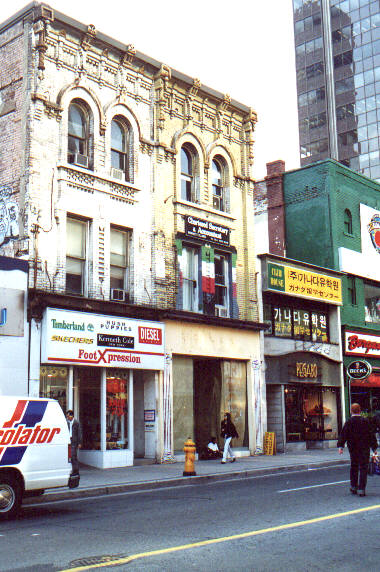
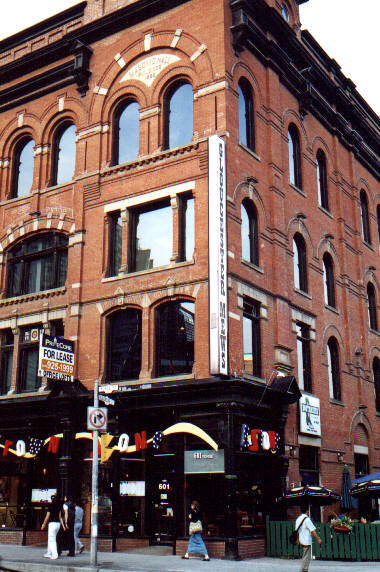
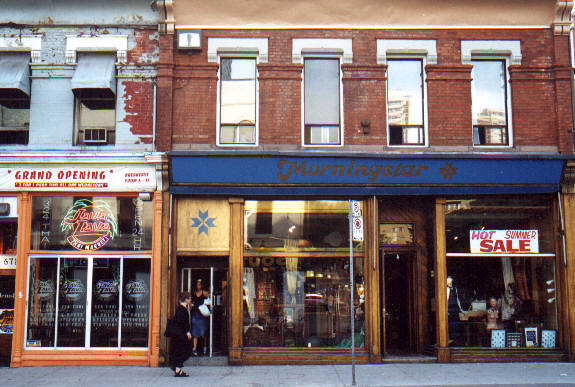
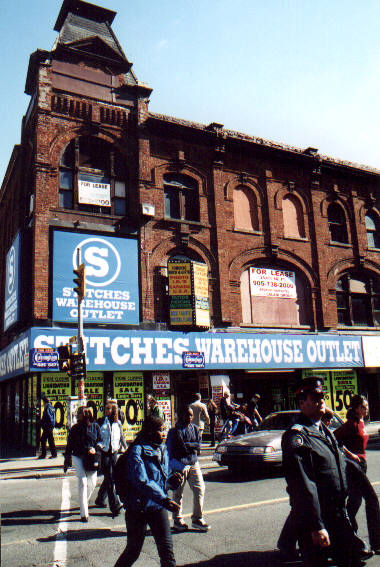
Old stores on Yonge Street between Bloor and Dundas: Not an elegant area, with an odd mix of dollar stores and curio shops. But when you look up, you see the ornate brickwork of buildings that were mainly constructed in the 1880s. 1. Just south of Bloor. 2. The old Masonic building. 3. Morningstar. 4. Stitches with a tower.
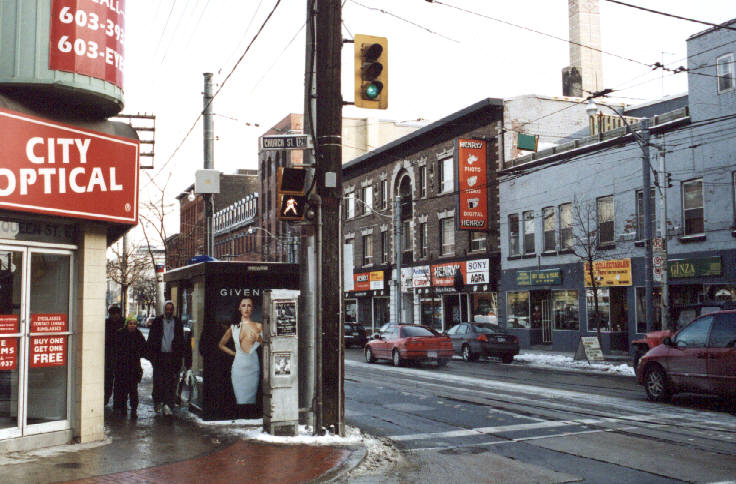
The corner of Church and Queen Streets, Toronto's camera store district. Just about every Leica for sale in Toronto is located within walking distance of this intersection. In the background, one of the entrances to Henry's, Canada's premier photo store, can be seen. (It's a large L-shaped complex that has gradually taken over half a block, and comes out on another street.) This is a fairly run-down district, and you'll find street people sleeping in the park across the street. Pawn shops abound (with good deals on used photo equipment), and some of the classier camera shops themselves had their origins in pawn shops. The pawn shops are now almost all run by Russian immigrants, who honed their skills in the finest black market in the world. (Photo taken with Pentax 35mm f/3.5 at f/8, Kodak 400 film).
The University of Toronto
This is one of Canada's largest universities, and highly regarded for its research. The central campus has some fine old buildings around a central green space. I was a student here for five years, and later taught economics there. For the past twenty years, I have worked a few blocks away from it.
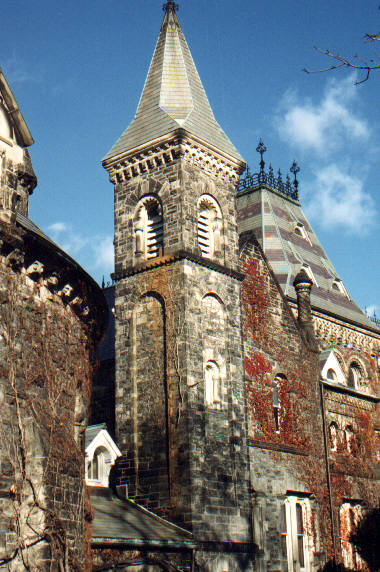
My college when I was an undergraduate was University College, built
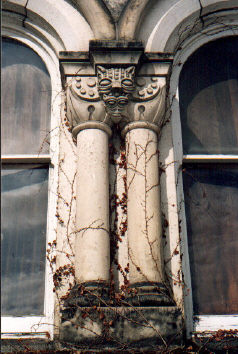
around 1851, and considered the finest example of Norman architecture in North America (taken with Sigma 28-80 lens at 80mm). Here is a
close-up of the detailed carvings around the windows (Taken with
Pentax M, 50mm f/1.7 lens). Here is a view of the whole building (Fuji 4700 digital camera, f/6.7). 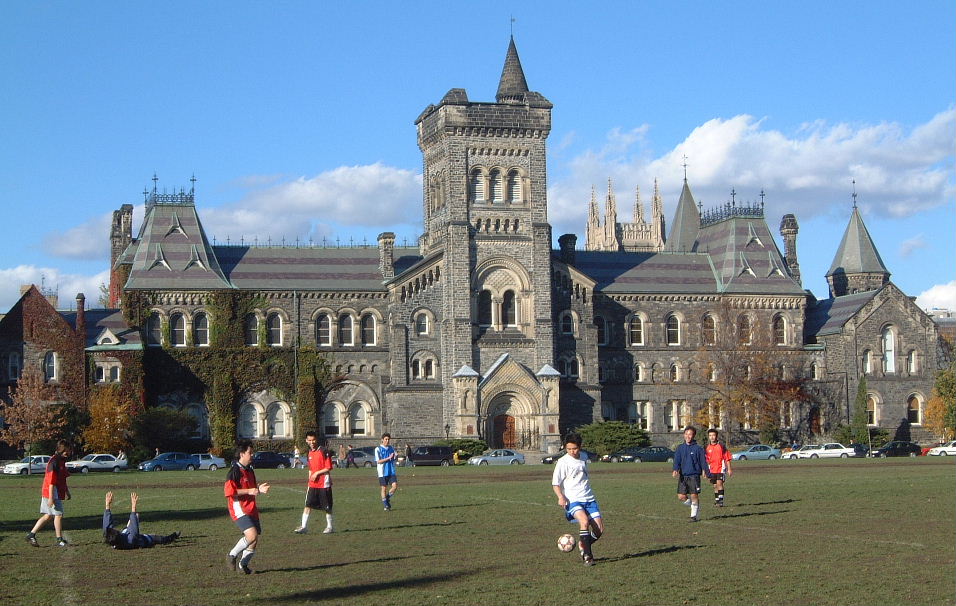
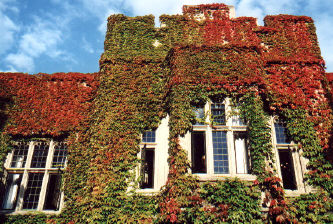
Hart House, a student club building, covered in fall vines. (Pentax 40mm lens at f/11).
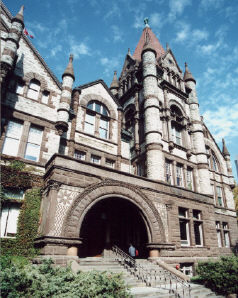
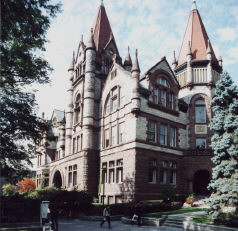
Victoria College is one of the most distinctive buildings, viewed from the front or side (Phoenix 19-35 at 19, f/11).
A maple tree at the height of its fall glory in the quadrangle of Trinity College, the most "Oxbridge" part of the University of Toronto (Fuji 4700, f/6.7). 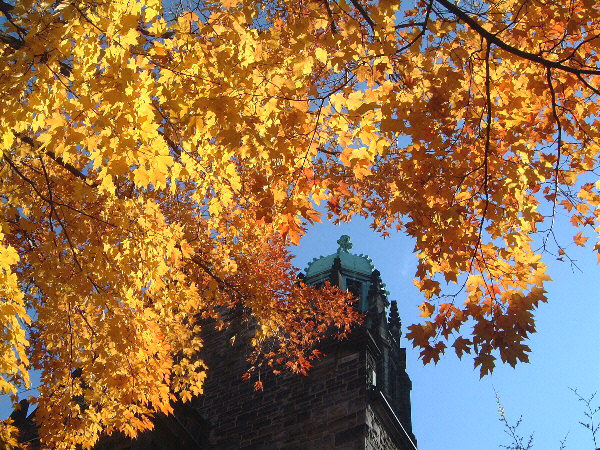
The old science and medicine library (Fuji 4700, f/6.7). 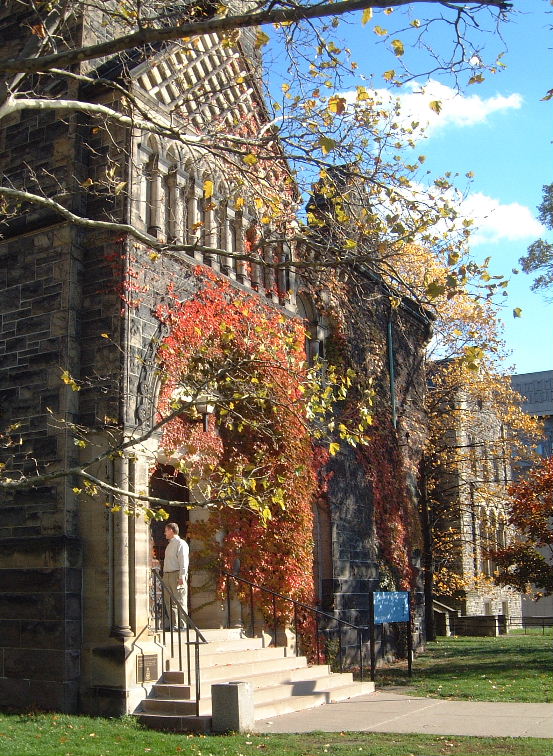
Another view of the same building: 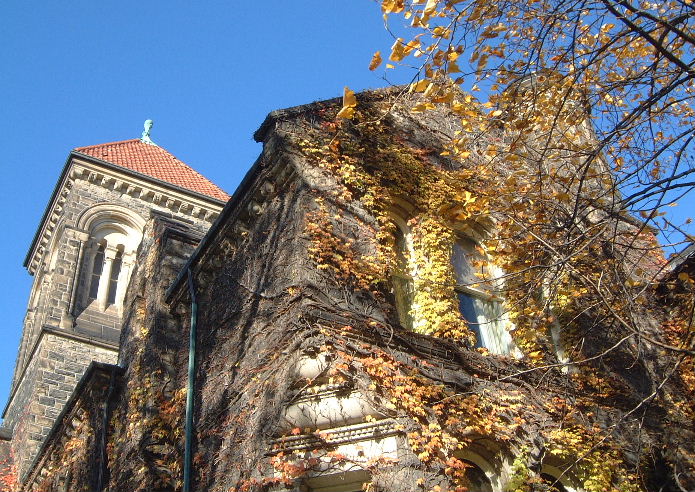
University College behind a rose border (Fuji 4700, f/6.7, at 36mm equivalent). 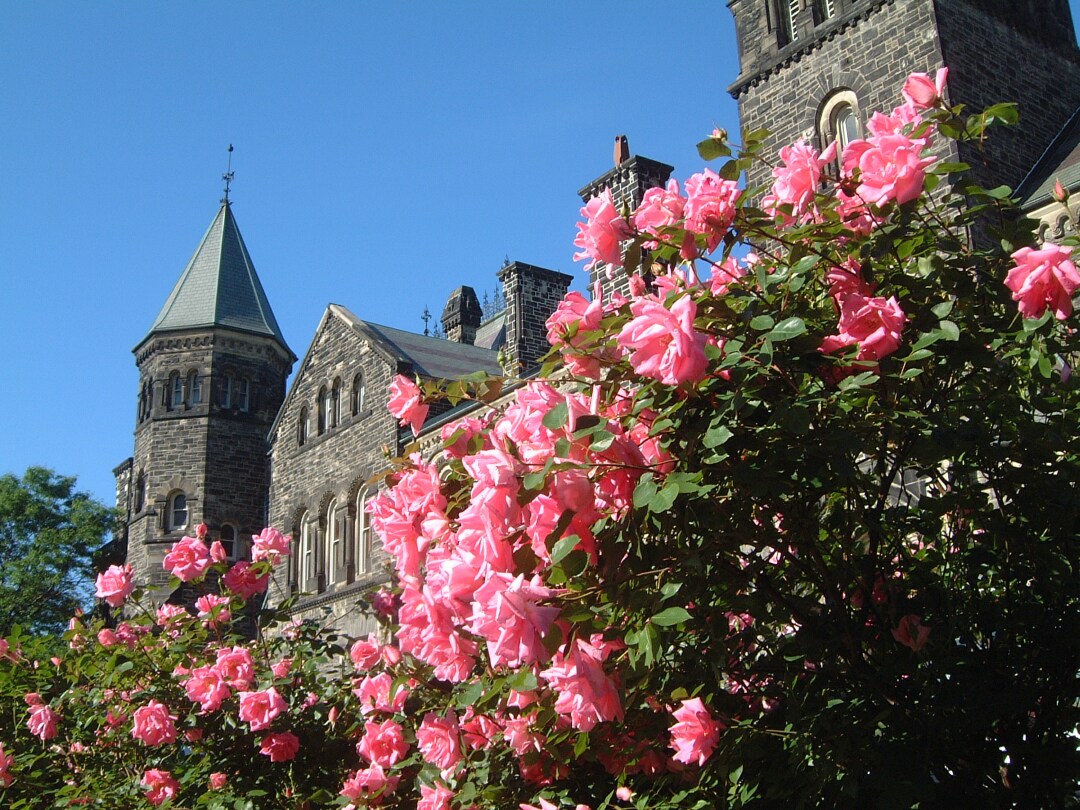
Flowers
1. Stargazer lily, taken with Fuji 4700 at f/2.8, photographed in my backyard. (Notice the substantial depth of field with the short focal length digital lens at this relatively wide aperture. If taken with a 35mm camera, it would have needed a much smaller aperture to bring both the stamens and the flower into focus.) These plants like to grow in
semi-shade. They bloom only once a year, near the end of July, and have a wonderful fragrance, in addition to their spectacular colour.
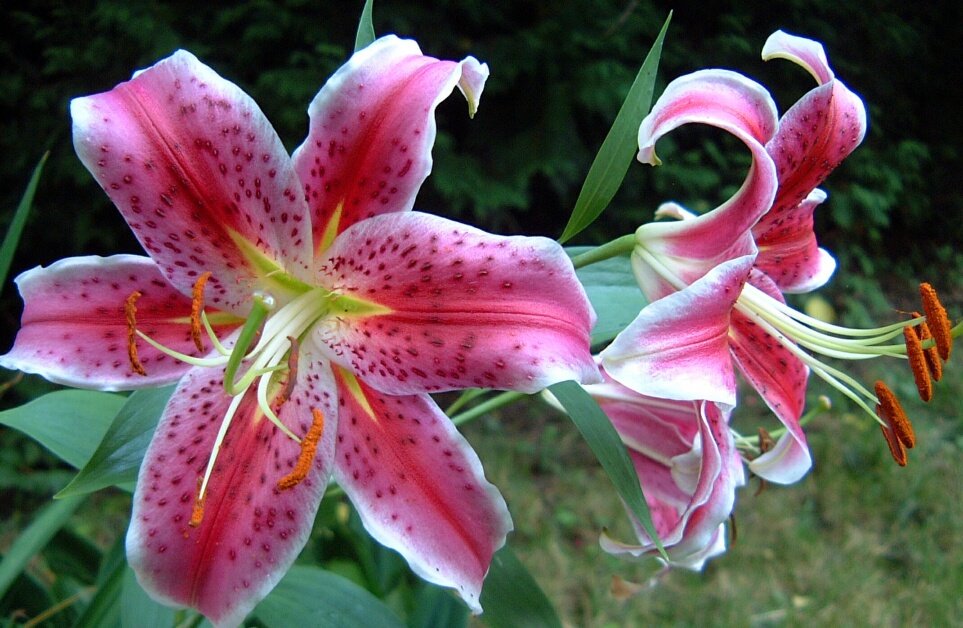
2. Stargazer lily no. 2.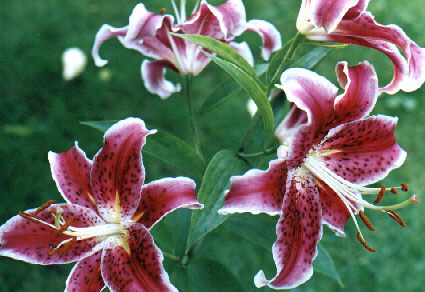
3. Wildflowers 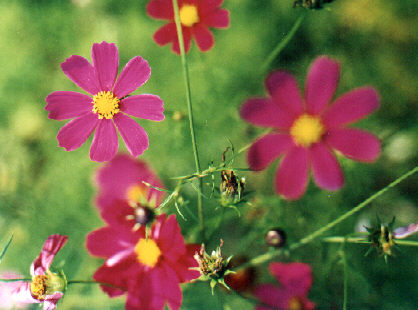
4. Lilies beside willow pond, taken with Pentax-FA 28-70mm zoom at
f/5.6 and 1/45th.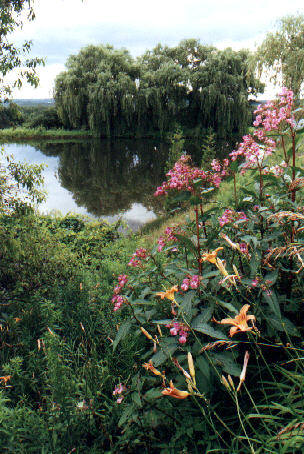
5.
9. View of Lake Ontario from the top of the Scarborough Bluffs (Fuji 4700, f/6.7, at 36mm equivalent) 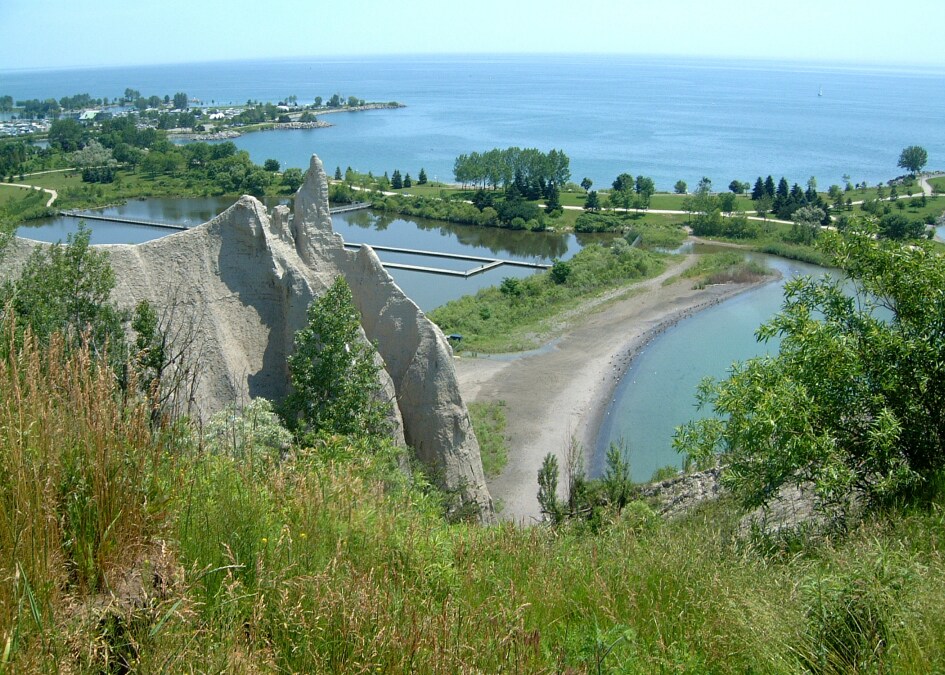
People and Places
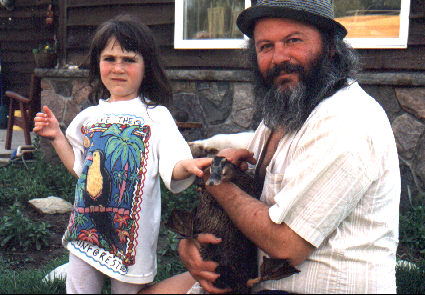
1. The lucky duck. He's lucky, because the man who caught him is a vegetarian.
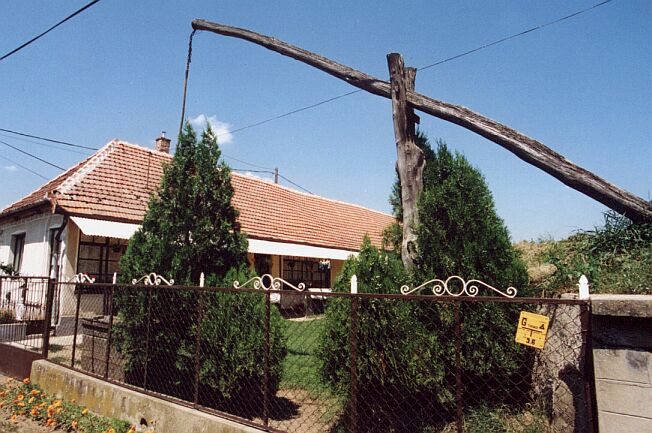
2. A shadoof or sweep well in Nyirkarasz, Hungary (near Kisvarda), called a gemeskut in Hungarian. It uses a long lever to lift buckets of water up from far below. The word "shadoof" is Arabic, and these wells originated in Egypt, but are still fairly common in the rural areas of Eastern Hungary.
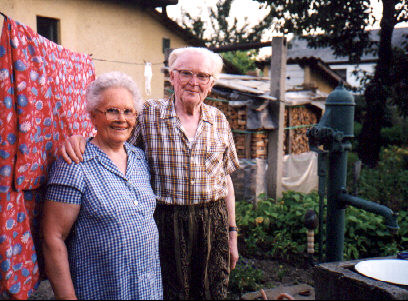
3. Sandor no. 1, and his wife, in their garden in Kisvarda, Hungary, 1998. He was an apprentice tailor with my father in the 1930s, and still remembered the old days and old friends very vividly (photo with Olympus Stylus Epic at f/2.8).
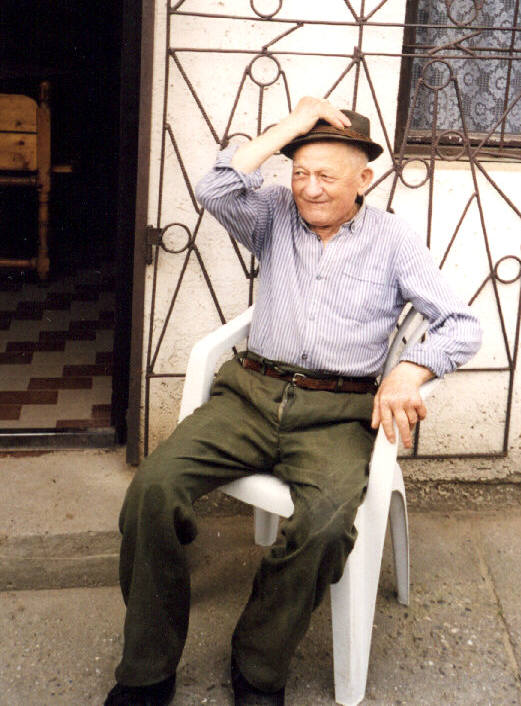
4. Sandor no. 2, Gemzse, Hungary (a village with population of 900). One of my father's boyhood friends, just about the last one living when I was there 1998.
5. Three heads are better than one.
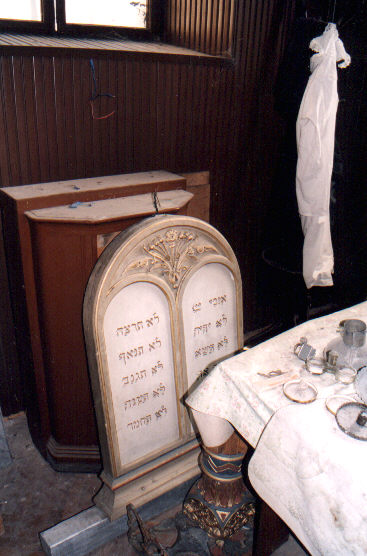
6. The Ten Commandments
on the floor, in the ruins of the last synagogue in Kisvarda, Hungary. About
a third of this city's population was Jewish before World War II, but there are
virtually none left today.
Back to my main Photography Page.
All images are copyright (c) Peter Spiro, and may not be reproduced without permission.