A perennial subject of concern among photographers is the issue of the accuracy of autofocus SLR cameras, and the extent to which they may reduce sharpness. An excellent article on this was written by Herbert Keppler in the September 1999 issue of Popular Photography. The information presented there included some tests of high-end Canon and Nikon SLRs. Keppler found that the "in focus" indicator LED for all the cameras stayed on as the camera was moved back and forth relative to a 10 foot target: "The great MIN to MAX distance over which we could move all three manually focused cameras and still see the focus-OK light was an unpleasant surprise." He concluded that the focussing errors were sufficiently large that they could lead to substantial degradation of image quality.
I tried my own tests with my Pentax MZ-5n and a Pentax-F 50mm f/1.7 lens. I used a moderately contrasty poster, with bright room light. I tried the camera at distances of 3 feet, 6 feet and 8 feet from the target ( I chose these distances because they are ones specifically marked on the focussing scale of my lens). Focussing manually with the ground glass in the MZ-5n and also with my MX, I verified that the scale markings on the lens are accurate. The best focus occurred when the lens was set exactly to the appropriate distance mark. I was very relieved to find that, at least for this prime lens, the scale markings are exact. I had worried that perhaps the markings were just approximations. (Unfortunately, for most zoom lenses, they are just approximations, since the focus actually varies as you change the focal length.)
I focussed about a dozen times from each distance. It was disconcerting to find what a large degree of randomness there is in the MZ-5n's focussing. Think of a roulette wheel that's spinning, and someone tries to stop it at a precise point, but his reflexes aren't perfect. That's the MZ-5n. I'd say about one-third of the time, it gets the exact correct focus, and the rest of the time it stops somewhere before the correct point of focus. I found that it rarely overshot the correct point of focus.
Were the focussing errors serious? It depends on the situation, and the aperture you are using.
When the object was 8 feet away, the lens would sometimes end up being focussed half way between the 6 and the 8, which implies maybe a focus of 7'. Consulting a depth of field calculator, we find that the depth of field range would exclude the 8' distance with apertures larger than f/5.6.
The errors were effectively more severe at the close focussing point, where depth of field is shallower. When the object was 3 feet away, the lens often stopped at the 0.8 meter mark (equal to 2'8"). Even at f/8, the depth of field only extends to 2'10", meaning that the object would be out of focus by this criterion.
You can see that the difference is very dramatic at three feet.
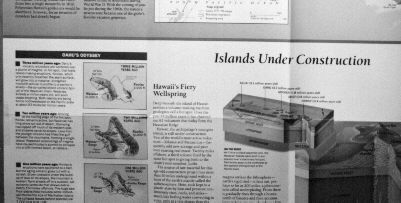
A scan of the bottom left hand quarter of a picture taken at 3 feet is
shown here, with the lens scale et to 3 feet, which was the true distance
to the object and which also appeared sharpest when focussing manually.
This picture verifies that the focussing screen on my camera is accurate.
Incidentally, it is also a testimony to how very sharp the Pentax-F 50mm
f/1.7 lens is. (Remember, this shot was taken wide open at f/1.7.
The letter H in Hawaii in the original is less than 4mm tall, and the main
text is less than 2mm tall. Every single word is quite legible in
the 4X6 print, taken on Ilford XP2, ASA400 film.)
Here is the same scene with the focussing distance most often chosen
by the camera's autofocus. The words are almost comletely illegible.
(Poster courtesy of the National Geographic Society.)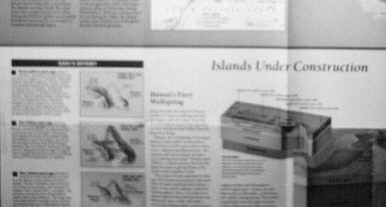
What this implies is that for relatively distant objects, with the lens stopped down to f/5.6 or more, autofocus does an adequate job. However, for close-ups where critical sharpness is important, it pays to switch to careful manual focussing.
Of course, the depth of field range is based on a subjective criterion of how much sharpness loss is OK. The point of exact focus is still the best. In the median cases in Keppler's tests, the autofocussing errors reduced sharpness by about 10%, as measuered in lines per millimeter.
Robert Monaghan sponsors a web page that is harshly critical of autofocus cameras. One of the criticisms that he pushes most strongly against them is this: not only is autofocussing inaccurate, but merely turning off the autofocus and using them manually doesn't work either. This is because the viewfinders and focussing screens of autofocus cameras are not as good as the ones that are designed into manual focus ones. I can't attest to the truth of this statement for other brands, but I feel pretty confident in rejecting it for Pentax cameras. I find the ground glass screen in my MZ-5n to be very easy to focus with, and in my tests the point of maximum sharpness in the viewfinder corresponded with the accurate value on the focussing scale.
In fact, in my experience with Pentax manual focus cameras, such as the MX and ME, I find that the accuracy of these is also somewhat faulty. The split image focussing screen gives a false sense of accuracy. It is pretty accurate for close objects, but once you get past 8 feet or so it is easy to make substantial errors. Attempting to focus on an object 8 feet away, I found that I often ended up turning the lens to the 10 foot point (which is outside the depth of focus range at f/5.6). It is very hard to see a difference in the split-image viewfinder between the lens set at 8 feet versus 10 feet. The trick with these cameras is to start the lens at the nearest focus, turning slowly, and to stop as soon as the lines look like they are about to converge. I found that the greatest focussing accuracy with a focussing aid was the microprism spot on my MX with an SA-23 screen (designed for fast lenses, this has no split-image aid). The bottom line is that even with manual focus cameras, it is the ground glass that should be relied on for critical focussing, not the focussing aid. These are helpful when you need to focus quickly, but they don't maximize accuracy.
I think that the greater difficulty in focussing autofocus cameras manually comes from the lens, not the focussing screen. Autofocus lenses have a loose mechanism, and a shorter range of rotation, making it harder to zero in on the point of optimum focus. For example, the Pentax 50mm lenses of the A and M series require about a 100 degree turn of the barrel to get from three feet to infinity. A Pentax autofocus 50mm lens takes about 70 degrees, while an autofocus zoom lens only takes about 40 degrees. Since tiny movements on the focussing ring of the latter represent much larger jumps in the focus setting, and this ring doesn't have much inertia, it is going to be considerably harder to find the right focus. One of the advantages of the Pentax system is that older manual focus lenses will provide full exposure automation with autofocus Pentax SLRs (with the exception of the low-end MZ-50 and MZ-30, which will work only with A series and newer lenses). These manual focus 50mm lenses are widely available, inexpensive, and provide excellent results.
While autofocussing is imperfect, so is the human picture taker. In the ideal situation, where you take all the time you need, and concentrate on it, manual focussing can in principle be more accurate. In practice, when you are rushed you will make mistakes with manual focussing. Even when I'm taking pictures at a leisurely pace, I sometimes focus, decide to move a bit to change the composition, and then forget to refocus. A lot of the time, autofocussing would end up more accurate than manual focussing. When taking pictures of people, naturalness of expression and movement are usually the most important goals, and here the speed of autofocus is the clear winner.
However, when I'm taking pictures of inanimate objects, I almost always do use manual focussing, and the benefit from it is not so much pure accuracy as creative control. Except in those situations where you are shooting a flat object (or where everything is at infinity) there is no perfect point of focus, because the frame has objects at varying distances. The great merit of manual focussing, along with setting the aperture to control depth of field, is that the photographer gets to choose what is the item of greatest interest which will "be the focus" of the picture.
Return to my "Photography
Page".

Peter Spiro, January 2001