
Audio Terms
|
|
Audio Terms |

Back to Main Menu
AB Test
A test method used to compare the performance of two pieces of equipment such as amplifiers or speaker systems. The two devices are quickly switched back and forth while listening for differences, or measuring instruments may be used to compare their relative performance.
A-B Microphone Pair
A pair of spaced microphones used for a stereo pickup. Generally used for recording, not sound reinforcement.
A/D Converter
Analog to Digital Converter. A computer sound card employs an A/D converter to process analogue audio from a mic or line input into digital form so that it can be stored on hard disk or transfered via electronic means to a remote computer in the form of streaming audio or a sound file. Conversly, a D/A converter processes digital audio back to analogue form.
Absorption The ability of a surface to absorb sound. The absorption coefficient of a material is a figure between 0 and 1, representing its degree of absorption. The absorbtion characteristics of a surface often vary with frequency.
Absorption coefficient
The sound absorption coefficient is a measure of the amount of sound energy absorbed by a surface. A surface with an AC of 0.2 will absorb 20% of the energy striking it and reflect the remaining 80% back into the listening environment.
Acoustics
The effect of the listening environment upon voice or music. Rooms are described as dead when there is little reflected sound. Room furnishings, heavy curtains and even the audience itself absorb the indirect sound field and allow the direct field to predominate. Conversly, a room with hard reflective surfaces creates plainly audible reflections and is described as live.
Acoustic Feedback is an unpleasant effect caused by regeneration of sound. Direct or reflected sound from a loudspeaker can re-enter an open microphone forming a circular feedback path which results in oscillation. Feedback can be prevented by decreasing the system gain by turning down the volume, or increasing the acoustic path loss between the speaker and microphone. For maximum stability and freedom from ringing effects the system gain should be set 6dB below the point at which feedback occurs.
Active
A powered device (typically providing amplification) that contains electron tubes or transistors.
Aliasing
In digital sampling and recording, aliasing is digital distortion that occurs when the frequency being sampled is higher than one-half the sample rate (called the Nyquist Frequency). Essentially, when a frequency exceeds the Nyquist Frequency, it is "folded over" and becomes an audible component of the signal. Most digital recorders have filters, etc., to prevent aliasing from occurring. In samplers, aliasing also becomes apparent when a sample has been "stretched" too far in pitch.
Ambience
Reverberation and early reflections (delay<50mS). The human ear is able to discern the characteristics of a particular room, due to these ambient sounds.
Ambient Noise
The prevailing background noise in a room due to people, outside traffic and HVAC noise (heater, ventilation and Air-Conditioning plant), in the absence of signal from a loudspeaker, musical instrument, or other sound source.
American Wire Gauge (AWG)
A numbered scale developed in the United States for measuring thickness of wire. The lower the number, the larger the diameter of the wire.
Amp
Abbreviation for amplifier. Also an abbreviation of Ampere, the unit of electrical current.
Amplifier
A device that allows a small amount of input power to control a larger amount of output power. In sound systems an amplifier converts the small electrical signal from a microphone or other source into the larger electrical signal required to power the loudspeakers.
Amplitude
The strength of a vibration; the higher the amplitude the louder the sound. Also refers to the amount of audio signal voltage present in a circuit.
Analogue
Literally, analog signals are electrical signals that are exact replicas of the waveforms of the original sound pressure wave in the air. Examples: In audio signals, changes in voltage are used to represent changes in sound pressure. On vinyl records, groove depth is an analog for sound pressure levels. On magnetic tape recorders, changes in magnetism are an analog for changes in sound pressure.
Anechoic chamber
A room in which all the surfaces are lined with acoustic absorbtion material to virtually eliminate reflections. Often used for R&D evaluation of loudspeakers and microphones.
Array
Generic name for a single collection of loudspeakers centrally hung in an auditorium. Also known as a Cluster.
Assign
In sound mixers, assign means to switch or route a signal to a particular signal path or combination of signal paths.
Attack Time
A term used in compressors and expanders. It refers to the time delay between when the device senses a change in level and when the device completes it's compression or expansion.
Attenuate
To make weaker. ie: Reduce the electrical or acoustic signal level.
Attenuator
Device which reduces audio signal levels by means of a resistor network or stepdown transformer. (Attenuators may be fixed or variable) In laymans terms "it takes a loud signal and makes it softer so it doesn't overload the amplifier, speaker etc. A fixed attenuator is also known as a Pad.
Audio Chain
A string of interconnected audio components. A typical lineup would be a microphone, mixer, graphic equaliser, power amplifier and loudspeaker. The microphone is a transducer which converts sound into electrical energy, intermediate components then perform signal processing of the audio signal before it is converted back into sound by the loudspeaker.
Automation
A feature that automates certain functions of sound or lighting equipment; mixing consoles, for example, can store specific scenes (certain inputs/outputs at specific levels) and recall them at a later time. This feature is indispensible for complex productions that involve multiple changes in short sucession.
Auxiliary Return
A specific line-level input on a mixing console designed to receive a signal from an effects processor.
Auxiliary Send
A specific output bus connected to each channel (with its own level control) that sends a signal out of the mixer and supposedly into an effects processor; can also be used as an additional output (for monitors, recording, whatever).
Axis
An imaginary line that is perpendicular to the front face of a microphone or loudspeaker diaphragm. For microphones, sounds reaching the microphone at an angle to the axis are said to be off axis.

Balanced Line
A transmission line consisting of a twisted pair of wires. Being electrically balanced, any electromagnetically induced interference is effectively cancelled at the distant end. An outer sheild of foil or braided copper wire is often used to provide additional rejection of electrostatic feilds. See unbalanced.
Bass-reflex
A type of speaker enclosure in which the speakers rear sound wave emerges from a specially dimensioned opening or port to reinforce
the bass notes. Bass reflex designs have a higher acoustic efficiency than infinite baffle (sealed) enclosures.
Biamplified
A system using seperate power amplifiers to drive Low frequency and High Frequency drivers in a loudspeaker. An electronic crossover is typically used to seperate the LF & HF channels prior to amplification. Biamped systems generally have a much lower level of intermodulation distortion.
Bi-radial horn
A horn type speaker in which the vertical and horizontal surfaces flare outward at different rates.
Boost
A term used to indicate an increase in level of a frequency or band of frequencies when equalising an audio signal.
Boundary Zone Microphone
A special type of microphone designed to be placed on a flat surface such as a table-top or floor. It's main application is picking up sound from a wide area such as a conference table or theatre stage. The transducer element is usually a condenser type.
Bridge Mode
A method of connecting two power amplifiers together to obtain
high power. The input of one amplifier is driven in anti-phase and the speaker load connected between the (hot) output terminals of both. This doubles the output voltage which theoretically quadruples the power output into the load.
Bridging
Connecting one electrical circuit in parallel with another. eg: Two amplifier inputs may both be connected to a mono output from a mixing console.
Bus
An internal equipment rail serving to combine signals from a number of sources. Conversly a common signal source can use a bus to distribute signal to a number of loads. Busses are commonly employed in audio mixing consoles for that purpose.
Canon Connector
See XLR.
Capacitor
An electronic component which is able to block the flow of direct current in an electrical circuit, but pass alternating currents to a degree depending upon the applied frequency. Widely used in filters and crossover networks.
Cardioid
A uni-directional microphone having a heart shaped pickup pattern. The sensitivity is best from the front and least directly behind the mic.
Circuit
A number of electronic components joined together in such
a way as to produce the desired function. eg: Amplifier, filter etc
Class A
A type of amplifier design that generally produces lower distortion
than class AB, B or H amplifiers, but with lower efficiency and lower power output. The bias setting chosen determines which class the amplifier falls into.
Coincident
Two signals are said to be coincident when they correspond
exactly, fall upon or meet at the same point. Coinciding or occurring in space or time in exact agreement.
Comb filtering
When two combining sound waves have different amplitudes phases and frequencies, the resultant soundwave develops many nulls or
spaces where the energy has cancelled. When viewed on a Spectrum Analyser the resultant frequency response resembles a comb.
Compression Driver
A driver, designed for use with a horn, which utilizes a diaphram rather than a cone to reproduce mid and high frequencies.
Condenser Microphone
A microphone which employs a capacitive (condenser) transducer element. Expensive studio condenser mic's often require a high voltage source to polarise the element. Modern technology has replaced the need for HV power by producing Electret materials which are given a permanent charge in the factory. Electret Condenser Mic's still require power for the internal preamplifier in the microphone. This is supplied via an internal 1.5v AA cell or by external phantom power from the mixer.
Cone
The cone-shaped part of a loudspeaker driver that moves the air. Manufactured out of paper, polypropylene, or carbon-fibre.
Critical Distance
The distance at which the sound pressure level of direct signal
from a source equals those arriving via reflections from walls, ceiling, floor etc.
Crossover
An electronic filter which seperates audio signals into low and high frequency bands for reproduction by woofers, tweeters, etc. A crossover for a two-way system would consist of a high-pass filter that sends the high frequencies to the tweeter, and a low-pass filter that sends the low frequencies to the woofer. For a three-way system a band-pass filter is added to send the middle frequencies
to the midrange speaker. Crossovers may be active or passive.
Crossover frequency
The frequency at which the crossover filters 'hand over' signal from one speaker to the other.
Crosstalk
Unwanted signals from an adjacent electrical circuit. Crosstalk
can be electromagnetically or electrostatically induced.
Cut
A term used to indicate a reduction in level of a certain frequency
or band of frequencies when equalising an audio signal.
Damping Factor
Damping Factor is a measure of how well an amplifier is able to control the movement of a speaker cone or diaphragm. (Poor damping factor results in soggy bass). The value of damping factor is calculated by dividing the speaker impedance by the amplifiers internal output impedance.
dB (Decibel)
A unit for measuring the RATIO of two voltages, currents or powers. The decibel is based on a logarithmic scale. A 3 dB increase equates
to a doubling of power; 6 dB a quadrupling (4x), 60 dB increase is one-million times as much, and a 120 dB increase is one-million times one-million as much power.
dBm
A decibel scale referenced to a power level of 1mW. (0dB reference = 1milliwatt)
dBSPL
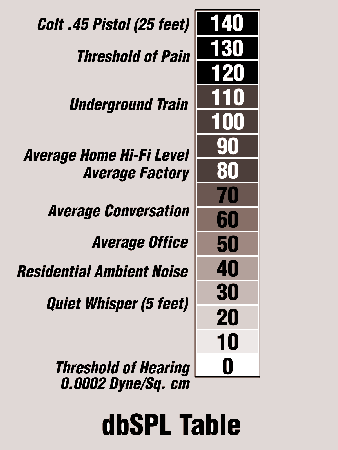
Sound Pressure Level in decibels referenced to the threshold of hearing.
dBv
A decibel scale referenced to a voltage level of 1V. (0dB reference
= 1 Volt)
dBW
A decibel scale referenced to a power level of 1W. (0dB reference
= 1 Watt)
DC
Direct Current. Electrical current that flows in only one direction.
Delay
The postponement of an audio signal for a specific time, usually measured in milliseconds. A Delay Unit is a device sometimes used in a sound system to delay audio signals to satellite speakers located under balconies etc.
Diffraction
Bending of a sound wave due to some room obstacle such as a column or divider. Only low frequency waves can be difracted.
Diffusion
The scattering of sound waves by a solid object.
Directivity
Area of coverage of a speaker or microphone.
Dispersion
The distribution or coverage of a loudspeaker measured in degrees.
The dispersion characteristics vary according to the design, and can be made to radiate more in one direction than another to solve certain acoustic problems.
Distortion
Any undesired change in the audio signal passing through a circuit or transducer. Distortion occurs when the signal is no longer a true replica of what went in. Also see clipping.
Driver
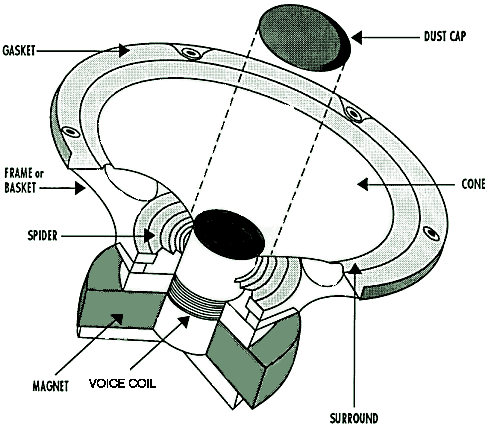
Driver refers to the actual transducer (e.g. woofer or a tweeter) in a loudspeaker cabinet which converts audio signal voltage into acoustic sound waves. A typical driver consists of a cone or diaphragm, a voice coil attached to the cone and a powerful magnet. The voice coil and magnet form a linear
motor which moves the cone back and forth in sympathy with the applied
audio signal. See cut-away drawing of a driver. Also see loudspeaker.
Dynamic Microphone
A microphone which employs an electro-magnetic transducer element. Dynamic Microphones are favoured for heavy duty use as they are less susceptible to damage from mis-handling. Unlike Condenser Microphones they do not require power to operate.
Dynamic Range
The ratio (usually quoted in decibels) between residual system noise and the signal overload point of an audio component. The dynamic range of a musical instrument is the difference in decibels between the loudest and softest sounds that can be played on that instrument
Earth Loops
See Ground Loop
Echo
A delay in sound of more than 50 milliseconds resulting in a distinct repeat of the original sound.
Effects Loop
Inputs and outputs that allow audio signals to be sent to and from a signal processor such as a reverb unit, delay, gate, or limiter.
Electrostatic Speaker
A loudspeaker that uses a large, flat (sometimes curved), thin membrane instead of a cone. The membrane is situated between two screens that are charged with a high electrical voltage to move the membrane. The large area and low moving mass are advantages. The limited membrane travel seriously limits the low frequency response. Also presents a difficult load impedance to an amplifier.
Equalisation
Adjusting the frequency response of a system by means of tone controls or a graphic equaliser etc to restore tonal balance.
Expander
A signal processor that increases (expands) the dynamic range of an audio signal. Expanders are sometimes used to restore compressed program material or as a means of noise reduction. Stretching the dynamic range makes loud sounds louder, and soft sounds softer.
Filter
An electronic circuit designed to selectively pass certain sound frequencies. Also see crossover.
Feedback
See Acoustic Feedback.
Fletcher-Munson Curves
A graphic representation of average hearing responses at particular sound pressure levels.
Frequency
The number of waves or cycles per second. The unit of frequency is the Hertz (Hz), 1 cycle per second = 1Hertz. A 1000 Hz (1 kHz) tone causes the eardrum to vibrate back and forth 1000 times each second. The lowest bass note on an organ keyboard is around 16Hz. The highest is a high pitched whistle of around 19,000 Hz which is inaudible to most males over the age of fourty.
Frequency band
A specific range of frequencies. For example a typical subwoofer
operates in the band 20 Hz to 100 Hz.
Frequency response
The range of frequencies that are reproducible by a microphone, speaker or other electronic component.
Front of House (FOH): The components of a PA that are directed toward the audience, as opposed to the back-of-house or monitor system.
Gain
The opposite to loss. The gain of a system is related to the amount of amplification present.
Ground Loop
Ground leakage currents can sometimes flow from one peice of sound equipment to another via the cable sheild and induce 50/60Hz hum into the signal path. Poor equipment design practices often contribute to the problem. Ground loop faults in balanced cabling can be isolated by temporarily disconnecting the sheild wire at one end of the cable.  WARNING! Disconnecting the mains safety ground to fix ground loops can have LETHAL consequences!
Group Fader
Used in audio mixing consoles to control a number of channels that have been assigned to that particular group. ie: The Vocal Group fader would typically control all vocal microphones 'en masse.
HF
High Frequency. (Typically refers to the Treble end of the audio spectrum)
Hertz (Hz)
Hertz is the unit of frequency. The number of waves per second.
Harmonic
A tone whose frequency is a multiple of the fundamental (lowest) tone. Every note played on a musical instrument consists of a fundamental frequency plus many harmonics. Harmonics are important as they give an instrument it's unique sound characteristics. Notes played on a piano sound quite different to the same notes from a trumpet.
Harmonic distortion
Spurious harmonics produced by the sound system. Usually not quite as objectionable as intermodulation distortion because harmonics occur naturally in music.
High Pass Filter
A circuit that discriminates between high and low frequencies
and allows only the high frequencies to pass.
Hum
An electrical disturbance that can occur in sound equipment due to leakage of signal from 50/60Hz power mains. This can be caused by induction from nearby wiring, faulty power supply filtering, ineffective sheilding etc.
See ground loops.
Impedance
Resistance to alternating current due to the inductance or capacitance in an electronic circuit. Loudspeakers are commonly rated at 8 ohms (4 ohms for cars). Balance audio lines in professional sound equipment are rated at 600 ohms. Unbalanced lines in consumer grade sound equipment may be anywhere between 5,000-50,000 ohms.
Inductor
An electronic component used in crossover networks and filters. Inductors impede the flow of alternating current - They present a high impedance to high frequency, and low impedance to low frequency AC. An inductor is basically a coil of wire that is self supporting or wound on a hollow tube. The value of inductance is determined by the number of turns used and the type of core material that it is wound on. (Compared to air, ferrous cores raise the value of inductance and non-ferrous cores decrease it)
Infinite baffle
A speaker enclosure that is completely sealed except for openings occupied by the driver cones. The enclosure performance is similar to mounting the drivers on a panel of infinite size, which explains the name.
Insert cable
(Sometimes called a 'Y' Cable) Is used to insert an effects processor, external equaliser, or a compressor/ limiter etc, into the signal path of a mixer channel. A 1/4" tip-ring-sleeve stereo plug is commonly used at the mixer end, while the other end(s) connect to the external processor - typically via seperate 1/4" mono plugs.
Inter-modulation distortion
Spurious signals created by non-linearity in the sound system. Two or more frequencies mix together to produce multiple sum and difference products that were not in the original music.
Jack
An audio connector designed for panel mounting
Jack Strip
A group of panel mounted connectors typically used for patching purposes. See patch cord.
Kilohertz
A frequency of one thousand cycles per second (1Khz).
LF
Low Frequency. (Typically refers to the Bass end of the audio spectrum)
Limiter
A device that electronically controls or limits the peak levels of program material.
Line Level
A signal whose voltage is in the range 0.25V - 2.5V across a load of 600 ohms or greater.
Linear
Having an output that varies in direct proportion to the input.
Load
A device (speaker etc) connected to the output of an amplifier or electronic circuit.
Loss
Opposite to gain.The amount of electrical or acoustic attenuation present.
Loudspeaker Unit
A loudspeaker unit consists of one or more drivers (woofer, midrange, tweeter etc), a crossover network where required, and a cabinet. The cabinet design and crossover network must be carefully matched to the driver characteristics to obtain best performance.
Low Pass Filter
A circuit that discriminates between high and low frequencies
and allows only the low frequencies to pass.
MIDI
An acronym for Musical Instrument Digital Interface. MIDI uses a series of two to three byte messages transmitted serially at 31Kb/s to define "performance gestures" only. MIDI does not transmit sound. Instead of transmitting the actual sounds, MIDI merely transmits the information that a note was depressed, which note and how fast the key went down (known as attack velocity). As long as a connected instrument or "slave" is assigned to a corresponding channel (MIDI has 16 channels) the slave should respond by playing whatever sound is assigned to that key. When a note is released a new message is sent telling the receiving device to stop the note.
MIDI allows electronic devices (ex. Synthesizers, Computers, light show controllers, VCRs, Multi-track recorders, etc.) to interact and work in synchronization with other MIDI compatible devices. MIDI sequences can be saved in the form of a midi file and exchanged with other musicians.
Midrange
A speaker driver that reproduces the middle range of sound frequencies. Various designs are used - from conventional cone type, to horns and domed radiators.
Mixer
An electronic device that permits the combining of a number of inputs into one or more outputs. Mixers commonly provide a variety of controls - tone, volume, balance and effects - for each channel.
Monitor
A speaker or earphone dedicated to making it possible for a performer to hear - or monitor - his/her own performance.
Network
A number of electrical components connected together.
Non-linear
Anything other than linear. Non-linear behaviour in an amplifier, loudspeaker etc, produces harmonic and intermodulation distortion. See linear
Octave
A one octave increase in frequency means doubling the frequency. A note one octave higher than another sort of sounds the same, but at a higher pitch.
Omni-directional
Capable of picking-up sound or radiating sound equally from all
directions.
Oscilloscope
An item of electronic test equipment employing a cathode ray tube or LCD screen to graphically display an audio signal.
P.A.
Abbreviation of public address system. A basic system would comprise a microphone, amplifier and a loudspeaker. More sophisticated setups typically use multi-channel mixers, graphic equalisers, effects units, and wireless microphones etc.
Pad
See attenuator.
Patch Cord
A short flexible cable used to inter-connect individual components of a sound system.
Passive
Not requiring an external source of power; containing resistors, capacitors, inductors, etc., but no tubes or transistors; provides no amplification.
Pentode
See tube.
Piezo-Electric
Piezo-Electric materials are crystaline substances which produce mechanical movement when an electrical charge is applied to their surfaces. Conversly if mechanical stress is applied to the material, an electric charge is produced between opposite surfaces. These characteristics are exploited in Piezo Tweeters and Crystal Microphones.
Piezo Tweeter
A driver which is designed to reproduce the high frequency end of the audio spectrum. It employs a crystaline transducer element rather than an electromagnet to move it's diaphragm.
Phantom Power
Operating voltage supplied to a condenser microphone by a mixer or external power source. Phantom power (typically 48v) is fed down the microphone cable via center tapped transformers at either end or a resistor network. The microphone then uses an internal regulator to reduce this voltage to a suitable value.
Phase
(1) A measure of how well two waves are aligned. In
phase means the crests align perfectly and add together. 1800 out of phase means crests align with valleys and the waves cancel each other. (2) When two speakers or microphones are said to be out of phase, the cone or diaphragms are not working in unison. In the case of a speaker one cone is pushing air forward while the other is trying to draw it back. This causes cancellation to occur which mainly affects the bass response of the system.
Phon
The unit of subjective loudness. Loudness level in phons is referenced to the Sound Pressure Level of a 1000 Hz tone. Generally used in tests where listeners are asked when a tone at a different frequency sounds as loud as a 1000 Hz tone, to define the subjective frequency response of the ear.
Pi (p)
A mathematical constant (3.14159) often used in electronic formula.
Pink noise
Pink noise is special test signal which covers the audio spectrum of 20Hz-20KHz. It is derived from white noise which has been passed through a 3dB/octave filter. Pink noise possesses even signal energy per octave and can be used in conjunction with an RTA to 'tune' a listening space. See also white noise.
Pinna
The exterior part of the ear. These ridges are used by the ear to determine the direction of the sound source.
Potentiometer
(Pot): A variable resistor (rotary or linear) used to control volume, tone, or other functions of an electronic device.
Port
See vented enclosure.
Power Amplifer
An electronic device that increases the volume of a signal. A basic unit of all sound systems. Power amps are typically connected to a preamp which provides controls for individual functions: level, tone, etc.
Pre-amp (Preamplifier)
(1) A low noise-high gain input stage of an audio mixing console. (2) A unit which amplifies low level audio from tape players or other music source to an amplitude suitable for driving a power amplifier. It may also control the source selection, volume, and treble and bass response.
Proximity Effect
An increase in the bass response of a microphone as the distance
between the mic and its sound source is decreased.
Push-pull
A type of amplifier design in which a pair of tubes or transistors driven in anti-phase simultaneously handle swings of audio signal, and recombine them to drive a load. This produces higher power and lower harmonic distortion than a single ended design.
PZM Microphone
See Boundary Zone Microphone.
Q
The quality factor of a network or system element. The lower the losses, the higher the Q. (In electronic circuits losses occur primarily due to resistance) Q is used to describe filter characteristics and the shape of the passband - High Q circuits produce a sharp narrow-band response and low Q a broad wide-band response. Better quality graphic equalisers employ 'Constant-Q' filters which result in lower passband ripple. Q is used in the field of acoustics in a similiar fashion.
Resistor
An electronic circuit component that resists the flow of electrical current. The unit of resistance is the Ohm. Increased circuit resistance results in less current. All electrical components (except superconductors) possess a certain amount of resistance.
Resonance
A reinforcement of sound due to echoes adding in phase with the original source. In general, a motion or electrical or other response at a frequency where a system responds much more strongly than at other frequencies. The higher the system Q, the narrower the frequency band where the response is strong.
Reverberation
Reflected sounds in a room heard after the original sound ceases. The reverberation characteristics of a room are usually quoted in terms of it's RT60 value.
RT60
The RT60 rating of a room/ hall etc is the time taken for reverberant sound to decay by a factor of 60dB. An RT60 value of 1.5sec is regarded as a good compromise for speech and music. (Prolonged reverberation has a deleterious effect upon speech intelligibility) Acoustic testing of a room is usually carried out with a Real Time Analyser (RTA).
RTA
Real Time Analyser - A computer based measurement tool used to determine the acoustic properties of a listening room. RTA's work on the principle of sending a burst of test signal such as pink noise into a room via the sound reinforcement system, then receiving it on special test microphone. On ceasation of the test signal, all remaining echos and reverberation are electronically stored in the RTA for further analysis. Each room produces it's own unique audio fingerprint which a trained operator can use to identify what problems exist and decide on suitable acoustic treatment to overcome them. (TEF, MLSAA and SMAART are three commercial examples)
Scalar
A physical quantity that involves magnitude, but not direction. Examples are speed, temperature, and pressure. Quantities that also involve direction, such as velocity, are called vectors.
Sensitivity (of a loudspeaker)
Sensitivity is normally defined as the Sound Pressure Level produced at a distance of 1 meter from the speaker, with 1 Watt of input power. 90dBSPL is a typical sensitivity rating for an average speaker.
Slew rate
A characteristic of amplifiers. The maximum rate of change of output voltage in response to a square-wave input, usually measured in volts per microsecond. The higher the better.
Snake
A cable typically routed between the stage and mixing desk which allows remote connection of multiple lines. The Snake can be used to connect mics, instruments and monitors to and from the desk.
Sound Level Meter
A portable test instrument used to measure sound pressure levels
in the listening room. It is normally scaled in dBSPL.
Sound Pressure Level
The volume of sound from a sound source is measured on the dBSPL scale. Because the scale has a 0dB reference value, absolute values of sound level can be described. The bottom of the scale (0dBSPL) is the threshold of human hearing, while the top is open ended. See SPL chart. The threshold of pain is around 120dBSPL.
WARNING! - Continual exposure to high sound pressure levels will cause permanent hearing damage.
Solid-state
See transistor.
Speaker
See loudspeaker.
Spectrum
A range of frequencies; e.g. the standard audio spectrum extends from 20 Hz to 20 kHz.
Spectrum Analyser
An audio measuring instrument which provides a visual display of the audio spectrum (typically 20Hz-20kHz). One particular design divides the spectrum into thirty slots approximately 1/3 octave wide using active filters, which then drive an LCD or LED bargraph display. Spectrum Analysers are useful for determining the frequency at which feedback is occurring so that corrective measures can be taken.
SPL
Abbreviation for Sound Pressure Level.
Subwoofer
A loudspeaker designed to extend the low frequency response of a sound system. Subwoofers typically operate in the 20-100Hz frequency range and provide bass that can be felt as well as heard.
Tetrode
See tube.
Thiele Parameters
A set of parameters that define the behavior of a driver in an enclosure. Used for designing enclosure and analyzing the
sound response.
Transistor
An electronic device that can amplify electric current. Manufactured from crystaline semiconductor material (silicon being the most common due to it's low cost and good characteristics). The transistor enabled the invention of the Personal Computer and many other modern inovations.
Triode
See tube.
Tube
Abbreviation for vacuum tube/ electron tube. A small glass envelope with all the air removed, containing cylindrical plates and wire grids. The simplest amplifying tube (called a triode) contains 3 elements - a Cathode which emmits a stream of electrons, a Grid which controls their flow, and an Anode that gathers the electron stream. A tetrode contains four elements, a pentode contains five. Tetrodes and Pentodes have a much higher gain than the basic Triode due to their extra grids.
Tweeter
A speaker driver with a small diameter cone or domed diaphragm which reproduces high frequency sounds.
Unbalanced
An input or output circuit that uses sheild or ground as a signal return path. Unbalanced circuits are universally employed in consumer grade sound equipment due to their simplicity. Balanced audio circuits are used in professional sound equipment due to their inherant rejection of induced signals such as 50/60Hz hum from the AC mains.
Uni-directional
Capable of picking-up sound or radiating sound from one direction only.
Vented Enclosure
See Bass-reflex.
Voice coil
The coil of wire in a speaker driver that conducts the electrical
current from the amplifier. This current creates a magnetic field that interacts with the permanent magnet of the speaker to move the speaker cone. See a cut-away drawing of a driver.
Volt
Voltage can be thought of as the pressure which pushes electric current
through a circuit and electric current as the volume of water flow. (Large volumes of water need large pipes to minimise flow restrictions). Ohms Law states that 1 volt will cause a current of 1 amp to pass through a 1 ohm resistance. In general, current is directly proportional to voltage and inversely proportional to resistance.
Watt
The unit of electrical power. Power is equal to the square of the applied voltage divided by the circuit resistance (or impedance in the case of an AC signal)
Wavelength
The wavelength of sound is the actual physical size that one complete cycle of sound energy requires in air for a given frequency. Usually denoted by the symbol l. A 20 Hz tone has a wavelength of 56 feet, a 1Khz tone is approx 13 inches, and a 20 kHz tone around 3/4 of an inch.
The Wavelength in feet is found by dividing the velocity of sound (1130Ft/sec) by the frequency in Hz. (Wavelength in inches is equal to 13,543 divided by the frequency in Hz).
White Noise
Is a random noise test signal which covers the full range of audio frequencies. It's signal energy rises at a rate of 3dB per octave. It sounds much like the hiss heard on an FM receiver when tuning between FM stations. See also Pink Noise.
Woofer
A speaker driver designed for reproducing low frequency sound.(ie: bass)
X
Symbol denoting reactance in an electronic circuit.
'Y Cable
A cable used to split a signal output so that it can drive two devices.
Also see Insert cable.
Z
Symbol denoting impedance. EG: 'Hi Z' = High impedance (See Impedance)
Back to
Main Menu