Little Birds with Big Appeals
Appearance
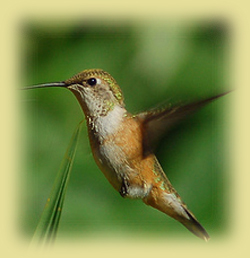
The hummingbird is a small bird with a long, thin beak. This lengthened beak is one of the significant characteristics of the hummingbird with an extendable tongue to allow the bird to feed upon nectar deep within flowers.
Hummingbirds vary in size. Most species weigh 2.5–6.5 g and are 6 –12 cm in length.
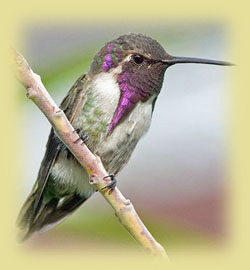
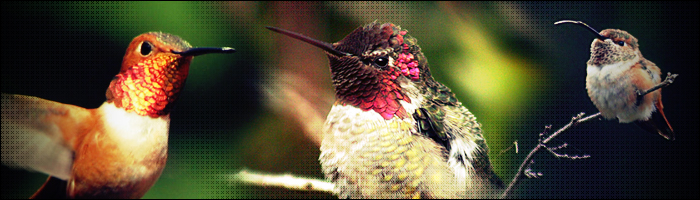
Male hummingbirds are usually more brightly colored, while females of most species display more cryptic coloration. Most males have iridescent plumage, in metallic red, orange, green and/or blue. Some have only an iridescent throat patch or cap, while others, such as the Coppery-headed Emerald are entirely iridescent.
Top
|
|
|
Metabolism
Hummingbirds have the highest metabolism of all animals in order to support the rapid beating of their wings. A great deal of energy is spent flying, so they must feed almost constantly.
They typically consume more than their own weight in food each day, and to do so they must visit hundreds of flowers daily. At any given moment, they are only hours away from starving.
Hummingbirds are capable of slowing down their metabolism at night, or any other time food is not readily available.They enter a hibernation-like state known as torpor. During torpor, the heart rate and rate of breathing are both slowed dramatically (the heart rate to roughly 50–180 beats per minute), reducing their need for food.
Top
|
Flight
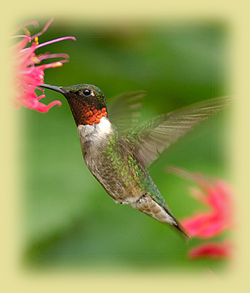
Unlike other birds, a hummingbird can rotate it's wings in a circle. Hummingbirds are the only bird that can fly both forwards and backwards. They can also fly up, down, sideways, hover in one spot, or fly upside down for short distances.
Normal flight speed is about 25 miles per hour, but they have been clocked at speeds in excess of fifty miles per hour during their courtship dives.
During normal flight their wings beat about 60-80 times per second. In their courtship dives they might beat up to 200 times per second.
Top
|
|
|
Range
Hummingbirds are found only in the Americas, from southern Alaska and Canada to Tierra del Fuego, including the Caribbean. The majority of species occur in tropical Central and South America, but several species also breed in temperate areas.
South America has the biggest variety of hummingbirds and more than half the species are found there. The country of Ecuador in northwestern South America has the largest number of any one country with 163 different species.
There are over fifty species that regularly breed in Mexico.
Sixteen different species breed in the United States, but the Ruby-throated Hummingbird is the only one that breeds east of the Mississippi River.
And four species breed in Canada.
Top
|
Feeders
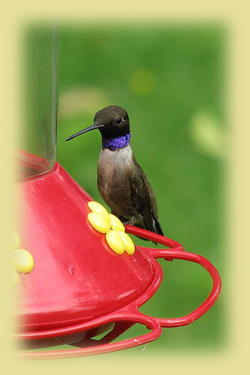
Hummingbirds will take synthetic nectar from artificial feeders. Maintaining cleanliness of the feeder is essential for the health of the birds. Hummingbirds will either hover or perch to feed, and red feeders are preferred. Such feeders allow people to observe and enjoy hummingbirds up-close while providing the hummingbirds with a reliable supply of nectar, especially when flower blossoms are less abundant.
Homemade nectar can be made from 1 part white, granulated table sugar to 4 parts water, boiled to make it easier to dissolve the sugar and to purify the solution so that it will stay fresh longer. The water should be boiled before measuring to ensure that the ratio of the sugar to water remains 1-4. The coolest nectar is then poured into the feeder. Things to avoid using in feeders include honey, which should not be used because it is prone to culture bacteria dangerous to hummingbirds.
Top
|
|
Resources
|
|
Top
|