|
|
Introduction
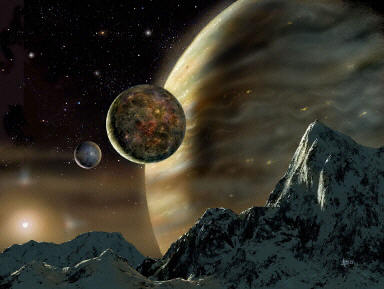
Our solar system consists of an average
star we call the Sun, the planets Mercury, Venus, Earth,
Mars, Jupiter, Saturn, Uranus, Neptune, and Pluto. It
includes: the satellites of the planets; numerous comets,
asteroids, and meteoroids; and the interplanetary medium.
The Sun is the richest source of electromagnetic energy
(mostly in the form of heat and light) in the solar
system. The Sun's nearest known stellar neighbor is a red
dwarf star called Proxima Centauri, at a distance of 4.3
light years away. The whole solar system, together with
the local stars visible on a clear night, orbits the
center of our home galaxy, a spiral disk of 200 billion
stars we call the Milky Way. The Milky Way has two small
galaxies orbiting it nearby, which are visible from the
southern hemisphere. They are called the Large Magellanic
Cloud and the Small Magellanic Cloud. The nearest large
galaxy is the Andromeda Galaxy. It is a spiral galaxy like
the Milky Way but is 4 times as massive and is 2 million
light years away. Our galaxy, one of billions of galaxies
known, is traveling through intergalactic space..
|
|
|

