URANUS AND NEPTUNE
HOME
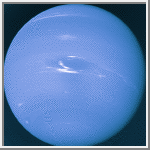
The 7th and 8th Planets are Uranus and Neptune. Uranus was discovered by William Herschel in 1781. It’s 51 120 km in diameter and is 2875 million km from the Sun. Neptune, the 8th Planet, was spotted in 1846 by Johonne Galle and Heinrich D’Arrest. It’s 49 530 km in diameter and is 4504 million km from the Sun.
Uranus and Neptune are in many ways twins. They are both four times bigger than Earth. Each is circled by dark, thin rings, and both have an atmosphere choked up with poisonous methane gas. Beneath this atmosphere lies a thick, slushy layer of ice and water.
Neptune has 8 moons with Triton being the largest. The temperature on Triton plunges to -235
° C. That’s as cold as any moon or Planet in the Solar System.
NEPTUNE
Uranus and Neptune do have some differences. If you kept going past Neptune’s layer of slush, you might come to a hot core. Astronomers believe heat from this core rises, stirs up the cloud tops and lets rip strong winds and large storms. The weather in Uranus’s atmosphere is clam in comparison. At the centre of Uranus is most probably a cold core.
Compared to other Planets, Uranus is tilted over on its side. For much of Uranus’s year, one of its two poles faces towards the Sun. One theory suggests that millions of years ago, an asteroid hit Uranus so hard that he Planet toppled over.
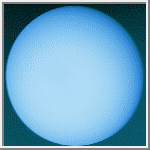
URANUS
Wow! That’s Incredible!