COMETS
HOME
Most comets stay in the deep freeze of space. Some orbit beyond Pluto in the Kuiper Belt. Others are further out, in the Oort Cloud
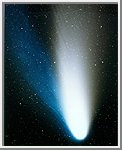
¾ a group of comets that extend towards the nearest star. Sometimes, perhaps after smashing into another comet, a comet falls out of the deep freeze and into orbit that takes it toward the Sun.In the deep freeze of space, a comet is like a filthy snowball the size of a small city. But as you get closer to the Sun it begins to vaporise. Jets of gas and dust erupt from the nucleus, its frozen core. The gas and dust flow away from the nucleus to form long, wispy tails. Most comets take thousands of years to complete one orbit of the Sun, but a few whip past the Sun every few years or decades.
Some famous comets include: Halley’s Comet, which flies past Earth every 75 or 76 years. Hyakutake, which is a comet that no one had ever seen until 1996. Its tail stretched half way across the sky. And Hale-Bopp, which is one of the brightest comets of the 20th century.
HALE BOPP
Wow! That’s Incredible!