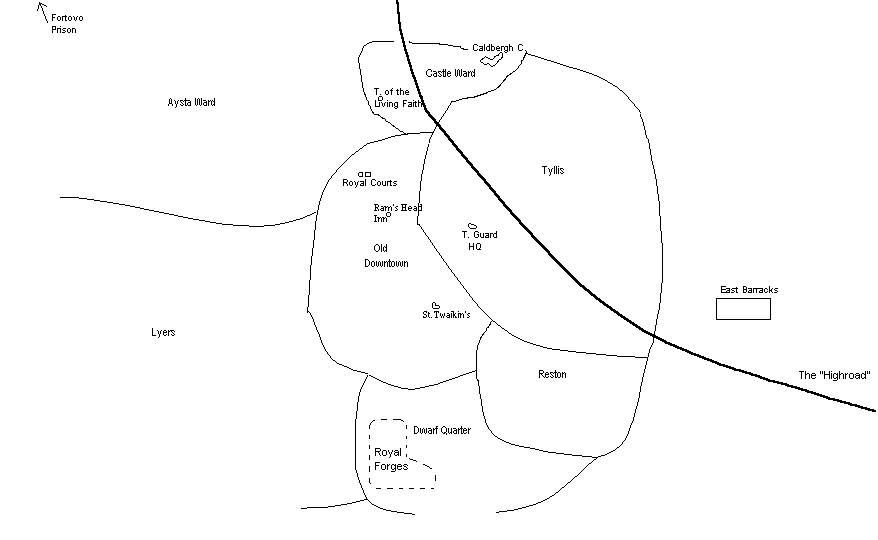
General City Features
Meria is quite a huge city, with over 80,000 inhabitants in the area. Okay, those who know something about history will know that that’s not that huge- Rome had a million and a half people in it during its heyday- but fantasy worlds tend to be weirdly underpopulated, which helps makes the heroes more important as well as be slightly easier to describe. And Florence only had 60,000 or so people in 1500; we all know the good stuff that came out of there during that time, so smaller cities can be important too.
Anyway, back to the point. It’s the largest city in the western half of the map, and does a reasonable amount of trade (even if it’s closer to Madrid than Lisbon). It’s near Riovanes Lake, but not actually a port on it, not that there’s much trade over the Lake. The Highroad, which manages most north-south trade, conveniently goes right through the town, often having many merchants & traders conveniently located to its side. It’s called that because, well, it actually is elevated in parts, and the sadistic planners of the road seemed to run it over hills and high places whenever they could. Another notable feature are the East Barracks, a truly massive series of ugly structures overseeing the road inward. Well, not quite overseeing, more like underseeing as the land slopes downward towards the barracks from the direction of the Highroad. Quite a lot of troops are garrisoned here; this is the capital, after all.
Also, whenever I say “Meria,” assume it refers to the city, not the country. I will say “the nation of Meria” if I meant that in this context.
Oh yes. There are various town guard stations at various parts of the city, just as there are temples & inns not on the map. Only a few notable ones were stuck on it. And those notable ones may not quite be to scale.
Castle Ward
You should be pretty familiar with here already. Caldbergh Castle is rather new by most castle’s standards, with construction only starting 120 years or so ago. King Eric ordered a lot of the renovations and upgrades to it during his reign, as well as expanding the town out toward the castle. As a result, there’s a reasonable number of government ministries and such here, as well as the standard service & support you’d expect to spring up around it. The Temple of the Living Faith is notable for its very modern design and seeming desire to compete with St. Twaikin’s for “memorable temple in Meria.” It attracts many nobles & high-level bureaucrats for its services- at least the ones who can’t attend the private chapel in the castle itself, of course.
Old Downtown
As the name implies, this is where the city of Meria started. As such, it rivals Tyllis for the most scizprenic section of the city; it used to be that all the poor and rich neighborhoods were in a smaller area here before expanding outwards, and not all buildings have been knocked down from previous days. So there might be a large old manor in the middle of what is now a poorer but newer section. Still, there’s something to be said for tradition, and some old families are proud to have held the same house here for the past 150 years.
The Ram’s Head Inn is notable as one of the classic places to meet and visit, and surprisingly enough, it hasn’t gone as upscale as you might think based off of selling that image. St. Twakin’s is the oldest temple in the area, built shortly after the faith of Amdan was brought to the West, and enjoys a fair amount of prestige. The justice system of Meria is also here in the royal courts, which are actually two largish buildings. The city crimes one is the new and spiffy building. The regional crimes one is the old and stately one. Mind you, obviously not every criminal is tried here, only the ones where the crime isn’t obvious, not too minor, or the accused has money but there’s still a lot of evidence. The constable is more likely to just throw you in the neighborhood lock-up for something like “public drunkenness in a good part of town.” Unusually vicious crimes (or the allegations of them?) have a tendency to have justice meted out on the spot as well. As such, the regional crimes courthouse doesn’t have that much work to do, truth be told. Rarely is it such that a crime is major enough to be worth dragging to Meria, and yet the local authorities don’t deal with it themselves. It generally occurs only for making an example of impudent nobles or criminals who travel a lot before getting caught. (Side note: The areas immediately around Meria city are considered royal territory, and that’s why this regional courthouse exists. Say, up in Narondy where the first mission was, the equivalent of a regional courthouse for the area Ulfus ruled would be “round up criminals, bring to his chateau, have him do whatever he wants with them.” The towns are small enough that this is a lot more useful than in heavily populated Meria, too, which can have more local courts.)
Tyllis
This is the cosmopolitan, international trade district of Meria. Many of the importers and merchants do business here, conveniently near the Highroad and the caravans offloading there. Lots of warehouses as well. There’s quite a mix of things going on here, and it’s also the most mixed in terms of classes- you can find nearly penniless laborers who merely do loading/unloading style jobs living right near middle-class merchants & caravan chiefs, with some rather wealthy people choosing to live here as well. Also, while there is no “Halfling Quarter” in the city- the Halflings, having lived near here for some time, are reasonably well integrated- probably the majority of Halflings in Meria live here. The same for half-elves.
Aysta Ward
Probably the most blue-collar yet still respectable neighborhood. Aysta used to be something of a sister city, but it was so close it merged with Meria. Here, you will find most of the boring industry of Meria. Things like brick making, weaving, potters, carpenters, fletchers, locksmiths… you get the idea. While hardly the flashiest part, Aysta is quite relevant and usually treated with at least a grudging respect. Also of note- while not really part of Aysta, this is the part closest to Fortovo Prison, so you generally go through here to reach it (and prison guards generally have homes here). Fortovo is where they keep the criminals who have done something serious enough to merit a lot of labor for the crown in doing mind-numbingly boring make-work tasks. Rebels and deserters often find their way here, too.
Lyers
On one hand, it’d be easy to dismiss Lyers as endless slums and the poorest part of town, but that wouldn’t be quite true. This is perhaps best seen in terms of the “border” with the Old Downtown, which of course doesn’t really exist. On the border, there is a fading and mix between the upright and the loose, most noted in the red-light districts that flourish there. It’s close enough to the main town for ease of access by “respectable” types, and yet far enough away to be discreet. The theatre districts are also in this area for the same reason, although they run mostly during the day rather than the night.
Anyway, Lyers is in fact the cheapest place to live, with tenements and ramshackle buildings quite cheap to rent or buy. As a result, most new arrivals to the city tend to live here, at least for awhile. Some industrious farmer types even maintain food gardens in the gaps and open space parts, although there is a need to be aggressive in picking them lest others “appropriate” your work. Petty crime is an issue, as a loose association of whiny gangs known as the “Rifa” maintain networks of youth ready to relieve people of their valuables should they go in too deep at the wrong time of day. What industry exists here tends to be the type that nobody wants anywhere else, like the tannery district, which stinks rather nastily. Most of the rest are brave loyalists who run necessary services like butchers and the occasional barber/nurse. And oh yes. Lyers is the source of what connection Meria has with the lake. The roads heading towards the lake most directly go through here, so fishermen who come to town often frequent this area.
Dwarf Quarter
Probably the safest place in Meria to live, especially if you’re a dwarf. This is pretty much the sole remaining above-ground concentration of dwarves in the nation of Meria, and a surprising amount manage to pack themselves into the space. The most notable & famous feature are the Royal Forges, of course, where much fine material has been made. That said, there are other careers for advancement that dwarves follow, too, so in some ways the Dwarf Quarter is a city within a city, as many services are replicated but in their own unique fashion here. Dwarves generally speak Common, but it is recommended you have your Dwarven phrase-guide handy if you’re walking about here and don’t want to be completely left in the dark. Think Little Havana in Miami.
Reston
Along with the Castle Ward, the smallest neighborhood in Meria, Reston is also the richest, even more so than the Castle Ward. Here is where you would go if you want to seek out some upscale service like a dentist or a sage to help out. Booksellers, antique dealers, jewelers, and vintners all tend to work out of here (although you can probably trade antiques in nearby Tyllis as well). Most nobles who come to live in Meria tend to try and snag a home in either the Castle District or Old Downtown, and many wealthy merchants still live in Tyllis; but those who decide against the obvious choice often opt to live in Reston. Unlike the somewhat undefined border of Aysta or Lyers where the city just keeps on going, but thinning out, Reston has a nicely defined eastern border, and makes a point of keeping a few trees around as well as a public park to showcase its wealth.
Here are some locations & people that have been ascertained to exist, as a reminder.
Aysta Ward
Montana the fletcher.
Lyers
An Herbalist.
Old Downtown
Ram’s Head Inn
St. Twaikin’s
Alfamale (inn/tavern); near Lyers.
Unnamed generic alchemist.
Tyllis
Town Guard HQ; Belphanior’s office.
Karuchie; a cosmopolitan restaurant, elvish wine and dwarven ale.
Dwarf Quarter
Lord Bafford’s House.
Castle District
Velvet Glove- snooty restaurant.
Reston
Master Kurt’s Apothecary.