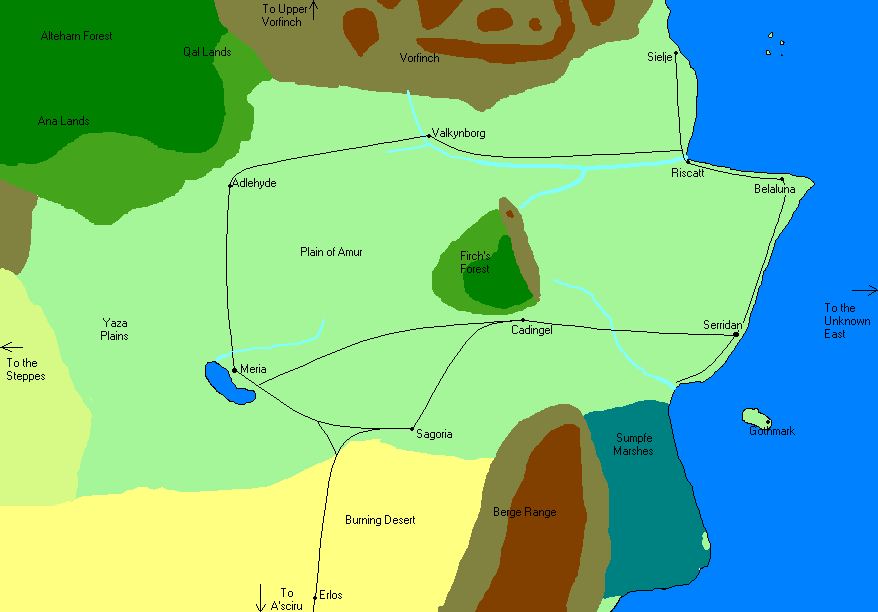
 Being that the lands of Meria are populated mostly by humans, it seems reasonable to start there. Meria was originally a rather pathetic “power;” a barely independent little duchy far off to the west where all the action was happening. 500 years ago or so, the city of Serridan was the center of a great empire that stretched along the coast, dominating trade with the exotic southern lands of A’sciru, at the time a good deal more advanced than the northeners. The lands to the west of the great mountain ranges were largely ignored, being populated mostly by barbarian herders & some remaining diehard elves. Meria was to the west of even this. Its mighty “navy” had merely a large lake to sail on, that went nowhere in particular aside from some halfling populated lands in the Yaza Plain. Still, Meria clung to civilization a bit more than its barbarian brethren, slowly expanding its power and turning plains originally used for mere herding into vast farming lands. Meanwhile, Serridan’s power waned, as inbred rulers were overthrown and replaced by murderous madmen. Eventually one of these “madmen” from Serridan- this was around 200 years ago- noticed the growing power at west, and decided he would have it for himself. He rode out west, and in a great battle on the edge of Firch’s forest, won a decisive if bloody victory over the Merians, killing their current king. Flushed with success, the King of Serridan declared himself Emperor, and rode back home expecting taxes to start flowing in.
Unfortunately for him, none of the tax-collectors sent returned alive, and the forces left to garrison the area stopped reporting in. Virtually as soon as it had been conquered, charismatic resistance leaders had sprung up over Meria, waging virulent ambushes on Imperial supply trains and isolated garrisons. Enraged, the Emperor poured about 10 year’s worth of Serridan’s money into a war to insure that the Merians were very, very annoyed with him. When the Emperor finally died (Assassinated as usual), the city of Meria was suddenly the capital of its own little nation, united from piddling little baronies by need.
Serridan had its own troubles, and exhausted from the war, many of the northern cities broke with Serridan’s empire, causing a small little civil war on its own part. By the time of 50 years ago, Serridan was merely a city, as were most of the other coastal ports- all competing with each other. Ironically enough, the situations had reversed; now Meria was unified and powerful, and Serridan was weak & split. Furthermore, Meria opened its own little trade route with A’sciru, taking the more ardrous land trip. While the contact with A’sciru was less and more expensive, it did help create a powerful independent ally of Meria in Erlos, a town in the desert that started out catering to traders, and later became a mining power of its own, after rare minerals were discovered in some nearby foothills. For flat Meria, whose main product was food, this was quite helpful. This set the stage for Meria’s most notable recent king, Eric the Wise. Eric was a minor noble who married into the kingship after the previous king had no sons and a weak-minded first daughter. He also had an edge in that his family had connections in Cadingel, an important border city renowned for its Wizard’s Academy. Backed by desert Iron & Cadingel Tower’s best archmages, Meria’s armies swooped through the East like a scythe, and even proud Serridan was brought to heel. Eric’s desire for conquest sated, he sat back and consolidated the bureaucracy, proving to be a fine ruler. He defended the north lands from an attack by an unusual breed of elves who had harassed them before, and drove them back into their underground caves. Under his rule, the dwarven nation retreated from human contact as well. The Orc tribes living in the nearby steppes to the East were virtually annihilated to a man in his campaigns against them, and the goblins retreated back into the northern caves of the Vorfinch range before any campaign could be conducted against them. He died a mere 18 years ago, at the ripe age of 76. His firstborn son Malachias had disappeared off in a seaborne expedition to the lands of the East, so his grandson Simon took the throne. Only 14 years old when he did, he has proven seemingly as decent a leader as his father.
Other notes: the elves have been involved in several terribly bloody recent civil wars. As usual, they claim that hundreds upon hundreds of years ago, there were only elves and the land was happy, then came the evil despoiling humans. Being that even old elves tend to only live 250 years or so at most, and that’s been shorter lately, it’s hard to confirm. It seems likely that humans were in this land at least 1500 years ago, but before that, who can say? In any case, there are two current Elven nations, the Qal and the Ana. The Qal are extremely patriarchal, have a strong emphasis on tradition, and are obsessed with pure bloodlines. They are ruled by a council consisting of the representatives of the “most pure” houses, who are roughly nobility. Few have the courage to speak against this council. That said, they are quite unorganized, and are spread out over the Eastern reaches of the Alteharn Forest. The Ana, on the other hand, are merely obsessed with pure bloodlines. Instead of a council, their current ruler is King Hakatri, who has been trying to organize them more, partially to insure more people join his armed forces. This was rather helpful in the last war, being that the Ana have perhaps half the population of the Qal. In any case, the Elven lands have been rather severly depopulated, thanks to punishing wars 10, 30, 70, and 130 years ago. This may not sound like much, but remember, this is an Elven timescale. The population is something like 60% female now due to losses of prime "young" elves before their time. As something of a result females are now a good bit more involved in the economy and politics, even among the normally patriarchal Qal. Also, there weren't really any clearly defined borders as such, just a lot of forest. The result was there were many raids back and forth and quite a few small towns and farms met the torch. Also, due to the difficulty in manning any kind of border patrol, spies were everywhere, and many high-ranking officials and elven magi found themselves with arrows in their head while walking to work in the city. This made things all the bloodier.
In the last war 10 years ago, King Simon sent human advisors in to watch and try and calm down the war. Eventually a peace treaty was brokered by him, and considering the might of the human empire to the South, perhaps the elves are worried enough to set aside their differences for now. Or perhaps not.
Oh yes, as a consequence of all this lineage-obsession, it is not a huge surprise that half-elves are generally persons non grata among either nation. A sign of weakness, after all. Hence, the vast majority of half-elves live in the city of Adlehyde- controlled by Meria- near the forest’s edge.
The dwarves are a rather more mysterious case. 25 years ago, the entire dwarven nation retreated into their vast underground caverns and collapsed almost all of the entrances to the surface world. The reason why is generally not known among humans, but a small enclave of dwarves- specially enticed by King Eric- still lives in Meria city. There, many work for the royal forges. There are extremely very few dwarves living anywhere else in the nation.
There are a healthy number of Halflings in Meria- most live in settlements & villages on the Yaza Plain, to the west of Meria city. These tend to be the settled-in type; think Tolkien’s hobbits. There are some halflings who venture into the big city and travel, and for whatever odd reasons, these seem to be quite unorthodox sorts, not following the slow, respectable ways to wealth. Instead, they... experiment with other methods of living. There is a long and storied alliance between the halflings and Meria in any case- several detachments of halfling slingers have distinguished themselves in war on Meria’s behalf.
Gnomes are extremely rare in Meria, being more common to the south. Still, a very few occasionally travel up to Serridan, bringing their odd devices with them.
Half-Orcs are probably killed on sight, if their lineage is obvious. The Orcs did not make themselves very fondly remembered back when they were a power to be reckoned with in Meria’s earlier days.