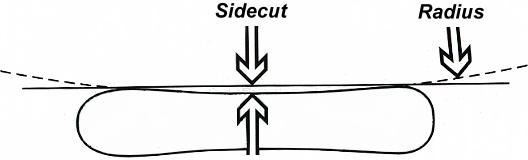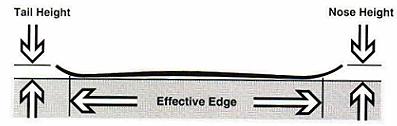
A snowboard has a measureable amount of camber or bow throughout the center. This camber is responsible for giving the board "pop" or liveliness and aids in the transitioning between turns. When a snowboard's camber is greatly diminished or gone, it is time to get a new one. Measured in millimeters, camber generally gets higher as a board gets longer. This is because of the simple fact that a longer object is easier to bend than a shorter object, and to accomodate for the extra weight of a heavier rider on the longer board. The life of the camber will depend on the construction of the board, the rider's weight, and the rider's level of aggressiveness.
Flex:
1) Longitudinal: This refers to the flex from the tip of the snowboard to the tail and can be gauged by holding the tip with one hand and applying pressure to the top of the board with the other. A stiffer longitudinal flex is good for freeriding due to it's ability to power through crud and provide stability at higher speeds. However, the stiffer the flex, especially the nose, the harder it is to maneuver and freestyle on. Most freestylers prefer a softer flexing board because they do not need the extra speed and like a more forgiving board that can turn quickly. The main disadvantage of having a soft flex is that the board will be less stable at higher speeds, especially when on ice.
2) Torsional: This refers to the flex from edge to edge of the snowboard and, while difficult to measure, can be gauged by placing the bottom portion of the board sideways between your feet and knees, and using your hands on both edges to twist the board against it's natural flatness. A stiffer torsional flex will hold a better edge, but is less forgiving in terms of feeling vibrations when going over bumps. A softer flex offers a smoother ride, but is not as stable on ice.
Shapes:
1) Directional: A purely directional board serves best for freeriding. It will have a softer nose for easier initiation into turns and a stiffer tail to snap you out of turns, allowing no loss of speed when entering the transition between turns. The longer nose will be slightly wider than the tail. Also, the hole pattern will be offset back on the board to, along with the wider nose, increase the ease of turn initiation and offer better flotation in powder. This is a stable shape, but not one for a rider who rides backwards or fakie a lot.



1) Regular: A regular sidecut is basically uniform throughtout. The deeper the sidecut of a board is, the shorter the distance it will take turn when on edge. A deeper sidecut will turn more quickly and is better for freestyling, but can be less stable at higher speeds. While more stable at higher speeds for freeridng, a shallow sidecut will not turn in as short of a distance when compared to a deeper sidecut.
2) Progressive: A progressive sidecut utilizes two separate radii, a large one in the front of the board and asmaller in the rear. This design helps to pull you through turns better, but is not the best for riding fakie.