1) Extruded: This is the cheapest, slowest, and softest of the three base types. An extruded base absorbs wax decently and retains it better than the other types, thus making it a good choice for riders who do not regularly maintain their bases. Although not hard to repair, it is the most easily damaged due to it's softness. To make this high density base, polyethylene pellets are fed into a heated extruder, where they melt and are pumped out of a die to form the base.
2) Sintered: The lighter, higher end sintered base is faster and harder, meaning it takes more to damage it. However, because it is harder, it is not as easy to repair as an extruded base. A sintered base can absorb up to five times more wax than an extruded base due to the amorphous areas in the material. The base is formed by heat pressing powdered polyethylene particles together. The particles harden where they join together, leaving microscopic void spaces between that add to the base's ability to absorb wax..
3) Electra: This is the most expensive of the bases, implementing graphite into the base. A faster ride is achieved because the graphite is conductive, thus dissipating static charges between the base and snow. It is produced by pre-compounding polyethylene with a small amount of graphite, which is then heat sintered. While not necessary, a graphite wax works best for maintaining an electra base. Other additives such as metals can also be found in some bases to help counter speed robbing static build up between the base and snow. Also, each type of base may be followed by a number(i.e. a sintered 2000 base). This number refers to the molecular weight of the polyethylene. The higher the number means the higher the molecular weight, which indicates a better and more durable base.
Cores:
1) Foam Composite: The use of foam in a core offers lighter weight and the ability to fine tune the characteristics of the core. Often the core is injection molded with the aid of computers, allowing the cell size to be changed and each core to have the same flex patterns. However, most feel that foam core boards tend to lose their camber faster. This of course will vary between companies depending on the level of quality put into the production of their cores.
2) Wood: This is the preferred type of core by most quality companies. It tends to offer good vibration dampening and retains it's camber well. It should be noted that some higher end companies use a combination of both wood and a quality foam in their core production in order to take advantage of each materials strengths.
3) Aluminum Honeycomb: A honeycomb core incorporates aluminum into it's structure. The major advantage of a honeycomb core is that it is extremely light in weight. Disadvantages include a higher price tag and slightly lower dampening abilities.
Edges:
1) Full Wrap: Virtually all manufacturers use Rockwell steel edges on their snowboards. A full wrap edge goes all the way around a board, stopping where it meets itself. This offers the greatest protection for the board, but can be hard to repair if heavily damaged. Although practically undetectable, the full wrap edge does make the board ever so slightly heavier.
2) Tucked: This form of construction stops the steel edges before going around the tip and tail. This concept focuses on the fact that metal causes the tip and tail to be heavier, thus making it harder to spin in the air. Of course the weight of the snowboard will be decreased because of this, but the difference is so small that it is unnoticeable. While much more easily damaged, the tip and tail are easier to fix. If one wishes, the shape of the tip and tail can also be customized with the use of a grinder.
Sidewall Constructions:
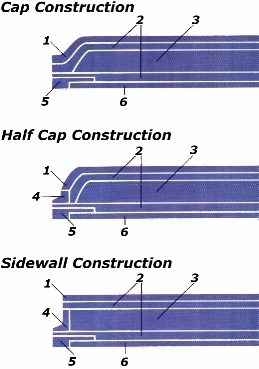
1) True Cap: While difficult to distinguish between when riding, there are advantages to each of the different types of constructions. However, such advanatges can be offset by the rest of the board's construction. A true cap is easily distinguished by the topsheet graphics continuing down to the edges on the sides of the board. This construction serves well for freestyling because it is light, offers a more responsive ride and has increased snappiness for ollieing. The disadvantage of a true cap is that it does not hold it's edge as well when in deep carves.
2) Half Cap: The half cap is a combination of the true cap and sidewall types of constructions. It's goal is to offer the best of both worlds and is usually only found on high end snowboards.
3) Sidewall: A sidewall board's graphics stop where the topsheet meets the sides of the board, giving way to noticeable separate walls that continue to the edges. This technique serves well for freeriding in that it tends to provide greater pressure to the edges and will not wash out as easily in deeper turns. Also, sidewall repair on this type of construction tends to come out looking slightly better than with the cap style. However, sidewall boards are more prone to chipping along the edges of the topsheet. This may lead to water seeping in and eventually delamination if not addressed.
1 - Topsheet
2 - Fiberglass
3 - Core
4 - Sidewall
5 - Edge
6 - Base