Home � Board Construction � Board Sizing & Shape � Bindings � Tuning & Waxing � |
Already know what your looking for? Jump to one of the sections bellow.
Width � Length � Shape � Sidecut �
|
|
|
Unlike width, ideal length is a gray area. For years, freestyle riders (riders that spend much of their time in a snowboard park) rode shorter boards mainly because the boards had a lower swing weight for technical tricks. This has changed slightly over time with the advent of lightweight core materials. Many professional riders now prescribe to more of a "landing gear" theory: a longer board makes sticking big airs easier. Regardless of personal preference, longer boards are more stable and float better in powder, while shorter boards are more maneuverable and make spinning easier. Snowboards are commonly sized off the height of the rider. There is however a better way to size a board. Rider weight is more important when sizing a board that the rider height. For example, if you have two people of equal height, yet one person weighs more, say 50 to 60 lbs., the rider that weighs more is obviously going to be able to put more force into his/her board. Boards are often sized off height only because much of the time height and weight correlate fairly closely. A board can be sized more appropriately off weight. The chart bellow is a good starting point to correctly select the right size snowboard to ride. |
| Rider Weight (lbs.) | 120 lbs. or less | 120 lbs.-150 lbs. | 150 lbs.-210 lbs. | 210 lbs or more |
|---|---|---|---|---|
| Board Length (cm) | 145 cm or shorter | 145 cm-155 cm | 155 cm-170 cm | 165 cm or longer |
|
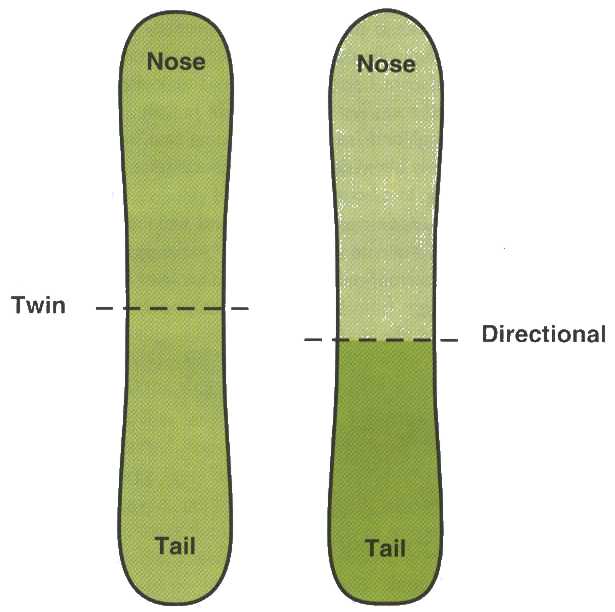
There are three predominant snowboard shapes
|
|
DirectionalDirectional boards are best suited to all-terrain cruising, high speed and powder riding. On a directional board, the nose is longer than the tail with the stance set back for better powder floatation without leg burn. Also, the tail may be stiffer than the nose, allowing the rider to track smoothly over uneven terrain, and power turn off the tail. TwinTwin boards are exactly what the name states: the tail and nose are the same shape and length, the stance is centered and the nose and tail flex patterns are identical. This shape excels in parks and pipes where riders spend equal time riding forward and backward and powder days are few and far between. Directional TwinThe directional twin marries characteristics of both the twin and directional boards with the shape of a twin and the flex pattern of a directional board. The twin shape remains ideal for forward and fakie freestyle riding, while the stiffer tail enhances a board's carvability and ollie snap. |
Progressive sidecuts have been gaining popularity in recent years. These are dual radius boards That generally start turning slowly and really pull hard through the end of turns, allowing for hard carves and quicker edge-to-edge power transfer. The drawback comes when attempting to ride fakie, where the board wants to pull you through the turns. |
Now that you have a good idea what you might be looking for in a board, why not check out the rest of the site?
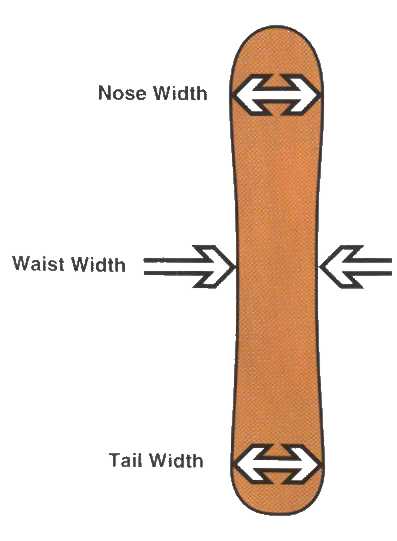 Width is one of the most critical and overlooked factors when buying a new board. If a board is too wide, edge-to-edge responsiveness suffers, making turning more difficult. Worse, if a board is too narrow, your toes and heels drag, causing spontaneous loss of control and wipeouts. The correct width should place your toes and heels directly over the edges, giving the board ideal toe-to-heel responsiveness. The chart to the left can be used as a quick reference as to the right width board for you.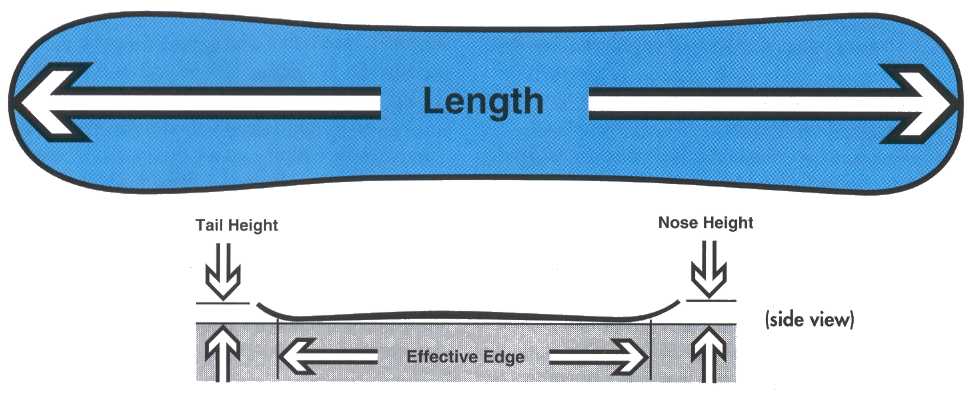
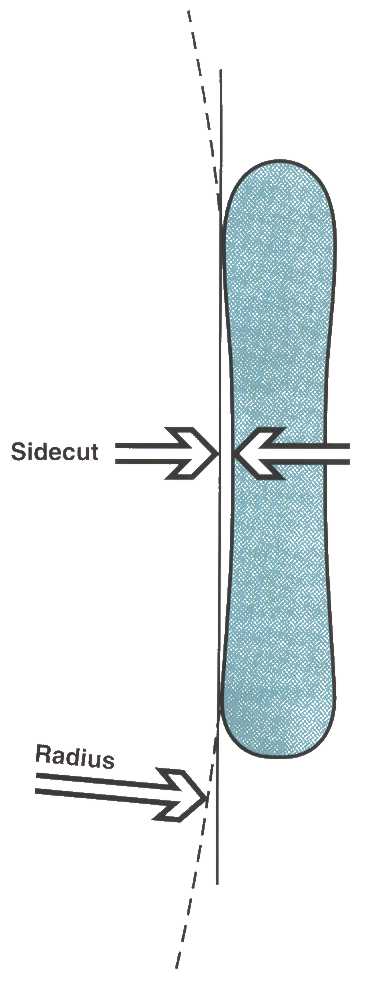 While any board can be forced to make quick slalom turns or long, sweeping carves, sidecut determines how fast or slow a board wants to turn. Riders looking for a quick turning board, or those looking to ride trees or moguls should look for a board with a sidecut radius of 8 meters or less. Riders that like to take a straighter "fall-line" approach at higher speeds mike want to take a look at boards that have a longer turning radius, in the neighborhood of 9 to 11 meters.