
Opium Poppy Stratification
by Roy Reynolds
Abstract
Plant seeds contain chemical inhibiters that must be broken down before the seed will germinate. We, the Greenhouse Perennial Class of fall 2003 at the Ohio State ATI, did an experiment that started September 30th to determine how the length of cold stratification effected the germination of the Opium Poppy, Papaver somniferum L. From our results the longer Opium Poppy seeds are stratified the faster, more uniform, and higher the germination rate is.
Introduction
Plant seeds contain chemical inhibiters that must be broken down before the seed will germinate. The process of breaking down these chemical inhibiters is called stratification. We propose that the longer seeds undergo stratification the higher the germination percent will be.
Review of Literature
Opium poppy, Papaver somniferum L., is an annual or biennial herb that has been cultivated, for the alkaloids it produces, for thousands of years. It is native to the Mediterranean region east to Iran, but now due to its cultivation, it is grown in many tropical, subtropical, and warm regions of the world. (Papaver somniferum.)
The seeds will germinate in 10-21 days with soil temperature between 60-65 degrees F. “What works if it's warm is to plant them in peat pellets as usual and then put them in the refrigerator for a week. They will not germinate in there, but when you take them out, they will germinate in masses.” (Papaver somniferum Seeds.)
Most seeds develop a dormancy that prevents germination until certain environmental conditions are met. This is a protection mechanism that prevents seeds from germinating when the conditions are not favorable for growth. (Hartman and Kestler’s Plant Propagation: Principles and Practices.)
There are different stratification treatments necessary for seeds to overcome dormancy. Some plants require a cold stratification. In this case the plant may only germinate if dormancy is overcome with exposure to a prolonged cold period delaying germination until after it has warmed up enough. Several seeds will only germinate if exposed to cold, wet conditions. Still others require warm, wet stratification. (What Does a Seed Need?: Seed Stratification Experiments.)
Materials and Methods
Materials
Method
September 30, 2003
October 14, 2003
October 28, 2003
November 10, 2003
From October 7th till November 25th the germination percent for the Tuesday of each week was recorded.
Results
In the experiment it appears that the longer the poppy seeds are stratified the faster they germinate and the higher the germination rate is. (Table 1 and Figure 1 through Figure 4)
I don’t know what happened but the seeds that were stratified for 4 weeks do not show the correlation between the number of weeks stratified, and the germination percent that the others do.
Table 1
|
Germination Percent per Week per Number of Weeks Stratified |
|||||||||
|
Weeks Stratified |
Germination Percent |
||||||||
|
Week on Germination bench |
|||||||||
|
1 |
2 |
3 |
4 |
5 |
6 |
7 |
8 |
9 |
|
|
0 |
15% |
20% |
22% |
25% |
31% |
31% |
31% |
31% |
31% |
|
2 |
25% |
33% |
40% |
41% |
42% |
43% |
44% |
|
|
|
4 |
25% |
30% |
33% |
34% |
35% |
|
|
|
|
|
6 |
0% |
95% |
97% |
|
|
|
|
|
|
Figure 1
Figure 2
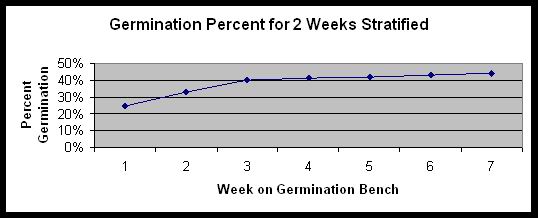
Figure 3

Figure 4
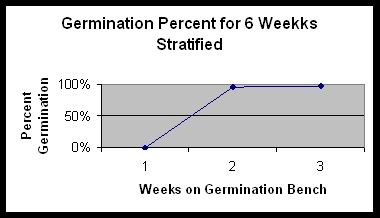
Conclusion
The experiment we did could have a major impact for growers of opium poppy. From our experiment, they can determine if it is cost feasible for them to cold stratify their seeds to get a higher more uniform germination in a shorter period of time or to plant more seeds to get the same number of germinated plants in a longer time period.
Works Cited
Hartmen, Hudson t., et al. Hartman and Kestler’s Plant Propagation: Principles and
Practices. Upper Saddle River, New Jersey: Pearson Education, Inc., 2002
Papaver somniferum. Accessed 22 November 2003. <http://www.poppiesinternational.com/papaver_somniferum/papaver_somniferum.html>
Papaver somniferum Seeds. Accessed 22 November 2003.
<http://www.poppiesinternational.com/papaver_somniferum_seeds/papaver_somniferum_seeds.html>
Propagating Wild Flowers from Seed. Accessed 22 November 2003. <http://www.lcncgarden.org/seedprop.htm>
What Does a Seed Need?: Seed Stratification Experiments. Accessed 22 November 2003. <http://wiscinfo.doit.wisc.edu/arboretum/earthpartprog/selectresources/whatdoesaseedneed.htm>