Common name: name
Historic name: Abraham Curry House
General Location: North of the northwest corner of Nevada and Telegraph Streets, Downtown Carson City, Nevada
Address: 406 North Nevada Street
Assessor's PN: 003-226-03
Current use: Offices
Original use: Residence
Year of construction: 1871
Architect: Unknown
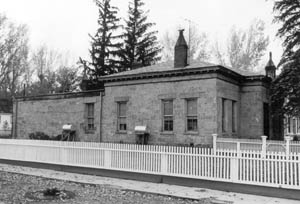
Italianate in design origins, the substantial one-story Curry House was built of stone quarried at the Nevada State Prison and laid in coursed ashlar bond. The building is an irregular L-shape with its extension at the rear and a projecting front entry porch. The roof is hipped and pierced by four chimneys. Detailing includes double-hung windows with four-over-four-lights, stone lintels and sills, brackets at the eaves, a frieze banding encircling the house, and a recessed entrance with transom, side lights, and engaged columns in wood. A narrow concrete terrace extending the width of the building stands at the entrance, but the door set is in stone.
The house originally had an octagonal cupola centered on the ridge of the roof that served as a skylight for the dining room and a front porch with five bays, both of which were removed about 1926. The rear wing was built as a school room for a private school run by Maryette Curry and later had served as a apartments.
A small, one-story shiplap surfaced outbuilding stands at the rear.
Larger in scale and massing than its neighbors, the building is also unusual for the area in its design and extensive use of stone. It contributes importantly to the neighborhood, however, in terms of height and historic image.
The structure was built in 1871 by local businessman Abe Curry, who may have also been its designer. Curry was a prominent Carson City pioneet, having built the Warm Springs Hotel, which, housed the first legislature, and served as the warden of the State Prison, superintendent of the U.S. Mint, and as construction supervisor of both the Mint and and the Virginia and Truckee railroad shops.
The architectural significance of the structure lies in the uniqueness of this this style and form within the city; its impressive stone presence and the fine execution of its design.
Its siting, with its large corner lot adds importance to the building. While the city contains other structures built of ashlar masonry from this general era, this building is the only representative of its style. It is an early example of the Italianate influence and is well-composed and proportioned in its design.
The structure was built of stone quarried at the Nevada State Prison of which Curry served as warden.
Sources: Carson City Historic Tour; Historic American Building Survey, 1974.
Listed in the National Historic Register: 1987 March 30.
City Landmark: Kit Carson Trail, Plaque No. 21.
Year of construction: 1871 (factual), on the original site.
Subdivision: Proctor and Green.
Architect: Unknown.
Text: Carson City Historic Resources Inventory, 1980.