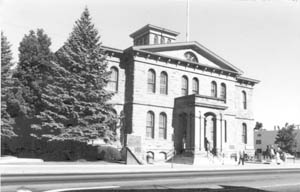
Common name: Nevada State Museum
Historic name: U.S. Mint building
General Location: Northwest corner of Carson and Robinson Streets, Downtown Carson City, Nevada
Address: 600 North Carson Street
Assessor's PN: 003-283-06
Current use: Museum
Original use: U.S. Government building
Year of construction: 1866-69
Architect: Alfred B. Mullett, supervising architect, U.S. Treasury
Builder: Abraham Curry, construction supervisor
Picture above: 1988
The two-and-half story, cruciform-plan structure is symmetrical and stylistically follows Classical design traditions, with some Italianate Villa influences. The roof is formed by the intersection of a shallow hip and gables and a small square cupola projects above it. The exterior material of the structure is rock-faced, random coursed ashlar sandstone, which was quarried at the Nevada State Prison. Pedimented central pavilions project from the east and west elevations. The one on the east facade contains a centered one-story single bay porch of dressed stone with a flat roof and deep cornice supported by L-shaped piers containing coupled pilasters. The gabled facade is pierced by arched windows and a fanlight in the pediment, which in turn, is supported by a series of brackets that encircle the structure in a frieze beneath the eaves. Projecting belt courses encircle the building at first and second floor levels and below the eaves. Windows are alike, arched, double hung with eight lights over six, and evenly spaced around the building on both first and second floors. The cupola contains similar windows, a shallow hipped roof, and a dentil course at the eaves.
Two wings adjoins the museum at the rear. The oldest of these rear building is the Judge Clark J. Guild Hall built in 1959 to the southwest of the building. Constructed of concrete, the two-story building has few windows and is essentially a rectangular box. It shares a rear wall with the museum. in 1971 the rear wing, which was added in 1878-81, was demolished and replaced with the John W. Calhoun annex. Designed by Hewitt Wells, the structure contains design elements reflective of the museum but differently scaled. Eight two-story tall arched windows are larger versions of those in the museum and the coping was made of stone from the demolished building, as was the wall around the parking lot.
In 1878 the building has been altered by the addition of an annex, which was enlarged in 1881. The Mint was remodeled for museum use in 1941, the primary work being renovation and repair. The Clark Guild hall was added in 1959 and the Calhoun annex replaced the demolished old annex in 1971. Metal handrailings have been added to the stairs, the basement windows closed, and the entrance doors and vestibule changed. Several chimneys, part of the original building, have been removed.
The structure is large and massively scaled in comparison to adjacent structures. It also differs in material and style, it being a rare example of this mode in Carson City.
Built between 1866 and 1869 to serve as a U.S. Mint, the structure was the first building designed by Alfred B. Mullett after his appointment as supervising architect to the U.S. Treasury department in 1866. His term in office was noted for its quality of work, and his designs are nationally important. Abraham Curry served as the Superintendent of Construction, later becoming Superintendent of the Mint itself.
The building is a fine example if its style, well designed and solidly constructed. Well founded in the Greek and Classical (Roman) design traditions, and later an exponent of Second Empire modes as well, architect Mullett employs some Italianate Villa design characteristics in the design. The porch is the only rather unrelated element in the overall design, and it seems appended to an otherwise cohesive statement. The structure is highly significant architecturally as well as historically, with some national importance as well as state and local significance.
Mullett, a nationally important architect is most famous for his Classical Revival design of the San Francisco Mint and his Second French Empire design of the State, War and Navy building in Washington, D.C. In 1890 he took his life because of his difficulties in being paid from the government for his work on the State, War and Navy building.
Source: American Building Survey, 1974.
Listed in the National Historic Register: 1975 Sep 05.
City Landmark: Kit Carson Trail, Plaque No. 7.
Year of construction: 1866-69 (factual): HABS, 1974, on original site.
Architect: Alfred B. Mullett, supervising architect, U.S. Treasury.
Text: Carson City Historic Resources Inventory, 1980 & 1988.