Common name: Roberts House
Historic name: Foreman House / J.D. Roberts House
General Location: Northeast corner of Carson and Rice Streets
Address: 1207 North Carson Street
Assessor's PN: 002-151-01
Current use: Parks & Recreation Department building
Original use: Residence
Year of construction: 1859
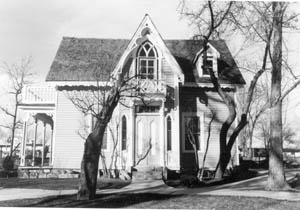
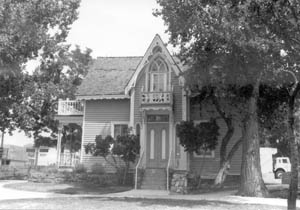
Pictures above: 1980 and 1988
The wood frame Gothic Revival structure is one-and-a-half stories in height. The roof is gabled, intersected by the gable of the southern entry bay, and the foundation is stone. The exterior is clapboard, and a porch with balcony extends the width of the western facade. Double columns with foliated brackets support the porch and a balustrade with slender turned posts. Barge-board of a cut an pierced half circle design decorates the gable. The southern entrance bay contains a double door with transom and pointed Gothic arched paneling. The second floor balcony is ornamented by a balustrade with an unusual cut design, and barge-board of Gothic pattern ornaments the steeply pitched gable. Windows in the projecting south bay utilize a variety of pointed arches and pane patterns. One window with a pointed arch is centered in the western facade. The remaining windows of the building are double hung with two lights over two. Patterned trim decorates the eaves. Framing stones for the south entry steps are carved with a Gothic design.
Concrete steps and a walk at the west have been added and the door is later. The original kitchen and bath in a lean-to at the rear have been removed and a small dormer facing south is a later addition.
The structure is a relatively isolated residential building on a highly commercial street. The building does relate somewhat to nearby residential structures on Rice Street in terms of scale, material and 19th century era construction.
The structure is the finest residential example of the Gothic Revival Style in Carson City. It is an outstanding structure in terms of design quality and execution. The small urban park for which it is a focal point is visually a most appropriate setting, enhanced by a picket fence and mature trees. Its placement on Carson Street detracts from its residential quality and scale, however, and traffic volume limits its appreciation by the public.
The structure was built in Washoe City in 1859 and moved to its present location in 1873. The last resident was Thurman Roberts, a miner and Carson-Colorado railroad worker. Hattie Nale, his wife, was a direct descendant of Revolutionary War hero, Nathan Hale.
Sources: Carson City Historic Tour; Carson City Historic Cookbook; Noreen Humphreys.
Listed in the National Historic Register: 1978 Jan 03.
City Landmark: Kit Carson Trail, Plaque No. 59.
Year of construction: 1859 (factual: C.C. Historic Cook Book); originally built in Washoe City and moved to its present location in 1873.
Architect: Unknown
Text: Carson City Historic Resources Inventory, 1980 & 1988.