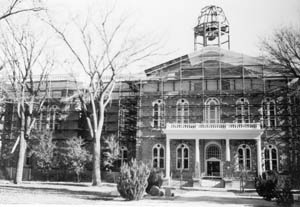
Common name: Nevada State Capitol
Historic name: Nevada State Capitol
General Location: Southeast corner of Carson and Musser Streets, Downtown Carson City, Nevada
Address: 101 North Carson Street
Assessor's PN: 004-203-01
Current use: Executive offices, museum and art gallery
Original use: State Capitol Building, Assembly and Senate Chambers
Year of construction: 1870-1871
Architect: Joseph Gosling of San Francisco
Builder: Cavanaugh
The Nevada State Capitol building is two stories in height and constructed of rock-faced coursed ashlar. The stone foundation is more roughly textured than the stone used in the rest of the building. The Classical Revival structure also incorporates design elements of Renaissance Revival and Italianate into its composition. Essentially identical two-story pedimented, gable-roofed bays project from the east and west elevations of the structure, that on the east being obscured by its connecting link to the annex. The western facade contains the arched recessed entrance flanked by four arched windows beneath five large arched windows of the second floor. A one-story porch [portico], three bays in length, is centered on the facade and fluted columns support it and its balustrade of turned posts. There are alternating quoins at the building corners, a theme echoed in the arched windows and door surrounds with rusticated architrave trim. Brackets, resembling large scaled dentils surround the building at the eaves and line the pediments. A balcony with turned posts encircles the structure. The large arched windows combine two smaller arched, double-hung windows with a circular window at the apex. A cupola on an octagonal base surmounts the building.
A two-story annex stands at the rear of the Capitol, constructed in 1904-1905. The octagonal building contains many design elements of the main structure, including three cupolas, and is connected to the Capitol by a second-story skyway link. In 1913, the north and south portions of the structure were extended. A new three-story building of contemporary design, built in 1970, stands on the northeast. The structure is not particularly sympathetic to the Capitol design. Recent alterations include those occurring as a result of the building's 1980s restoration. Essentially all major decorative elements, previously fabricated in wood, have been replaced with fiberglass, including cupola covering, porch elements, window and door framing, pediment cornices and roof balustrade.
In 1875, an iron fence was built by Hannah Clapp, an important early Carson City educator.
The structure is larger than buildings in the residential area to the east but compatible in size and scale to other State buildings on Carson Street. The building is sited in the Plaza, the center of large park-like grounds.
Constructed between 1870 and 1871, the structure was designed by San Francisco architect Joseph Gosling. Even with the stone provided free from the State Prison quarry, costs from the project reached about $170,000.
As completed in 1871, the building was cruciform. The additional north and south extensions were made when it was determined the legislature required more space. The octagonal annex is perhaps the only one in Nevada, and was originally used to house the State library.
Architecturally, the structure is an excellent representative of its style. Its symmetrical formality creates an aura of dignity and restraint befitting a building of its use. The ornamentation of the structure is particularly rich and contributes significantly to the architectural quality and fabric of the city. The setting on the expansive grounds enhances its design and adds to the impressiveness of its image. The Capitol constitutes a pivotal component of the Capitol Complex grouping of State buildings, and it serves as the focal point for early city planning gestures that it highlights.
Source: Historic American Building Survey, 1974; Noreen Humphreys.
Listed in the National Historic Register: 1975 June 06.
City Landmark: Kit Carson Trail, Plaque No. 1.
Year of construction: 1870-1871 (factual), original portion, on the original site.
Subdivision: Proctor & Green, Blocks 6 & 7; plus Sears-Thompson-Sears, Blocks 4 & 5 (for the portions south of the King Street alignment).
Architect: Joseph Gosling of San Francisco
Builder: Cavanaugh
Text: Carson City Historic Resources Inventory, 1980.