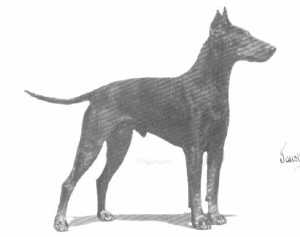
 Ch.
Canyon Crest Cinder
Ch.
Canyon Crest Cinder
The black and tan coat color was never accidental or a matter of fashion. Terriers needed to be easily distinguishable from their quarry during a hunt. White or black was favored as these dogs were never mistaken for foxes or other vermin. Interbreeding between varieties was common as written records were not as important as the job the dog was able to do. It was not until the advent of dog shows and the founding of the Kennel Club that written records and stud books became important. With this came the distinctions between breeds or varieties and the birth of the purebred.
The terrier was always the working man's dog. He traveled with his owners from the country to the new industrial cities, he was a pet, companion and yet a good vermin killer and a hunter. Ratting competitions became the rage. One of the most avid participants of the day was a gentleman named John Hulme of Manchester. His breeding program incorporated Whippet or Italian Greyhound, to give speed and added vision to the terriers of the day. Thus the Manchester was born.
The Manchester excelled in the sport of rat killing, but this was banned around the end of the 19th century. This breed was well-established by this time and was high in demand in all classes. It was described, in 1864 by J A Walsh, as being..."Smooth haired with long tapering nose, narrow flat skull, eyes small and bright, chest rather deep than wide. The only true color is black and tan...." At the height of the Manchester's popularity, the practise of ear cropping was banned and then outlawed in 1898. The effect on the breed was devasting. The old ear was thick and heavy and when uncropped it hung pendulously and spoiled the alert expression of the dog. Their unpredictable temperments and thin hair coat led to public disinterest in the breed.
Numbers continued to dwindle and by 1945 only 11 purebred dogs remained in England, of these only 5 were of breeding age and fertile. Dogs were imported from the United States and inbreedings with the Black and Tan (Miniature) were allowed until 1960, when the miniature became the English Toy Terrier. In the United States, the AKC recognised the Manchester Terrier as a single breed with 2 varieties, Toy and Standard, with no breeding restrictions between them. By 1955, numbers had recovered in England to the point that breed-Challenge Certificates were again being offered.
The Manchester is credited with influencing the development of a number of other breeds, mainly the Dachshund, Miniature Pinscher and Doberman. The unregistered Louisiana Squirrel Dog is agreed to be a descendant of our Black and Tans as well, as is the recent Russian breed, the Moscow Terrier.
The Manchester is still not a popular breed. There are about 500 registered in the United States. The Manchester of today is still known for his keen hunting and ratting ability. He is highly intelligent, curious and energetic. He loves to learn, is very responsive to praise and food treats but has the typical terrier personality and a mind of his own. He is an excellent candidate for agility, flyball and terrier sports, but may not be the perfect obedience dog due to his independent nature. As a whole, they are a dominant personality breed, so you must establish his place in the household right from the start. He is a terrific watch dog and will bark at things that catch his interest, although he is not a yappy dog. They love children and will play endlessly with them, but are not always the best choice for a household with very small children as they will chase anything that moves quickly. They need lots of time and attention and do well even in an apartment but need frequent exercise due to their high energy level. This doesn't mean they need 12 walks per day, but a good walk and a couple of sessions of fetch is sufficient. This also does not mean they aren't willing to be a couch potato with you, they love to snuggle and are happiest right up next to their person on the couch or under the covers on the bed. Grooming needs are minimal, nails and ears and an occasional bath are sufficient. They need a very secure yard or to be leashed at all times due to their high prey drive. A chain link fence may not be enough as they can climb up to 6 feet and jump 4 times their body height. This breed is still an excellent all around dog, he is an ideal house dog, a good protector, his temperment is excellent with his family and friends, although a bit stand-offish with strangers.
For more information on this breed, please contact The
American Manchester Terrier Club. They can provide you with more information
on this wonderful breed and referrals to reputable breeders.