Citations
WorldYouthDay.org
Pope John Paul II
"Rise, Let Us Be Going!"
Pope John Paul II,
Warner Books; (September 28, 2004)
The Holy See
If you have questions or comments,
Email Me
|
|
Pope John Paul II
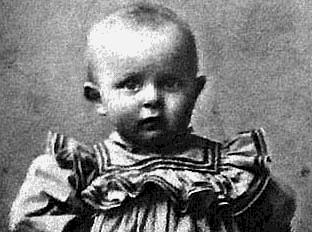 On October 16, 1978, Karol Josef Wojtyla became Pope John Paul II. Karol was born on May 18,
1920 in Poland, in the city of Wadowice. As a young man, he played soccer, and excelled in his
studies. Later in his life, Karol became a professional actor. During World War II, he
participated in the UNIA, an underground organization which has been found to have helped
Jews escape the Nazis.
On October 16, 1978, Karol Josef Wojtyla became Pope John Paul II. Karol was born on May 18,
1920 in Poland, in the city of Wadowice. As a young man, he played soccer, and excelled in his
studies. Later in his life, Karol became a professional actor. During World War II, he
participated in the UNIA, an underground organization which has been found to have helped
Jews escape the Nazis.
While in recovery after an accident, he considered becoming a priest, and by 1942 had entered
the seminary. He was ordained on November 1, 1946. In 1958 he was named bishop of Krakow.
In 1967 he was made a cardinal by Pope Paul VI.
On October 16, 1978, after the sudden death of Pope John Paul I, Karol was elected Pope of
the Catholic Church.
As the Pope...
He has named the more saints in his 25 years as Pope than all other Popes combined. This
includes the recent beatification of Mother Theresa of Calcutta. In 1984 he initiated
World Youth Day. In 2003 he added the
Glorious Mysteries
to the Mysteries prayed during the Rosary.
As pope, John Paul II has continued to implement the decisions of Vatican II and has placed special emphasis on Marian devotion. He has traveled widely, increasing the international character of the papacy. In the first decade alone of his pontificate he visited 50 countries, despite the physical setback caused by his being shot in St. Peter's Square on May 13, 1981, by a Turkish terrorist. John Paul has continued to travel widely despite his increasing age and frailty, and by 2003 had visited more than 125 nations, having made 100 trips abroad. In 1998 he visited Cuba; in 1999 he visited Romania and Georgia, becoming the first pope to visit predominantly Orthodox countries; in 2000 he visited the Holy Land; in 2001 he retraced St. Paul's missionary journeys in Greece, Syria, and Malta and visited Ukraine; and in 2002 he visited Azerbaijan, Bulgaria, Canada, Guatemala, and Mexico. He also has expanded international representation in the College of Cardinals and Roman Curia.
John Paul has pursued ecumenism (primarily with the Anglican Communion and Orthodox churches) and has taken various steps to improve relations with Jews, including Vatican recognition of Israel and acknowledgment of Catholic failures in responding to the Holocaust. Conservative on doctrine and issues relating to women, he also has been strongly critical of liberation theology and of those who call themselves Catholics yet continually question the church's teachings. In a 1995 encyclical he reasserted the church's condemnation of abortion, euthanasia, and capital punishment. However, he also considers it the church's responsibility to grapple with social questions and has been an outspoken commentator on world events. John Paul has issued two encyclicals (1981, 1991) on economic issues in which he praised free-market economies but criticized the inadequacies and injustices of both capitalism and Communism. He expressed his opposition to the imposition (1981) of martial law in Poland and used the resources of the church behind the scenes to support Solidarity prior to the collapse of Communism in his native country. His 1998 encyclical, Fides et Ratio, condemned both atheism and faith unsupported by reason and affirmed the place of reason and philosophy in religion.
Some of the above was taken fromThe History Channel
Through the past 25 years as Pope, John Paul II has become a man of great faith, which is often overlooked,
and instead only his decisions about the Church and other wide reaching decisions have been paid very
much attention to. Each morning, he awakes an hour before the time necessary in order to spend in hour
in Adoration of the Blessed Sacrament. With him he has a long list of prayer requests sent to him, and he
prays for each request. Day after day he prays for people afflicted with cancer, those who are starving,
the poor, fighting, and above all else he prays for peace. His constant prayer for peace shows the tremendous
faith he has in each person in the world. He believes that scientists will find a cure for cancer,
the wealthy will be compassionate towards the poor, and share their food. He trusts that those who lead our
nations will make moral decisions; decisions which will only help, not hurt, other people. He has been
doing this nearly his entire life. This constant belief and trust in others is testimony to the
Holy Father's faith in everyone, everywhere in the world, at all times.
|
