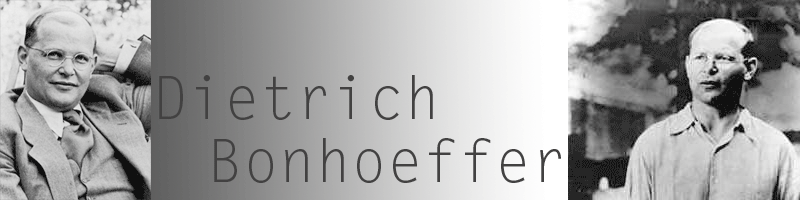
Complication of images from University of North Carolina left | right by Shane Mulligan


            Although the formation of the Nazi party and Hitler’s rise to power convinced the minds of Germany’s people that there was only one “Aryan” race and all others should be destroyed, Dietrich Bonhoeffer, amongst others, remained firm in his Christian beliefs and rejected the Nazi view. Dietrich Bonhoeffer was born in Breslau, Germany in 1906 to a wealth family. He became a theologian, spiritual writer, author of fiction and poetry, and vital figure in the Protestant church’s struggle against Nazism.[1] His beliefs were strong and very well known against Hitler and the Nazi regime prior to their coming to power. He was most well known for his lectures at Berlin University in the late 1920s and 1930s and his attacking the Nazi party in radio broadcasts beginning in 1933.[2]. He was later banned from Berlin University and was not allowed to speak publicly, which shows the Nazis’ fear of his great influence as a teacher.

After the Nazis came to power and closed down Lutheran institutions, Bonhoeffer participated in an underground church, the Confessing Church which was a movement of Protestant leaders who left their official churches because their churches were accommodating the Nazis. However, the Secret Police later found and dismantled the seminary.

            In 1933, he went to England and while there made arrangements to go to India and see Gandhi. He considered Gandhi’s actions consistent with his views and considered Gandhi’s political actions Christ-like and wanted to learn from them. Also while in England, because he was a pacifist, Bonhoeffer tried to rally for a religious resistance to the Nazi party. In his book The Cost of Discipleship he wrote:


Jesus does not promise that when we bless our enemies and do good to them they will not despitefully use and persecute us. They certainly will. But not even that can hurt or overcome us, so long as we pray for them. For if we pray for them, we are taking their distress and poverty, their guilt and perdition, upon ourselves, and pleading to God for them…Their persecution of us only serves to bring them nearer to reconciliation with God and to further the triumphs of love.


            Bonhoeffer specifies what it takes to be a true Christian, a disciple of Christ. Among his ideas was the idea of two types of grace: “cheap grace” and “costly grace. He referred to “cheap grace” as, “Grace without discipleship, grace without the cross, grace without Jesus Christ, living and incarnate.”[3] Bonhoeffer declared “costly grace” to be a Christian’s willingness to sacrifice his or her life for their beliefs in Christ. He further called Christians to take on their faith actively because “faith can no longer mean sitting still and waiting; the Christian must rise and follow Christ.”[4] Another point was made on the Sermon on the Mount. Bonhoeffer uses the Beatitudes to help explain Christ. Bonoeffer emphasizes the suffering of Christ and calls the church to

            In 1939 Bonhoeffer contacted Reinhold Niebuhr and escaped to the United States. However, after a short time in the United States, he began to think that his true place was in Germany with his church as they suffered for their beliefs. He did not think that he should stand on the side, safe, free from persecution, when his fellow Christians were being persecuted by the Nazis. By returning to Germany, he was living out his idea that it is necessary to bear suffering as Christ did to further understand him saying, “Bear the whole burden of Christ, especially as it pertains to suffering.”[5]

            In 1943 Bonhoeffer was arrested by the Nazis and would spend a total of nineteen months in jail. During his many months of imprisonment leading up to his execution, Bonhoeffer wrote an essay called After Ten Years. In the essay he encourages people to beware of evil that is disguised as good, saying that evil will often times take a form of good to lure people into it. Such was the case with Hitler. Many people did not realize that the persecution of people was horrific because they were convinced it was the right action. Their beliefs did not change overnight, but rather, over the course of several years as Hitler made his way up to the head of the Nazi party and dictator of Germany. Bonhoeffer recognized the change of people’s beliefs and as he neared the end of his life, concentrated on telling people to beware of the evils in the world.

His time in prison came to an end in 1945 when he was executed for involvement in helping a group of Jews escape to Switzerland and supporting a plot to murder Hitler, today known as the Officers’ Plot.[6] As would be expected of someone so deeply rooted in their faith and who believed greatly in all that Christ said, on his way to be executed Bonhoeffer said, “This is the end – for me, the beginning of life.”[7]    


[1] <“http://www.dbonhoeffer.org/who-was-db2.htm”>

[2] <“http://www.probe.org/docs/bonhoeffer.html”>

[3] Dietrich Bonhoeffer, The Cost of Discipleship.  New York: Macmillan, 1960, 30.

[4] Ibid, 53.

[5] Ibid, 102.

[6] Susan Bergman, Martyrs. Maryknoll: Orbis Books, 1998, 155.

[7] Ibid, 168.


Bibliography

Bergman, Susan. Martyrs. Maryknoll: Orbis Books, 1998.

Bonhoeffer, Dietrich. The Cost of Discipleship. New York: Macmillan, 1960.

http://www.dbonhoeffer.org/who-was-db2.htm

http://www.probe.org/docs/bonhoeffer.html

Hosted by www.Geocities.ws

1