Photographs on this site are 'low resolution' to speed up the page loading. This has reduced the quality.
A Little About Smocking - History, Care and Hints
Historical smocked garments
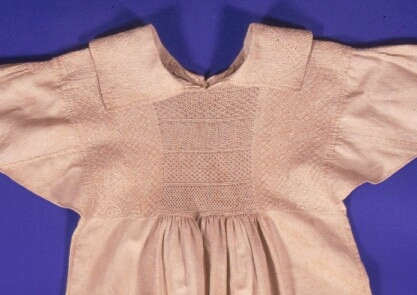
Smocking has come a long way from the original purpose of protecting 'Ye olde English peasants' from the elements, providing a loose working garment and, in some cases, indicating their profession... wheelwright, woodcutter etc. Considering most of these were outdoor professions, the need for practical, warm and somewhat weatherproof is logical. The photo above, used courtesy of Hereford Museum and Art Gallery, shows a man's smock. The smocking pleats are stitched in matching thread and if you look closely you will see the embroidery on each side at the front of the garment. This is where, typically, the symbols representing a person's profession would be stitched. |
Modern smocked garments
The modern variety of smocked garments are more decorative than functional and move in and out of fashion with the the times although for some it is an art form in itself.
I would place myself in the 'I-think-it-is-a-sophisticated-and-beautiful-style-of-clothing' category... and, in my opinion, they will invariably draw expressions of admiration.
There are many variations in 'hand-smocking'. Some so called 'hand-smocking' is quite obviously done by machine. (How they 'get-around' the use of the term and the issue of honesty, I don't know.)
Then there are some very skilful smockers who have mastered the art of using less material and still producing an extremely attractive garment. I have admired such work, although it is not 'traditional'.
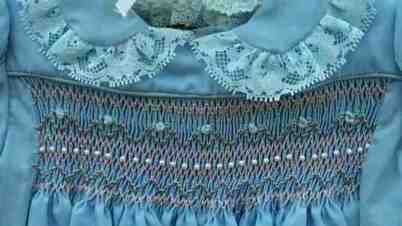
A sample of my smocking.
|
At least in the last fifty or sixty years, traditional smocking uses two and a half to three times the width of material when it is pleated. Taking a random example from my stock wardrobe and measuring it. The smocked section is approx 7 inches and the width of the front of the garment is almost 33 inches. Allowing for the armholes in the garment this is at the high end of the proportion of fabric to pleats for the traditional style. Depending upon the garment style, some of my garments might have a lesser amount, but not less than the 'traditional' width.
About my smocking
My smocking incorporates embroidered features and beading into the design of some of the dresses and rompers I make. So if you thought that smocked children's clothing sounded boring, I invite you to browse through the various smocking sections here on this site. There are clothes for newborns, baby rompers and dresses, little girl dresses, toddler rompers and dresses... and some Special Occasion dresses for three to five year old girls. In all of the smocked clothes I have made, I only made two dresses of the same design. Those dresses are in different colours, would suit twins, and are in the Special Occasion Dress section. However, other than these two I do not make more than one of the same design. (This is not to say that another smocker will not arrive at a similar combination.)
I am aware that because of the detail shown in the photos on this site, designs could be copied but if that is something you would consider doing, I would urge you not to do so.
If you love smocking the pleasure gained from coming up with your own, individual, design is extremely rewarding.

General information, care and hints...
- All these smocked garments have been made in easy-care fabric so that it is simple to keep the garment clean and fresh.
- As far as possible drip dry (non-iron or minimum iron) fabric has been used.
This is also the reason that for the most part the laces used are nylon, not cotton. Cotton requires ironing and this can be rather complex on the sleeves or collar of a small garment... Especially a small, smocked garment. One cotton lace I have used in these garments is a very fine, narrow lace that can be straightened out with gentle fingers when damp. when it is used I will point it out. The other cotton lace is on a garment that requires ironing. This too will be pointed out.
- NEVER iron the pleats.
- Each dress was named when I made it and this name appears on the page describing it as well as being on the hand-made swing label... which also gives the size and basic washing/care instructions.
|
- Age sizing is a difficult thing to estimate. For example a customer bought a newborn size dress for a much anticipated great-grandchild and it did not fit the baby till it was over six months old. Some babies are 'dainty' some are normal and of course some come in a well developed size. For the latter a somewhat larger size may need to be chosen.
Both the garment swing tags and on the 'details' pages, size by weight is also given.
Please note that even then garments may vary according to the design.
- Traditionally smocked dresses are made with deep hems so that the hem can be let down and the garment can 'grow' with the child. I have very rarely done this with the baby size because the armhole width will also change as a baby grows towards the first year.
So with 'early' age groups, in most instances, hems are quite short... but the garment could be passed on to a sibling or saved for the next generation.
|
My dresses are not sold at anywhere near 'chain store prices' but neither are they sold at the price that could be charged in an exclusive childrens' boutique or other specialised shop for this type and quality of garment. I invite you to judge for yourself.
You will find the prices for each smocked garment given in a 'linked' currency window in three main currencies on each garment's details page.
Click the appropriate flag to view the price in that currency. For other currency prices please click the mailbox to send me an email and I will respond as soon as possible.
With the more expensive garments, within reason, I am willing to negotiate on price, so you are welcome to click one of the email links and contact me about this.
(Buttons on this page will re-use this window but there are links back on each of these other section main pages.
Garments are grouped into approx age sections...
Please also take time to check the Credits Page
Credits: Top picture of historical garment -
Courtesy of Hereford Museum and Art Gallery.
Please report faults with this site by clicking on 'Seawalker' above.