| Mohandas K. Gandhi |
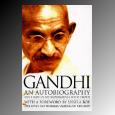 |
| I choose this book to read because Gandhi is a great hitorical figure and his ways of kicking the British out of the indians country was phenomenal Link to review on the book |
 |
| to the home page |
| Society during Gandhi Life 1885 Indian National Congress is formed by Allen Octavian Hume 1930 The Dandi Salt March, The Simon Commission, First Round Table Conference 1920-22 - Nationlist figurehead Mahatma Gandhi launches anti-British civil disobedience campaign. 1915 Home Rule League is founded by Annie Besant 1931 Second Round Table Conference, Gandhi-Irvin Pact 1919 Jalianwala Bagh Massacre, The Rowlat Act 1937 Provincial Autonomy Begins with Congress winning power in many states. WWII breaks out and political deadlock in India 1921 Rise of Gandhi and his Civil Disobedience Movement 1942 The Quit India Movement, Rise of Subhas Chandra Bose 1922 Gandhi Suspends movement after the Chauri-Chura violence 1946 INA men tried. Muslim League Adamant about Pakistan 1928 Murder of Lala Lajpat Rai and subsequent revolutionary activities 1947 India is Partitioned. British Leave India - Freedom at Midnight. 1942-43 - Congress launches "Quit India" movement. 1947 - End of British rule and partition of sub-continent into mainly Hindu India and Muslim-majority state of Pakistan. |
| Gandhi's Life 1869 2 October Mohandas Karamchand Gandhi born of a Bania ( trading caste) family at Porbander in Gujarat, India. 1932 Gandhi begins a "fast unto death" to protest the British government's treatment of India's lowest caste, the "untouchables" (whom Gandhi calls Harijians� God's children.) He urges a new boycott of British goods, and after 6 days of fasting, obtains a pact that improves status of the "untouchables." 1933 Begins 10-month tour of India to end untouchability. 1888-1890 Studies law in England. 1942 All-India Congress passes Gandhi's "Quit India" resolution, and Gandhi begins another campaign of passive resistance against the British. Gandhi is arrested along with many other Indian leaders, and the demonstration is forcibly suppressed by the British government. 1893 Sails for South Africa, being engaged by a Muslim firm for legal work, and is thrown out of a first class bogie because he is colored. 1943 Begins fast at Aga Khan Palace to end deadlock between Viceroy and Indian leaders in talks on British pullout from India. 1906 Gandhi speaks at a mass meeting in the Empire Theater, Johannesburg, on September 11, launching a campaign of nonviolent resistance (satyagraha) to protest discrimination against Indians. The British Government had just invalidated the Indian marriage. 1944 Gandhi's wife, Kasturba, dies in detention at Aga Khan Palace at the age of 74. 1914 Returns to India at age 45 after 21 years of practicing law in South Africa. Attracts wide attention in India by conducting a fast�the first of 14 he will perform in his life�as a form of political protest. 1947 India is partitioned and granted independence after 200 years of British rule. While this is a major victory for Gandhi's nonviolence movement, Gandhi opposes the Congress's decision to accept the partition of the country into India and Pakistan. 1930 Begins a civil disobedience campaign against British rule in India, leading a 165-mile march to the Gujarat Coast of the Arabian Sea. Produces salt by evaporation of sea water in violation of the law as a gesture of defiance against the British monopoly on salt production. 1948 Gandhi is assassinated by Nathuram Godse, a Hindu fanatic, at a prayer meeting on January 30. |
| Credit to: BBC Online News Kamat's Potpourri: Timeline of India Autobiography of Gandhi |
| In my English class we've been studying Ancient Greece. The Greek has scoiety and culture that show in Ganhi and that is that your never to old to learn. |