Spirit In The Dark
Article by Jessica
Berens
Spin, September, 1986
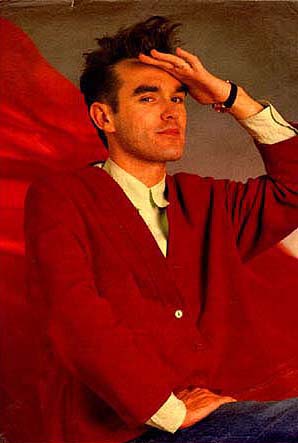
Morrissey says he's celibate, hates Thatcher, DJs, Madonna,
pop-music TV shows, and video. "I do feel sad most of the time about most
things," he says. "I don't find there is a great deal to get jubilant
about." That's show biz.
"Morrissey," remembers Paul Morley, "was always
laughed at in Manchester when we were kids. He was the village idiot. That's the
ironic thing - now he's the poet of a generation. But in those days he was
'that-one-in-the-corner, Steve the Nutter'."
Morley left his hometown in the north of England to become a journalist and,
subsequently, generalissimo behind the coup that was Frankie Goes To Hollywood.
Steve the Nutter, meanwhile, maintained a brooding isolation in the bedroom of
his mother's house, surrounded by his huge collection of James Dean and New York
Dolls memorabilia. Then guitarist Johnny Marr rescued him by appealing to
Morrissey's other submerged obsession: celebrity. Steve was, he has since
admitted, the kind of person who wore cumbersome overcoats on the sweltering
summer days, because he believed that what he wore was fashionable and what
everyone else wore was not. Jesus knows he wanted to be famous. He craved love.
He gained a reputation for being well-read, outspoken, funny, and refreshingly
deranged. He hurled gladiolas at his audience, wore a hearing aid onstage, made
a single with discarded '60's pop star Sandie Shaw (his idol along with Oscar
Wilde and David Johansen), sported flaccid woolen cardigans and unattractive
spectacles of the variety issued by the ailing British National Health Service.
"Some people think I invented them." Voluminous floral shirts were
selected from Evans, a nationwide chain of shops specializing in clothes for
large women.
As a person attracted to the morbid and macabre - Harold and Maude (the
scene where Harold chops off his own hand), Jackson Pollock (the blood on the
canvas), Hemingway (the gun), Jim Morrison (the alcoholic cheeks) Sylvia Plath
(debilitating mania), I always found the Smiths' memento mori sensibility
appealing. Marr's driving dirges, illuminated by Morrissey's socially conscious
lyrics, which dwell on misery, death, loneliness, and despair, are summed up by
the quintessential line, "I think about life/And I think about death/And
neither one particularly appeals to me."
Morrissey stays in a quiet apartment near London's upmarket Sloane Square. When
I visited him, it was bathed in subdued daylight, cluttered with boxes of books
and the occasional blown-up photograph of himself. Tea was served. He perched at
the opposite end of the table. Divested of glasses and contact lenses, he is
seriously myopic and admitted he couldn't actually see me from that distance.
This was probably a good thing, since I had an inane grin on my face, like one
of those girls who used to hang out at the Manson ranch. His sculptured features
are albescent, almost greenish. The hair could have been designed by an
imaginative hedge trimmer.
His purple shirt, "wildly expensive," was bought in Beverly Hills, his
moccasins were suede. Odd for someone whose strong politically green stance was
promulgated on the last Smiths album, Meat Is Murder. We hear,
"The flesh you so fancifully fry/Is not succulent, tasty or nice/It's death
for no reason/And death for no reason is MURDER." So, leather shoes then?
"I find shoes difficult to be ethical about - one just can't seem to avoid
leather. One is trapped, ultimately."
Morrissey was the child of a broken marriage and grew up with his mother, a
librarian. His childhood must have been marred by the Moors Murders, a crime
spree that astounded England and terrorized Manchester, where it happened. Myra
Hindley, an ice-queenish misfit, and Ian Brady, a man obsessed by Hitler, were
sent to prison for life. Their crime? Child murder. One of their victims,
10-year-old Leslie Anne Downey, was photographed in pornographic poses and
tortured. Her screams were taped and subsequently played to an appalled jury
after police found her little body on Saddleworth Moor. She was not the only
child who disappeared at that time. Mancunian parents were terrified, and when
Brady and Hindley, these extraordinary monsters, were sent to prison in 1966,
Morrissey was 7. The song "Suffer Little Children," about that crime,
is one of the Smiths' most powerful.
A woman said, 'I know my son is dead,
I'll never rest my hands on his sacred head!'
Oh Manchester
So much to answer for
The song inspired rampant controversy. How chic can sociopathic child murderers
be? "Veiling the Moors Murders is wrong," Morrissey explains. "We
must bring it to the fore. If we don't overstate things, they'll continue to
happen. We don't forget the atrocities of Hitler, do we? In the north, I was
painted as a hideous Satanic monster, and the word was that I had upset Ann West
[Lesley Anne's mother]. In fact, I had not, and have since become great friends
with her. She is a formidable figure."
The Queen Is Dead, the Smiths' third album, reveals a Morrissey who is,
as usual, unreticent about his opinions. Mouthing off against royalty is rather
brave in a country that is by and large staunchly royalist and currently
preparing to celebrate the marriage of gnomic Prince Andrew to his lumpen lover,
Sarah Ferguson. The monarchy is one of the many things Morrissey hates. "It
preys on people's ignorance. I'm of humble origins, and it's the working classes
who are always roped in. The royals inspire blind devotion, a devotion that
cannot explain itself."
Other things he hates are Mrs. Thatcher, radio disc jockeys
("masturbatory"), radio programs ("I would never be on one, it
would be like joining their side"), Madonna ("organized
prostitution," he told the NME), pop music television programs
("one practically has to go into military training to survive one"),
the music industry ("if you want to protect yourself in this business, you
have to be up very early"), and music videos. The Smiths do not make them.
"I do feel sad most of the time about most things," he mutters.
"I don't find there is a great deal to get jubilant about these days. I'm
not a manic-depressive, just a realist. I'm just not someone you'll see romping
about in a haystack, singing and swinging a bottle of cognac." He laughs.
Morrissey says he is celibate. What that means is anybody's free guess.
If he'd rather not talk aobut his love life (and God knows he talks about
everything else), why doesn't he say so? He talked occasionally of a girl he had
once loved. But if he's frightened now, why doesn't he say so? The truth of this
would not be so important if he was not such a staunch exponent of truth and
integrity. From "Frankly, Mr. Shankly":
I want to live and I want to love
I want to catch something
I might be ashamed of
He is 27. "I'm still waiting to be chosen for the swimming team," he
once said. Perhaps he just hasn't grown up yet.
The above article was originally published in the
September, 1986 issue of Spin magazine. Reprinted without
permission for personal use only.