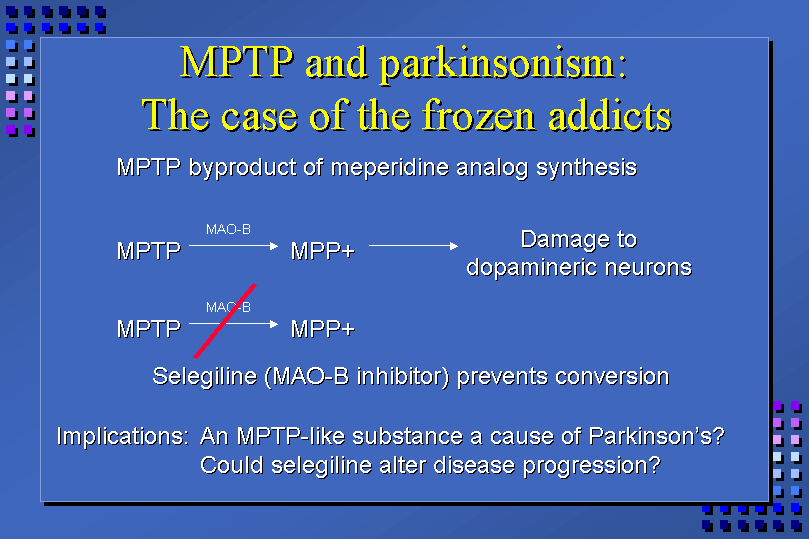
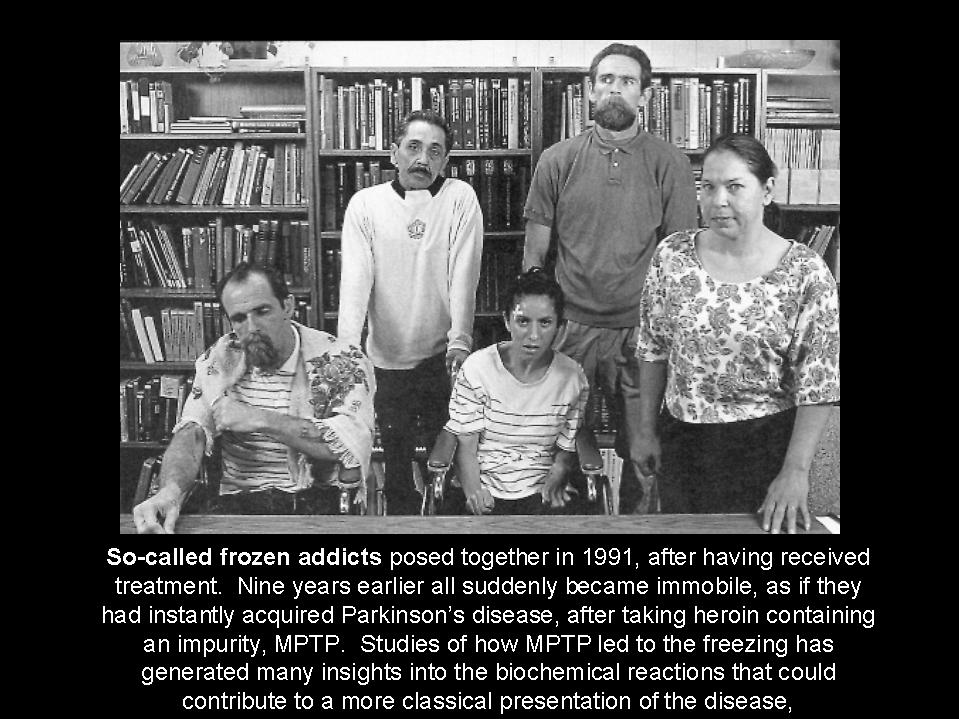
| Dr. Langston became involved in the history of Parkinson's Disease when he found in 1982 that all of a number of young people in California who had become catatonic overnight and displayed parkinsonian symptoms had all taken a designer drug that mimics heroin. He found that the agent of these parkinsonian symptoms was MPTP, or 1-methyl-4-phenyl-1,2,3,6-tetrahydropine. These symptoms included tremor, rigidity, bradykinesia, salivation, micrographia, etc. These patients showed irreversible damage to the substantia nigra but were extremely responsive to therapy involving L-DOPA. Langston found that it was not MPTP that was toxic, but its derivative, MPP+. This transformation can be prevented by a mono-amine oxidase inhibitor. Langston's findings have led to the idea that the cause of Parkinsons' Disease could be a toxic substance in the brain that is converted to MPP+ which then causes Parkinsonism. This is an especially viable hypothesis since Parkinson's Disease first began to appear as a clinical condition in the early 1900s, which is concurrent with the industrial revolution. |