 |
|
 |
| Pierre Marie Charcot worked with Parkinson's Disease from 1860 to 1890 at the Salpetriere in Paris. He related the disease to depression, catotonia, and hysteria. He even called Parkinson's Disease a "neurosis." He saw the final futile outcome of the struggle between the patient and Parkinson's Disease as the tremor, rigidity, and akinesia of his patients. It was Charcot that coined the term "la maladie de Parkinson," which later became translated into Parkinson's Disease. |
 |
 |
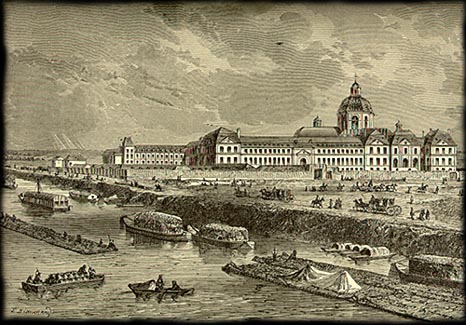
| The Salpetriere |
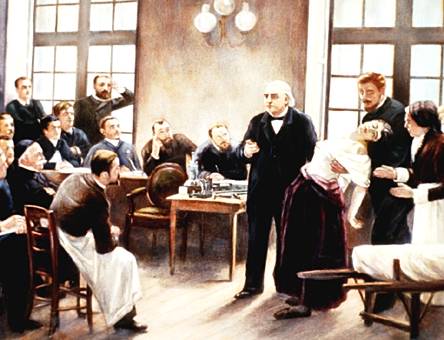
| Charcot Teaching his Class on Hysteria |
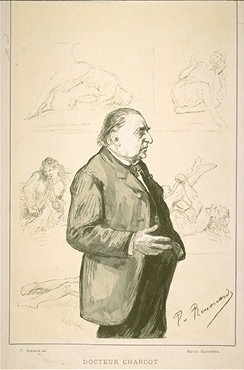
| A humorous sketch of Charcot |
| 1825-1893 |
| Charcot was a famed French physician who was chief of clinical medicine then later senior physician at the Salpetriere. With his friend, physician Edme Felix Alfred Vulpian, he studied Multiple Sclerosis, and employed a sphygmograph to distinguish between Multiple Sclerosis and Parkinson's Disease. Charcot noted that the tremors were seen in MS during voluntary movements, while in PD tremors were seen during involuntary movements. He described these observation in his first volume of his "Lectures on the Nervous System," published in 1872. |
| "To Doctor Charcot unquestionably belongs the credit of distinguishing this condition (MS) from other Paralytic Disorders and notably from paralysis agitans (Parkinson's Disease), recognizing its pathological individuality, and tracing its clinical history." -Meredith Clymer on Charcot, 1870 |
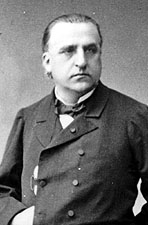
| Pierre Marie Charcot |
| Charcot observed the rigidity associated with Parkinson's Disease and wondered why Parkinson had not reported it. He also noted the blank stare and postural changes associated with an advanced course of the disease. In regard to hand movements, he wrote, "At this stage of the disease... we occasionally find the rhythmical and involuntary oscillations of the different parts of the hand recalling the appearance of certain coordinated movements. Thus in some patients, the thumb moves over the fingers, as when a pencil or paper ball is rolled between them; in others, the movements are more complicated and resemble what takes place when crumbling a piece of bread." Charcot also observed the propulsions, or forward running movements, of his less progressed patients, as well as their tendency to jerk backward. He noticed subtle changes such as how they spoke between their teeth and changes in handwriting. |
| Charcot also devised some novel treatments for Parkinson's Disease, though most of his inventions were more creative than therapeutic. He built a trembling armchair for his patients after he observed that his patients seemed to tremble less after traveling long distances in shaky carriages. He also devised a harness that bounced his patients into the air. In addition to his work on Multiple Sclerosis and Parkinson's Disease, Charcot studied Amyotropic Lateral Sclerosis, cerebral localization, Gilles de la Tourette's Syndrome, Hysteria, and Charcot-Marie Tooth Disease before his death in 1893. He was one of the most prolific clinical scientists in history, and was especially talented in his observations of medical conditions. |
 |
| References: Morris, A.D. (1989) James Parkinson: His Life and Times. Boston, MA: Birkhauser. Sacks, O. (1973) Awakenings. San Bernardino, CA: The Borgo Press. |