the
current digimuse public interface
analysis
While the public
interface of the Drexel Digital Museum is beyond the scope of my project,
analyzing the interface as it now stands has helped me think more clearly
about the museum's content representation needs.
Here is the home
page (http://digimuse.cis.drexel.edu/home.html),
viewed in Internet Explorer 5:
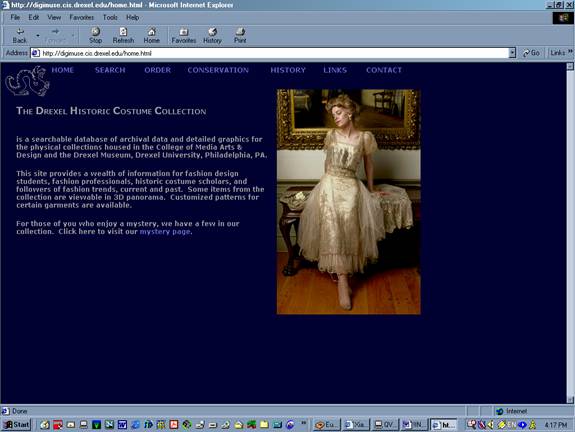
It's not apparent
to me that I need to click on SEARCH in order to view the collection;
however, since that's the first choice after HOME, it doesn't take
me long to reach the collection.
Here is the search
page (http://digimuse.cis.drexel.edu/search.jsp),
the gateway to the collection:
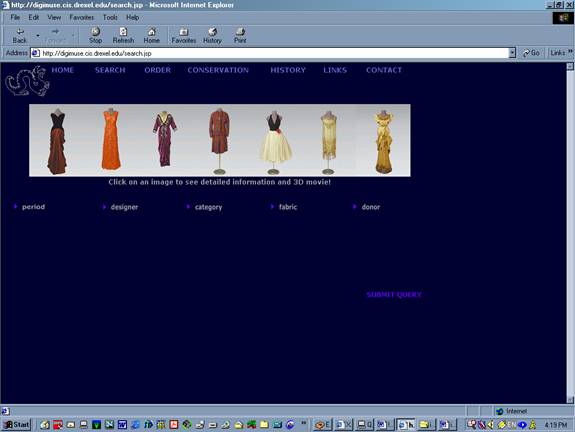
The overall design
is attractive. The dark blue is serious, and combined with the sparse sans-serif
text, gives an elegant look.
It's obvious
to me that I can find out more about any one of the seven gowns by clicking
on its image. However, it isn't clear whether the collection comprises just
seven gowns; if not, how do I find the others?
I try clicking
on the words period, designer, category, fabric,
and donor. Nothing happens. Next I try clicking on the blue arrows
next to those words. Now I get drop-down menus:
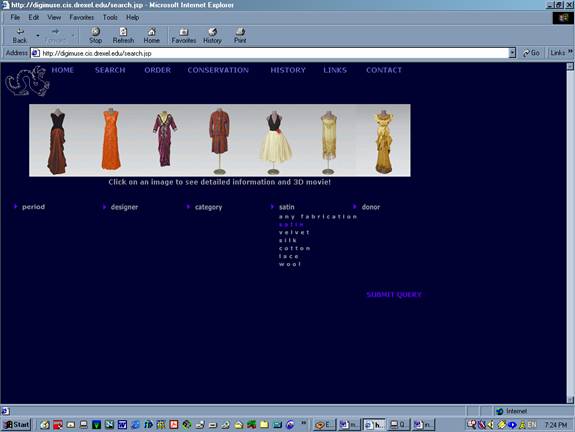
I select a word
from the menu, for instance, satin, and expect a new page to appear
with search results. Nothing happens. I try clicking on SUBMIT QUERY.
Now I get results:
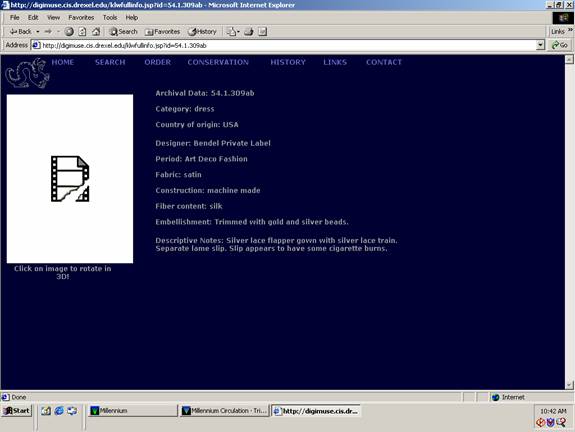
I now have more
text concerning the gown, but no picture, even though there's an empty box
that promises a rotating 3D image. The box has no ALT tags to give me an idea
of what I'm missing or how I should proceed.
Eventually I
figure out that I need QuickTime viewer, which I download. Now I have a rotatable
image:
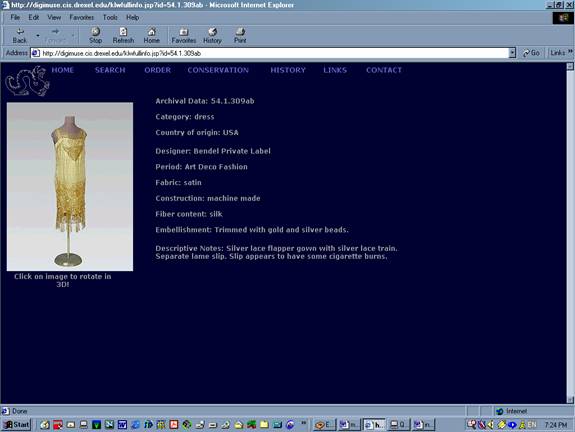
This is fascinating.
I spend a few minutes rotating this image and the others available.
Then I look at
the text. I click on various words in the text to see if there are hyperlinks
hidden there. No hyperlinks.
I would like
to click on Archival Data and find out the significance of this string
of numbers and letters. I'd like to have links to more information on Bendel
Private Label, Art Deco Fashion, and other terms. I'd also like
more data fields. Who was the donor? Who was the person who actually wore
this? Is there any other provenance information? Does the museum hold any
related documents?
Furthermore,
the image is too small to give me much more than a general impression of the
gown. I'd like to be able to zoom in on details, then zoom out for an overall
view.
Going back to
the search page, I try some other searches, for instance, wool. However, this
search comes back empty, as do many others:
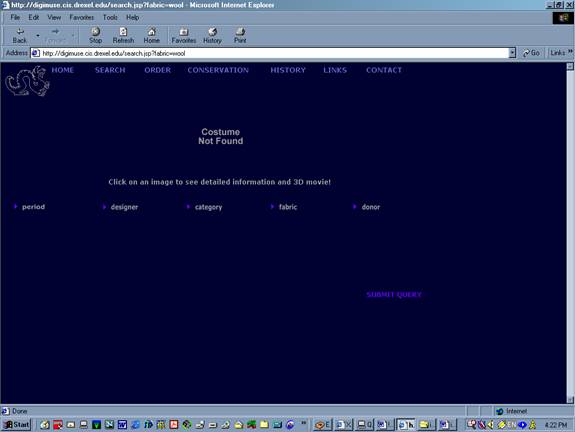
I assume that
this is because of lack of data and not a malfunction.
comparisons
I find Drexel's
site easier to navigate and more informative than many similar sites. For
instance, the Bath Museum of Costume site (http://www.museumofcostume.co.ac/)
has few images, with minimal captions:
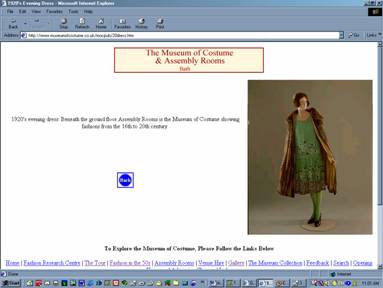
The Bata Shoe
Museum site (http://www.batashoemuseum.ca/)
has a few poor-quality images, again with minimal text:
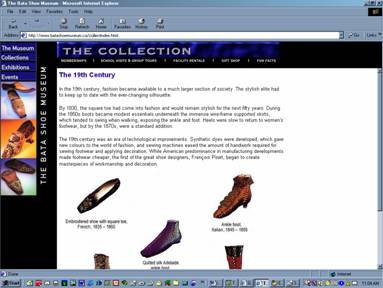
The Los
Angeles County Museum of Art
site (http://www.lacma.org/)
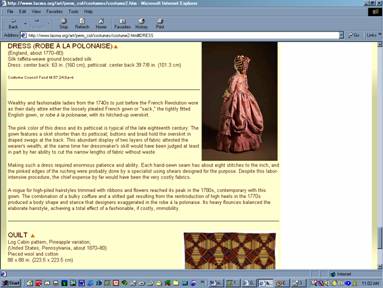
has more extensive text, but a minimal selection of images:
The Hooser Weaving
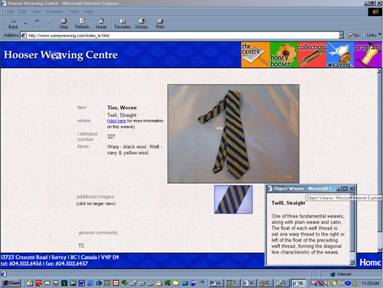
Centre site (http://www.surreyweaving.com/)
is somewhat confusing to navigate, but its rows of thumbnail images and its
pop-up windows are interesting solutions to the problem of providing maximum
information with minimal confusion:
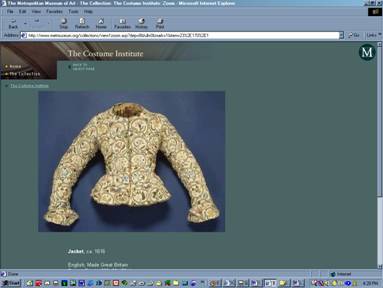
The Metropolitan
Museum of Art site (http://www.metmuseum.org/)
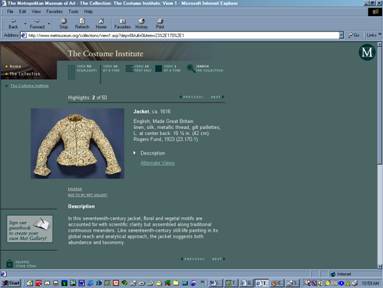
is one of the best. From each collection, there's an online selection of fifty
items. The viewer can view fifty thumbnails or five groups of ten or one at
a time. The item display includes a small image and a basic description:
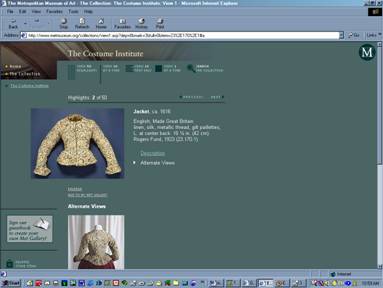
The viewer can
click on Alternate Views for more images:
The viewer can
click on ENLARGE for magnification:
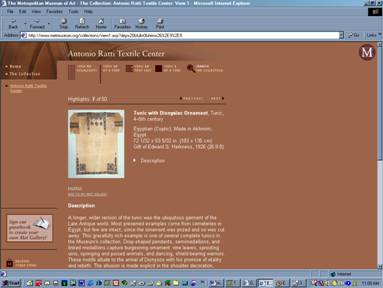
And here's an
item from a different Met collection:
recommendations
In a user survey,
Kravchyna & Hastings (2002)
identify two main uses for museum websites. The first is the ability to view
remote artworks. The second is creating new images from museum images and
juxtaposing museum images with others. This juxtaposition in particular can
open whole new opportunities for researchers. For instance, a scholar anywhere
can take the image of a papyrus fragment owned by one APIS (Advanced Papyrological
Information System) depository and digitally match it with fragments owned
by any other depository to recreate the original document (Gagos,
1996, p. 20). Such work in the past would have required huge travel budgets
and years of research.
Goodrum &
Martin (1999) identify
three potential user groups for the Drexel Historic Costume Collection:
- fashion designers
and textile or fabric designers,
- university
students,
- historians,
archivists, and design faculty.
Each group has
different needs and research habits. Designers tend to prefer hands-on experience
and in-person handling of materials, though information taken from books and
photographic reproductions is useful as well. Students require historical
background and provenance information, in addition to needing photographic
reproductions or in-person handling of materials. Faculty and other scholars
need even greater access to handling materials and to historical information.
As Kravchyna & Hastings point out, the bulk of museum collections is inaccessible
even to physical visitors, with most works in storage and many on loan. "Perhaps
one definition of a 'good' museum Web site is one that combines well-produced
general interest information with full access to the whole collection"
(2002).
My initial recommendation
for the interface is to keep the elegant interface with its limited data and
small images, but to provide multiple hyperlinks on each item's display screen.
For items like
the Bendel flapper gown above, each field label could be linked to a definition,
answering questions such as, What does the Archival Data number mean? What
other Category labels are there? What counts as Embellishment? The data
in each field could be linked to a thesaurus or an authority file, providing
basic information such as, What is the definition of dress? When was Bendel
Private Label active and where was it based? What exactly does machine made
mean? The data in the Period field could be linked to longer narratives
or historical overviews. Once the user was in the thesaurus, authority file,
or overview, further links could lead the user to all other items of the same
category.
In addition,
as stated above, the user should be able to find provenance information and
other documentation for each item.
As for searching,
the current interface is fairly inflexible. The user can only select from
menus of terms; there is no search box for entry of user-chosen terms. If
a user wants crinolines or pill-box hats, there should be way
to do that specific search. To be more useful, however, the search engine
would intermesh with the thesaurus so that even if there were no crinolines,
petticoats could still appear in the search results. To be most useful,
the search interface would give the advanced user access to a hierarchy of
terms so that even if there were no crinolines or petticoats,
the user could move up the hierarchy to below-waist women's undergarments
or even to women's undergarments.
Further functionality
might be provided by graphic displays of term relationships, such as those
developed by Xia Lin and colleagues (Lin,
1996; Lin, 1998) or the
many information visualization interfaces mentioned in OLIVE (Reed
& Heller, 1997).
Ultimately I
would like to see an extremely interactive interface in which every piece
of data could lead the user to further related data. Potentially, the user
could even select a pixel from an image and search the database for other
occurrences of the color of that pixel, or the user could mouse over the outline
of a garment and search the database for other garments with similar outlines.
Chris Yapp asserts,
"If the Internet as technology is used just to hold collections it becomes
boring, if it's used to show links and relationships then it becomes interesting"
(summarized in Napier, 2001).
Millions of documents and images have been digitized-more than any one human
being could ever bring together. Automating the links between countless disparate
items is the real promise of projects like the Drexel Digital Museum. Digital
museums aren't substitutes for physical museums and their objects any more
than online public-access catalogs and digital libraries are substitutes for
physical libraries and their resources.
appendix:
digimuse.cis.drexel.edu viewed in other browsers
Netscape Navigator
4.0 (this version of Netscape had serious problems with the pages, which
I was not able to diagnose):
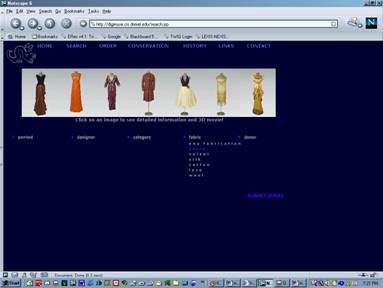
Netscape 6.1:
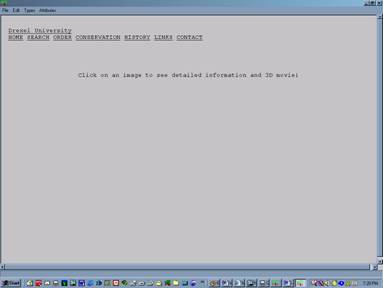
Amaya 5.1 (my version of Amaya is not generally able to handle non-html
files and their plug-ins):
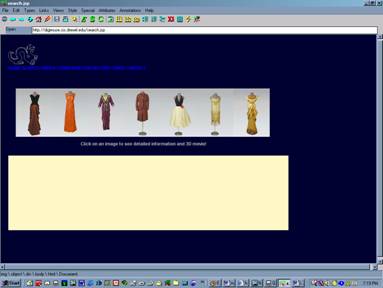
Amaya 5.1, alternate view:
next
page: faceted controlled vocabulary
back
to project home page
Donny
Smith
May 2002
[email protected] or [email protected]