| Our Atmosphere: It's Gassy! |
| The atmosphere that surrounds Earth is a mixture of many different types of gases, as well as particles that have drifted up and away from their natural or human-made sources. Gravity keeps this chemical cloak wrapped around the planet, instead of just drifting into space. What is each layer made of? Where is it in relation to Earth? Read on to find the incredible answers to these vital questions... So to start, here are some general facts about what exactly this thing around the planet is. If our atmosphere was a food, it would probably be one that you would never find at the local coop- think marshmellows. Although they are comprised of some basic and obvious ingredients like sugar, there are those weird ingredients that make up a tiny percent of the marshmellow. Bringing this analogy back to my actual topic, here is the recipe of Earth's atmosphere (basic ingredients and weird ones both included). |
| The Thermosphere!!!!! The thermosphere extends above the mesosphere, and is named for its extremely high temperatures: aproximately 1200 degrees Celcius |
| The Mesosphere!!! Above the stratosphere is the mesosphere, which extends from 50-90 km above sea level. Within the mesosphere, temperature decreases as altitude increases. |
| The Troposphere! The troposphere is the atmosphere's lowest layer, which makes it the part that we are most familiar with. This is where weather occurs, and where most clouds can be found. In tropical areas, the troposphere extends to 16 kilometers (distance is measured from sea level straight upwards), but the average of most locations has the troposphere ending at a height of 9.7 km. As distance from earth lengthens, the air temperature decreases, at a rate of 5.5 degrees Celcius/1000 meters. The temperature at the "top" of the troposphere is usually around -51 degrees Celcius. |
| The Ionosphere!!!! Technically, the ionosphere is not actually acknowledged as a separate atmospheric layer; after all, it overlaps both the mesosphere and the thermosphere, before extending past the exosphosphere. Between 60 and 1000 kilometers, X-rays, UV rays, and electrons radiating from the sun ionize the molecules that form the atmosphere, enabling this part of the atmosphere to conduct electricity. |
| The Exosphere!!!!!! The exosphere is the farthest reaching layer of Earth's atmosphere, extending to a height of 9,600 above sea level. |
| The Stratosphere!! The stratosphere starts where the troposphere ends, and reaches to a height of 50 km above sea level. In this atmospheric layer, there is no large change in temperature as the altitude increases; but the temperature does rise slightly. The increase is more noticeable over tropical regions. The ozone layer makes up the higher part of the stratosphere, where temperature increases more drastically. |
| Nitrogen 78%, Oxygen 21%, Argon 09% Carbon Dioxide .03% |
 |
|
|
|
| Water Vapor Hydrogen Ozone Methane |
|
|
|
|
|
|
|
|
| Carbon Monoxide Helium Neon Krypton Xenon |
|
| BASIC TRACE TRACE |
| The amount of each chemical present in the atmosphere is not strictly constant; instead, atmospheric makeup is constantly shifting in the amount for each component, and even the types of components. For instance, the water vapor content of the atmosphere is in constant variation- at 100% relative humidity, water vapor would be at roughly 190 parts per million at -40 degrees Farnheit, while at 86 degrees it could be at 42,000 parts per million. (One ppm is roughly equal to one ml.) A further example of what might cause atmospheric fluctuation is a volcanic eruption. Eruption can spew several different types of substances into the air, which can spread miles away from the active volcano. One eruption might leave ammonia, hydrogen sulfide, and sulfur and nitrogen oxides in the air before they are washed out by rain. Although scientists have separated the amosphere into different "layers," there are no definite borders dividing them. In this text, I might use terms such as "end" or "border" when referring to the different atmospheric layers; these terms are simply more convenient to use when describing the atmosphere, they are not definite locations. On the contrary, the depth of each of level varies between regions- the troposphere is deeper in tropical regions than other areas on earth, for example. Also, the chemical components of a layer are not necessarily bound to that layer; this was a major problem with aerosols. A Brief History Earth's atmosphere took aproximately 4.5 billion years to evolve, first emanating from early volcanos. Using emmisions readings from present-day volcanos, scientists hypothesize that the young atmosphere was composed mainly of water vapor, carbon dioxide, sulfur dioxide, and nitrogen, but hardly any oxygen. Because the planet started out with scorching climates, and eventually cooled, the atmospheric water vapor probably condensed during the cooling to form the first oceans. Besides these large bodies of water, early atmosphere played other roles in forming terrestrial substances; such as carbonate minerals. This occured when the CO2 in the atmosphere reacted with Earth''s crust. CO2 also dissolved in the oceans, allowing marine life to use photosynthesis, which produced large amouonts of oxygen. Almost all of oxygen in the air today was formed in this process hundreds of millions of years ago: 570 million years ago was the first breathing marine life, and just 400 million years ago, there were the fisrt breathing land animals. . |
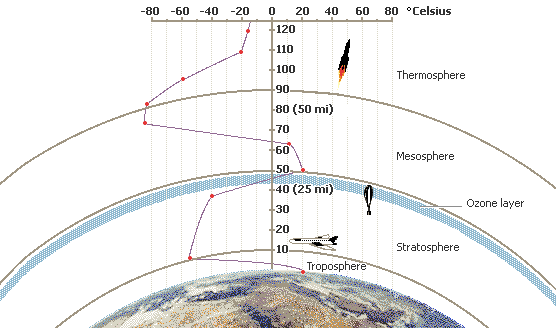 |
| Diagram from encarta.com |
| What tools do atmospheric chemists use to find this information? |
| Some examples... |
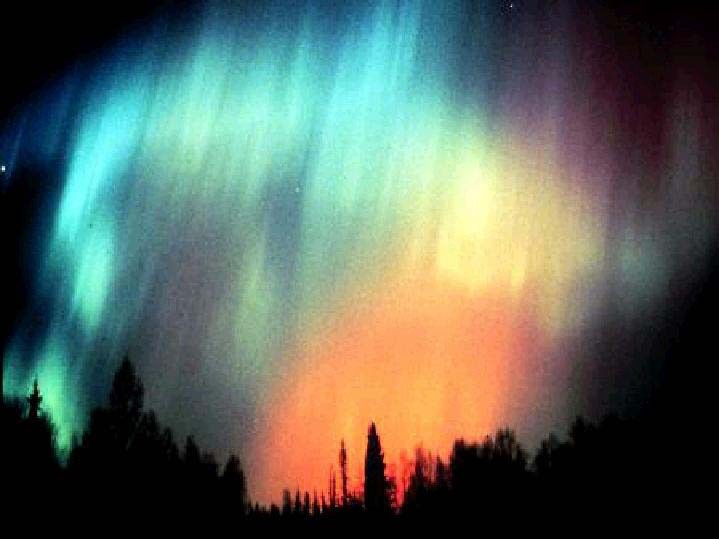 |
| BALLOONS : Scientists are able to measure the atmospheric pressure of the troposphere and stratosphere by using instruments attached to balloons, which radio data back down to Earth. ROCKETS: To gather meteorological data that is higher than 400 km, scientists can attach instruments to rockets, which have radios thatsend back the observations. NATURAL SOURCES: By observing the form and color of the aurora borealis and the aurora australis, scientists can conclude information about atmospheric currents and the concentration of certain elements in that part of the atmosphere. |