 |
 |
| So What Happened?? |
| The release of several articles and papers about the "spray-can controversy" launched a national, and eventually international, debate on the validity of the research methods used by Rowland and Molina, as well as other well known scientists involved in the issue. The manufacturing and use of CFCs was a key part of a billion dollar industry, and corporations did not take the attack sitting down. By 1976, two years after the release of the first anti-CFC paper, the issue had splashed across the front pages of the New York Times, Nature, Science, and numerous university journals. The argument grew more heated when Rowland and a partner, Ralph Cicerone, headed a new movement that pushed for the full termination of spray can manufactuing. They insisted that CFCs in spray cans, though convenient, were not at all necessary, and that the danger they posed to the environment was enough for a national ban on their use. Industry, on the other hand, argued that nothing could be decided immediately without further research, and that the current research was a result of greedy and unscientific lobby groups. A "wait and see" approach was the best way to go, they argued. |
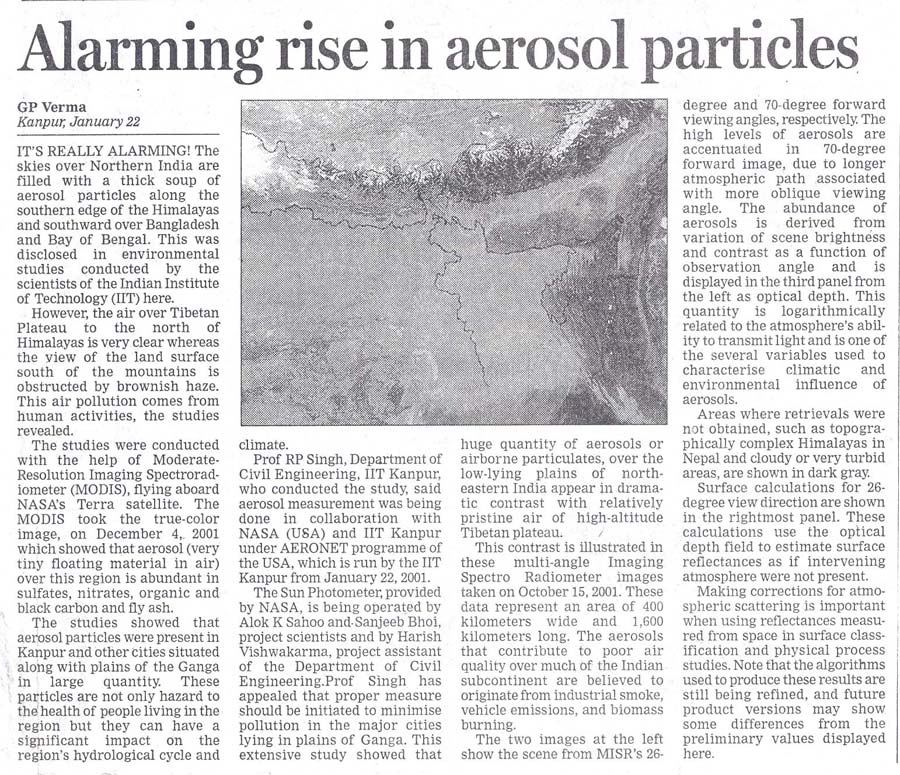
| newspaper clipping: home.iitk.ac.in/~ramesh/ aerosol.jpg Picture: www.nacky.it/web/index1.php |
| The argument grew increasingly nastier; at one time, an article was even printed in the journal, Aerosol Age, (a pro aerosol journal) that all of the anti-aerosol "propoganda" was created by a minority of red heads who wanted to "foist their minority views on the rest of the population," because of their increased tendency to sunburn (Gribbin, Hole in the Sky). In order to bring a conclusion to the battle over aerosols, the government issued research assignments to several organizations to study the issue. NASA became the most prominent among aerosol observation research agencies, and in 1974, Congress passed a bill assigning the National Academy of Sciences to study the topic. The NAS report was finally published in 1976, and confirmed the earlier research that CFCs were harmful to the ozone layer. In 1977, the Food and Drug Administration, the Environmental Protection Agency, and the Consumer Product Safety Commision wrote the legislation to limit and eventually ban the use of CFC spray cans. |
| June 1974: Rowland and Molina's paper on their discovery is published in Nature June 1975: Johnson Wax, the fifth largest manufacturer of aerosol sprays, angers the rest of the industry by announcing its termination of the use of CFCs September 1976: The NAC verifies the Rowland-Molina theory October 1976: The FDA and EPA publish a timeline for the fade-out of CFC use March 1977: The UN Environmental Programme holds its first meeting about the ozone issue October 1978: CFCs used in aerosols are banned in the US 1980: The EPA announces that the US would limit CFC manufacturing to 1979 levels 1981: Donald Heath, a NASA scientist, releases satellite records that show the ozone has decreased by 1% March 1982: The NAS releases a third report on CFCs, and predicts the ultimate ozone depletion to be from 5% to 9% April 1983: During international talks, the Netherlands suggest a world plan for an international ban of aerosol CFCs, and limitations on other types of CFCs Februrary 1984: NAS lowers ozone depletion estimates to 2%-4% 1984: Joe Farman leads a British research group in detecting a 40% ozone loss over Antarctica. March 1985: The Vienna convention is passed, callinng for further research and international research projects on ozone depletion. Negotiators cannot agree, however, on CFC regulation legislature. June 1986: Hearings are held in the capital to discuss global warming and the ozone hole. Arguments are made that greenhouse warming is the result of CFCs and other released chemicals 1986: Du Pont announces it will limit worldwide CFC productionJune 1987: NASA reports a 4% ozone loss in seven years September 1987: The Montreal Protocol is signed, calling for eventual worldwide CFC reductions of 50% March 1988: Du Pont refuses to stop CFC manufacturing outright September 1988: THe EPA releases new research that reveals that the ozone depletion had been underestimated, and that 85% cutbacks are needed March 1989: Europe agrees to quicker limits on CFCs, but developing countries reject the idea |
| "Why do these companies keep releasing these chemicals? Just what planet do they expect to live on?" -a California radio DJ, as quoted by Gibbin in his book, Ozone Crisis: The Evolution of a Sudden Global Emergency |
| *A TIMELINE* |