HOW TO BUY GOOD
STEEL
1.0 Introduction
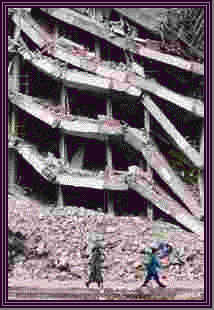 The
spate of collapsed buildings has become a matter of concern to all stakeholders
in the construction industry. The
reason for the collapses have been severally adduced to poor designs, use of
substandard materials, inadequate quantities of even good materials, poor
workman-ship etc. The reasons are
legion. In this write-up, emphasis
is on how to identify good steel reinforcement bars, a major material used in
construction.
The
spate of collapsed buildings has become a matter of concern to all stakeholders
in the construction industry. The
reason for the collapses have been severally adduced to poor designs, use of
substandard materials, inadequate quantities of even good materials, poor
workman-ship etc. The reasons are
legion. In this write-up, emphasis
is on how to identify good steel reinforcement bars, a major material used in
construction.
Reinforcement bars are used to beef-up the strength of
concrete in construction. They
assist concrete in load bearing capacities. Good structural designs ensure that
loads are appropriately distributed as to ensure a sturdy building.
This, however, presupposes that the reinforcement bars used in the
construction are within the standard used in the calculation of the parameters
of the design. Where the quality of
the bars is below the standard applied, building collapse may occur. The
Standard Organization of Nigeria (SON)’s standard for reinforcement bars is
contained in Nigerian Industrial Standard (NIS) 117. Meanwhile, not all
reinforcement bars in the market conform to this standard.
Thus, just as we have substandard drugs, so also, there are substandard
reinforcement bars in the market. The
question then is, how can one tell the difference, in order to ensure a reliable
and safe construction, given that all other factors are adequate?
The difference lies in the metallurgical properties and features that
make for good quality bars.
2.0
Characteristic
Properties/Features of Good Reinforcement Bars
2.1 High Yield Strength
The yield strength indicates the capacity of the bar to
carry load (vertical and horizontal) before plastic deformation. NIS 117
stipulates a minimum of 420N/mm2 for high tension bars.
It is impossible to tell the strength of a bar by mere looks.
One can however, rely on the fact that the product tag carries an NIS
mark as an indication of conformity to strength standard. The method of steel
production may give some indication of the
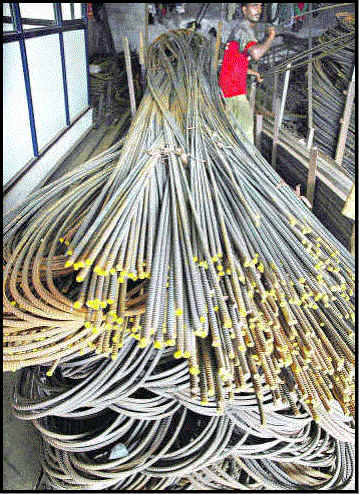 quality
of product there from. Generally,
products from the electric arc furnace, continuous casting and continuous
rolling processes are better than those from induction furnace route. The arc
furnace route has the advantage of removing deleterious tramp elements like
sulphur and phosphorus and other inclusions unlike the induction furnace
process.
quality
of product there from. Generally,
products from the electric arc furnace, continuous casting and continuous
rolling processes are better than those from induction furnace route. The arc
furnace route has the advantage of removing deleterious tramp elements like
sulphur and phosphorus and other inclusions unlike the induction furnace
process.
2.2
Rib Configuration:
The rib configuration of the bars refers essentially to the
height and type of the ribs. The ribs ensure concrete bonding and do not
contribute to the load bearing function of the rebars. Therefore, very low rib
height does not allow for adequate concrete bonding while excessive ribs
compromise the weight bearing function of the bars. An average rib height of
about7 to 8% of the rated diameter is just adequate
2.3
Standard Weight/ meter:
There is a standard weight per meter for each profile of
rebar. The heavier bar, of two
pieces of rebar of same length and profile will conform better to the standard
weight per meter for the profile in question.
2.4
Dimensional Specification:
This refers to the diameter and length of the bars.
The diameter of rebars can be easily measured by a vernier caliper and
the length by a tape. The diameter
depends on the profile sought after, for example, 10mm should be 10mm not 9.5mm,
or 12mm being 11 or 11.5mm. Approved
standard finishing length should be 12m or 40feet.
2.5
Bend-abilty
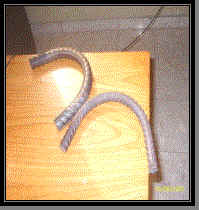
The rebar should be able to bend, and without fracture to
accommodate the design of the building. Those
that break on bending when the right mandrel is used are substandard. Below is
the recommended mandrel diameter for the corresponding profiles.
|
Diameter of
the bar
(mm)
|
Diameter of
mandrel
(mm)
|
|
8
|
64
|
|
10
|
80
|
|
12
|
96
|
|
16
|
128
|
|
20
|
160
|
|
25
|
200
|
|
32
|
256
|
3.0
Summary of Characteristic Features and Benefits
|
Features and
other material properties
|
Benefits
|
|
Perfect rib
|
Excellent concrete bonding.
|
|
High strength ( YS between 420 and 480 N/mm2 )
|
Less steel volume per cubic meter of concrete
required for construction
|
|
Correct rib diameter
and nominal diameter
|
Excellent concrete bonding and more steel per unit
length for construction.
|
|
Better elongation
|
Structure can sustain seismic vibration
|
|
Correct length (12 meter)
|
More
steel per length
|
|
Test certificates
|
Company’s guarantee of quality
|
|
SON certified material
|
Guarantee of quality product
|
|
Better bend ability (no fracture on bending)
|
Structure can with stand vibration.
|
|
Standard weight per meter
|
More steel available per unit length.
|
|
Oblique ribs (fins)
|
Promotes concrete bonding & avoids lateral
movements.
|
|
ISO accredited firm
|
Guarantee of quality product
|
4.0
Quality Assurance Plan of Producer.
It is generally better to patronize products from
organizations that have adequate quality assurance plans for their products.
For such organizations, quality checks are carried out right from the raw
materials consumed and at every stage of production to ensure quality
conformity. For them too, finished products are subjected to various
metallurgical tests to ensure conformity to standard before dispatch to dealers
and end-users. A detailed history of quality practices and billet tracking
from charging to final product can therefore be of great assistance in
determining the product reliability and quality.
5.0
Reinforcement bar testing centers in Nigeria
The table below shows some of the places where the
properties of steel reinforcement bars can be tested
|
Name of
Testing Centre
|
Facilities
Available
|
|
Delta Steel Company Plc
|
80 ton Universal Testing Machine ( UTM ) Bend Test
Machine, Optical Emission Spectrometer ( OES )
|
|
Ajaokuta Steel Company Ltd
|
100 ton UTM, Bend Test Machine, OES
|
|
University of Lagos
|
UTM
|
6.0
Product Identification Mark
All mills have their own product identification marks. You
can check with the distributor if you need more information on the same.
7.0
Conclusion
Generally speaking, the NIS mark of quality should be
looked out for in rebar tags. The mark should be enough indication that the
rebar has been produced to standard. Other
checks, as itemized above can serve to erase any doubts concerning the quality
of products to be purchased. Suffice
to say that the pains to ensure the purchase of good steel are worth the while,
if the consequences of buying substandard product are considered.