Summer Faith Course 2003 Outline Revised July 10, 2005
Return to Summer Theology 2005 Home page


Junior Theology Faith

Course Outline Summer 2005

St. Louis U. High Summer Faith Course

Extra Credit | Test & Exam Preview
Weekly WebAssignments | Tentative Grading Plan


We'll begin the course with a discussion of Holden Caulfield. Was he a person of faith?

We will introduce Plato�s Allegory of the Cave

These should help us begin to address the key issues of the course:
What does it mean to be a person of faith? Does faith really make any difference?

The Human Condition

Weekly review and assignments

A. The problem of evil
  1. Definition of the Problem
  2. Ways of Approaching the Problem
Rabbi Kushner's When Bad Things Happen to Good People

B. What is the human condition?
  1. Blasie Pascal, 17th Century A.D.
  2. Marcus Aurelius, 2nd Century A.D.
  3. The Buddha, 5th Century B.C.
  4. Erich Fromm, 20th Century A.D.
  5. Plato�s �Allegory of the Cave" 5th Century B.C.
C. What is the cause of our condition?
  1. The Christian Doctrine of Original Sin
  2. Buddha�s Second Noble Truth
  3. Plato�s Allegory of the Cave

Reason

A. Philosophy, epistemology and theology
  1. What is theology?
  2. What is epistemology?
  3. What is philosophy?
  4. Key existential questions for any person:
    • Practical: How should I live my life?
    • Philosophical: What does it mean to be human?
  5. Five Foundational Existential Truths
B. Three kinds of knowledge
  1. Experience
  2. Authority
  3. Reason
C. Five common thinking errors
  1. Non sequitur
  2. False and/or vague premises
  3. Ad hominem
  4. Begging the question
  5. Red herrings
D. Five steps to critical thinking
  1. Know the facts
  2. Remember the principle of contradiction
  3. Define your terms
  4. Be intellectually humble
  5. Look for different perspectives
E. The Process of knowing
  1. Perceiving
  2. Categorizing
  3. Evaluating
  4. Symbolizing
  5. Testing


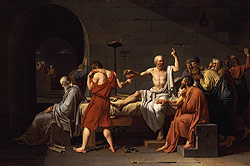
Jacques-Louis David's Death of Socrates
Accused by the Athenian government of denying the gods and corrupting the young through his teachings, Socrates (469�399 B.C.E.) was offered the choice of renouncing his beliefs or being sentenced to death by drinking hemlock. David shows him calmly discoursing on the immortality of the soul with his grief-stricken disciples. Painted in 1787 the picture, with its stoic theme, is perhaps David's most perfect Neoclassical statement. The printmaker and publisher John Boydell wrote to Sir Joshua Reynolds that it was "the greatest effort of art since the Sistine Chapel and the stanze of Raphael. . . . This work would have done honour to Athens at the time of Pericles." The subject is loosely based on Plato's "Phaedo," but in painting it David consulted a variety of sources, including Diderot's treatise on dramatic poetry of 1758 and works by the poet Andr� Chenier. The pose of the figure at the foot of the bed was reportedly inspired by a passage in a novel by the English writer Richardson.
from The Metropolitan Museum of Art Web Site

What is Faith?

A. The secular definition of faith.

B. The biblical idea of faith
  1. Faith is not totally intellectual; it is more a loving trust.
  2. Faith involves periods of doubt and struggle.
  3. Faith involves risk and periods of darkness.
  4. Faith is an ongoing series of decisions.
C. The Catholic definition of faith
  1. Faith is a grace.
  2. Faith is a human response
  3. Faith is a risk.
  4. Faith is reasonable.
  5. Faith is certain.
  6. Faith seeks understanding
  7. Faith is a virtue.
D. Faith: The Golden Way
  1. Nihilism
  2. Radicalism
  3. The golden way of faith.
Film exercise The Mission and assignment.


Some lesser known comtemporary models of faith: Paul Rusesabagina (Hotel Rwanda), Fern Holland, Nelson Mandela.

Continuing reflection/discussion: The Odyssey, Star Wars, The Trilogy of the Rings, The Matrix

Challenges to Faith

A. The attack from atheism
  1. Friedrich Nietzsche
  2. Thomas Hobbes
  3. Ignatius Loyola, a dissent from atheism.
  4. How do their worldviews compare?
B. The challenge of science
  1. The Catholic view of science and faith
  2. History of the relationship between science and faith
  3. Limitations of the scientific method
C. Other contemporary challenges
  1. Scientism
  2. Moral relativism
  3. Materialism/consumerism
  4. hedonism
  5. Nationalism/chauvinism
  6. Zanzig's "major societal values"
Fr. Dick Hadel came in and talked to the students about his ideas and challenges about faith.

Videos:

Jesus: Model of Faith, Model of Humanity


We took a close look Jesus the human person.
  1. Students read the entire The Gospel of Mark in one sitting.
  2. We studeid the sermon on the Mount in Matthew.
  3. Images of faith in the Bible/Zanzig's "The Characterstics of Biblical Faith"
  4. Key teachings of Jesus: The Greatest Commandment, The Judgment of Nations, The Story of the Rioch Young Man.
  5. We read and reflected upon the Parable fo the Prodigal Son. We took time to be ikn the chapel and read this in a contemplative manner. See Fr. Joe Tetlow's Praying with Scriptures
  6. We read and studied two articles of Fr. William O'Malley


This seciton of readings were given to students but not assigned.

Religious Faith


A. Knowledge of God
  1. Are there reasons to believe?
B. Knowledge of via the natural world
  1. Wiliam Paley's "Watch and the Watchmaker"
  2. C.S. Lewis's Moral Argument for the Existence of God
  3. The Golden Ratio
  4. The Anthropic Principle
  5. Kalam's argument
  6. Pascal's Wager
  7. Plato and Aquinas argument from the degrees of perfection
C. Knowledge of God via the human person
  1. argument from religious experience
  2. argument from conscience
  3. argument from natural law
Monika Hellwig's Finding God in All Things

Return to Summer Faith Home Page
Hosted by www.Geocities.ws

1