Summer Faith Course 2004 Class Summary Revised December 19, 2004
Return to Junior Faith 2004 Home page


Junior Theology Faith

Summary of what we did in the course

St. Louis U. High Fall 2004
This is a work in progress and will change!

Grading Plan | Extra Credit
Test & Exam Prievew for Fall of 2004
Test & Exam Preview of Summer Faith Course 2003


First two weeks:

We began the course with some introductory material on a pretest:
  • the snail question (metaphor about real learning)
  • Is one person ideals/values/beliefs as good/valid/true as everyone else's?
  • Some key teachings of Jesus: the greatest commandment, the story of the rich young man,the judgment of nations, the beatitudes.
We spent most of the first two weeks thinking about and discussing faith. Students completed these assignments:
  • Essay for homework 8/23: Was Holden Caulfield a person of faith? Students could write about James Longstreet in Killer Angels or suggest another person they'd like to consider.
  • In class they paired up and read each other essays and discussed their ideas.
  • In class they were reminded of what their freshman text offered about faith: (1) that faith had two necessary components: belief and trust. (2) that the characters in the Old Testament taught us that faith was not totally intellectual-it was more a loving trust; that periods of doubts occurred; that there was risk involved and that it was a life long process.
  • For homework due 8/27 students interviewed someone about their ideas of faith and offered their definition or description of faith.
  • Students met in small groups by person written about to discuss faith in light of all they had heard.
  • A final "Was Holden Caulfield a man of faith?" was due August 29.
  • A worksheet was done for homework on 8/31 and 9/1. Key questions: "What did you learn about faith?" and "Are you a man of faith?"
On 9/2 and 9/3 students had time in class to begin their webpage. They had those evenings to work on it at home. By Tuesday, September 7 they should have begun their home page, e-mailed me their address so I could add the link and add their second essay to the site.

Third week/four days:

All the prior homework and essays will be returned and we will discuss what was learned about faith in the first few weeks.
A worksheet will remind us of some key ideas, offer questions for our faith discussion and lead into the Five Foundational Existential Truths.
We'll begin to see why this course is so important as we consider Five Foundational Existential Truths.
A 40 point test on the introductory material will be Friday. A take home essay on Faith will be part of the test due on Friday (20 points). Students were given a handout about the essay and had the weekend to edit or change their faith essay. This essay should be on their internet site.
Homework for the week is to work on this essay and prepare for the test.

Fourth and fifth week:

Students will read and mark the chapter in the Readings Book (RB) on Reason. We will see and hear some short stories about New York Assistant Fire Chief Gerard Barbara, Eric Clapton, Deion Sanders and Socrates. We will do a jury experience during Block Week. There will be a test on this on Friday, September 24

Sixth and seventh week:

We read and discussed "The Human Condition."

All the above was covered in the first quarter.


The first week of the second quarter

we took some content we did not get to in the first quarter: M. Scott Peck�s �Choosing a Map for Life,� Thomas Jefferson's "Develop an Honest Heart,� John Kavanaugh, S.J. "Natural Law Applies Regardless of Religion, Race or Gender,� John Paul II �Fides et Ratio� and Harry Chapin's "Cat's in the Cradle."

The next three weeks we took section on Challenges to Faith

. Students read and marked the Reading Book and did two worksheets (1) Challenges to Faith worksheet. (5 points) (2) Faith and Science worksheet. (5 points) Then they read the last part of this section i the Reading Book, Kavanaugh's �The Power of Dehumanization� watched We ended this section with a part take home test and an essay. Use one of these titles. You can put this on your internet web site if you want. It should be personal but it would also be good to be able to read what your classmates wrote.
  • �My Challenges to Faith�
  • �My Challenges to Living an Examined Life�
  • �My Challenges to Living a Good Life�
Or if you have a better title for a personal reflection on this unit, suggest it to me.

The two weeks before Thanksgiving

we took the seciton in the Readings Book "What is Faith?"
  • Students were to read/mark study the section �What is Faith?�
  • Watch movie �The Mission� in class during the week of November 15-19. (10 points)
  • Write an essay on one of the topics assigned in the Readings Book. Put it on your internet site. This will be due by November 23.
  • You will have two library days for personal or group work with computers available: Wednesday November 17 and Monday, November 22.
  • Readings Book "What is Faith� test .

The weeks before the Christmas we centered on Jesus as model of humanity and model of faith.

Students read a gospel all the way through. Most read mark, some read matthew or Luke. Each did a special Jesus project to be shared in class after the Christmas break..

Above is a summary of what we have done. Below is the tentative outline for the rest of the course.


The second week of the quarter we had a guest speaker on addiction then viewed a video: Harold Kushner's "When Bad Things Happen to Good People."

Reason

A. Philosophy and theology
  1. What is theology?
  2. What is philosophy?
  3. A key existential question for any reflective person:
    What does it mean to be human?
B. Three kinds of knowledge
  1. Experience
  2. Authority
  3. Reason
C. Five common thinking errors
  1. Non sequitur
  2. False and/or vague premises
  3. Ad hominem
  4. Begging the question
  5. Red herrings
D. Five steps to critical thinking
  1. Know the facts
  2. Remember the principle of contradiction
  3. Define your terms
  4. Be intellectually humble
  5. Look for different perspectives
E. The Process of knowing
  1. Perceiving
  2. Categorizing
  3. Evaluating
  4. Symbolizing
  5. Testing
Extra credit film exercise Twelve Angry Men and assignment.


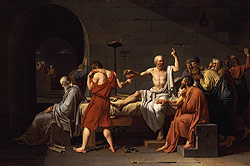
Jacques-Louis David's Death of Socrates
Accused by the Athenian government of denying the gods and corrupting the young through his teachings, Socrates (469�399 B.C.E.) was offered the choice of renouncing his beliefs or being sentenced to death by drinking hemlock. David shows him calmly discoursing on the immortality of the soul with his grief-stricken disciples. Painted in 1787 the picture, with its stoic theme, is perhaps David's most perfect Neoclassical statement. The printmaker and publisher John Boydell wrote to Sir Joshua Reynolds that it was "the greatest effort of art since the Sistine Chapel and the stanze of Raphael. . . . This work would have done honour to Athens at the time of Pericles." The subject is loosely based on Plato's "Phaedo," but in painting it David consulted a variety of sources, including Diderot's treatise on dramatic poetry of 1758 and works by the poet Andr� Chenier. The pose of the figure at the foot of the bed was reportedly inspired by a passage in a novel by the English writer Richardson.
from The Metropolitan Museum of Art Web Site


The Human Condition

We'll continue to look at the beginnings of philosophy with the Greeks: Socrates, Plato�s �Allegory of the Cave" and some basic Aristotle. We'll read M. Scott Peck, a letter from Thomas Jefferson to his nephew Peter Carr and more. We'll hear the stories of Icarus and John Harmon. George Carlin's "euphemisms.If time, we'll take an article from either Seinfeld and Philiosophy, The Simpson's and Philosophy and/or The Matrix and Philosophy. There will be a test on Wednesday, October 6.
A. The problem of evil
  1. Definition of the Problem
  2. Ways of Approaching the Problem
Rabbi Kushner's When Bad Things Happen to Good People

B. What is the human condition?
  1. Blasie Pascal, 17th Century A.D.
  2. Marcus Aurelius, 2nd Century A.D.
  3. The Buddha, 5th Century B.C.
  4. Erich Fromm, 20th Century A.D.
  5. Plato�s �Allegory of the Cave" 5th Century B.C.
C. What is the cause of our condition?
  1. The Christian Doctrine of Original Sin
  2. Buddha�s Second Noble Truth
  3. Plato�s Allegory of the Cave
Film exercise The Mission and assignment.


What is Faith?

A. The secular definition of faith.

B. The biblical idea of faith
  1. Faith is not totally intellectual; it is more a loving trust.
  2. Faith involves periods of doubt and struggle.
  3. Faith involves risk and periods of darkness.
  4. Faith is an ongoing series of decisions.
The story of David

C. The Catholic definition of faith
  1. Faith is a grace.
  2. Faith is a human response
  3. Faith is a risk.
  4. Faith is reasonable.
  5. Faith is certain.
  6. Faith seeks understanding
  7. Faith is a virtue.
D. Faith: The Golden Way
  1. Nihilism
  2. Radicalism
  3. The golden way of faith.
Reflection/discussion upon 20th Century giants of faith:
Karol Wojtyla, Deitrich Bonhoeffer, Martin Luther King, Jr. , Malcom X, and Mother Teresa


Challenges to Faith

A. The attack from atheism
  1. Friedrich Nietzsche
  2. Thomas Hobbes
  3. Ignatius Loyola, a dissent from atheism.
  4. How do their worldviews compare?
B. The challenge of science
  1. The Catholic view of science and faith
  2. History of the relationship between science and faith
  3. Limitations of the scientific method
C. Other contemporary challenges
  1. Scientism
  2. Moral relativism
  3. Materialism/consumerism
  4. hedonism
  5. Nationalism/chauvinism
  6. Zanzig's "major societal values"
Video:
Reflection/discussion: The Odyssey, Star Wars, The Trilogy of the Rings, The Matrix


Jesus: Model of Fatih, Model of Humanity


  1. The Gospel of Mark
  2. C.S. Lewis "The Shocking Alternative" from Mere Christianity
  3. William J. O'Malley's "Understanding Jesus" from Becoming a Catechist
  4. Jesus Project assignment and class presentations


Return to Faith 2004 Home Page
Hosted by www.Geocities.ws

1