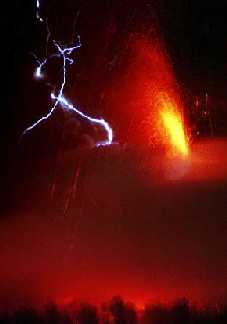
帕卡亚火山爆发
左图
帕卡亚火山爆发时夜景Reuters Photo(2000/01/16)最新消息
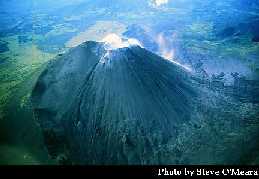
:1月18日帕卡亚火山再次大喷发,喷出的烟柱升到3280英尺的高空。无人员伤亡的报道。右图
爆发前的帕卡亚火山,此图在火山世界帕卡亚火山之页 Steve O'Meara摄据新华社记者陆在宽1月16日从危地马拉首都危地马拉城报道:危地马拉埃斯昆特拉省境内的帕卡亚火山16日猛烈喷发。从火山口喷出的烟柱高达2000多米,但未造成重大损失。危地马拉国家地震和火山局的一份报告还说,火山喷出的
岩浆高达150米。岩浆从火山南坡流向山下的卡拉科尔村。按:新华社报道中的岩浆(magma)均应作熔岩(lava).岩浆是在地下压力极大的环境中,水与气体可以保存在内的硅酸盐熔浆;一旦喷出,由于受到的压力突然减轻,气体和水分迅速分离出去,剩下的硅酸盐物质称为熔岩,刚喷出时温度高,保持液态,还能在地面流动,在热量散失逐渐冷却後,凝结成为坚硬的岩石。火山喷出的灰渣,主要是堵塞火山通道的熔岩在火山爆发时炸碎而成。堵塞愈紧,爆炸愈烈.因此特别猛烈的火山爆发中,常见不到流动的熔岩,而在比较温和的喷发中则多有熔岩流出。
帕卡亚火山的活动方式与有“地中海灯塔”之称的斯特朗博利火山属同一类型,在70年代曾有一天爆发几次,一次持续5-15分钟的纪录进入
http://www.sjordi.com/pictures/guatemala.html .可看到这种喷发过程。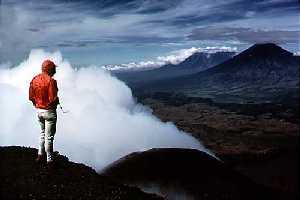
由于帕卡亚火山离危地马拉的首都危地马拉城南边约
40公里处,当日可往返,在活动期间时有小的爆炸发生,但不猛烈,成为招徕游客的好去处,危地马拉1999年举办过的旅游活动,攀登帕卡亚火山有一天的日程;2000年还将继续举办,下面是他们的宣传介绍。左图是登上火山见到的景色。均在Rutahsa's Guatemala-2000 Adventure 中Rutahsa's Guatemala-2000 Adventure
will be held in July-Aug., with a likely departure date of July 16.Aug. 2:
A hard choice today: There is so much to see and do in Antigua, that it's hard to leave it; some will choose to spend another full day here, and who can blame them? But for the hearty, today is the day we climb active Volcán Pacaya. This is a completely non-technical climb, but it is a real huffer-puffer. We hike for about 2 1/2 to 3 1/2 hours to reach the peak at about 8550 ft (it changes from year to year because of the constant activity which alternately builds it up and blows it away!). A stupendous view along the Pacific volcanic chain is just one of the rewards for those who make the climb.---------------------------------------------------------------------------
这座火山的详细资料可进入以下网址取得
http://volcano.und.edu/vwdocs/current_volcs/pacaya/pacaya.html http://volcano.und.nodak.edu/vwdocs/volc_images/south_america/guat/pacaya.html http://www.public.usit.net/rfinch/pacaya.html 美国有线电视(CNN)的报道可由此进入阅读-------------------------------------------------------------------------------------------------------------
下面是路透社的报道
Sunday January 16 10:22 PM ET
Volcano Erupts Near Guatemala City, Airport Closed
GUATEMALA CITY (Reuters) - A volcano near Guatemala City erupted on Sunday, spewing lava and ash into the air and forcing officials to evacuate at least two neighboring villages, officials said.
Officials also shut down the airport as a precaution.
The Pacaya volcano, some 25 miles south of Guatemala City, began spewing lava and ash at 4:15 p.m., Luis Alberto Sanchez Flores, a volcanologist at the National Volcanologist Institute, told Reuters.
Emergency officials said no injuries had been reported and at least 792 villagers from Patrocinio and El Caracol had been sent to temporary shelters.
``There are no injuries but we are evacuating people in shelters,'' Maira Gutierrez, from the National Commission Against Disasters, told Reuters. ``It looks like things are under control now,'' Gutierrez said.
Flores said the eruption sent spurts of lava 3,000 feet into the air and that heavy winds were carrying flakes of ash as far as 30 miles south of the volcano.
``We decided to shut down the airport as a precaution,'' Peter Zimeri, director of Civil Aviation, told Reuters. ''Aircraft can get damaged by the ash and we don't want to run the risk,'' Zimeri said.
Officials warned residents in the area to stay inside their homes to avoid inhaling poisonous gases or getting burned by airborne ashes.
The Pacaya, at about 7,380 feet above sea level, last erupted in September of 1998, covering parts of the capital with white ash flakes and forcing officials to shut down the airport. It is the most active of the 33 volcanoes that dot this small Central American country.
``I didn't get scared. I've known this volcano for more than 40 years and it's always rumbling,'' said Rodrigo Peralta, 46, a farmer who lives in Patrocinio, about a mile from the volcano.
``My family was evacuated but I decided to stay to keep an eye on burglars,'' Peralta told Reuters.
Residents in Guatemala City and neighboring villages could see the lava flowing from the volcano's crater.
Police reported traffic jams in many busy arteries in the capital as drivers and their families stopped their vehicles to observe the night sky being lit up by orange bursts of lava.
回
火山专页||回主页||去地震专页||天下见闻||