1999年厄瓜多尔的火山活动
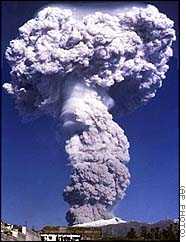
皮晋查(Guagua Pichincha,)火山爆发
这座火山位于这个国家的首都基多(Quito)西边11公里。火山的顶峰海拔4794米,但汽车可开到海拔3800米的高度,无需太多的攀登便可到达火山口。从基多前往,一天就可来回,因此成为旅游的好去处。由于它经常表现出还在活动的特征,近代地理学奠基人洪堡(1769-1859)曾到此考察,以后科学家前去者不断,又成为研究火山的标本。在今年以前,已有25次爆发的记录。1660年这次最强烈,曾使基多堆积起厚达30厘米的火山灰。此后虽仍有活动迹象,但对人已无威胁。科学家一直监视着这座火山,1993年正当多位火山学家在观测火山口,它突然喷发,虽然轻微,但也使两人遇难;不过在现代观测手段的帮助下,它大的活动是能够预知的,如去年便探测到岩浆正在这里的地下聚集上升,在10月发过一次火山将要爆发的警报,但随后发现爆发的趋势在缓和,于是警报又取消。今年8月24日这座火山再次提出了警告,9月29日这座火山发出隆隆的声响,还喷出了一些气体和火山灰,一场大的爆发显然就要到来,谁都能感觉到了。9月30日当局开始撤退火山附近的居民,10月5日这座火山果然爆发了,喷出的火山灰和气体,形成烟云达到19500米的高度;7日早晨它又一连三次爆发,喷出物形成巨大的蘑菇云,顶端高达12000米。上右图, AP拍摄,取自http://cnn.com/WORLD/americas/9910/20ecuador.volcano.ap/index.html 由于危险地区的居民事先已撤走,只死了一位89岁的老人,是因为空气中火山灰和有害气体弥漫,不能适应而死亡的。这一天,奎多落下的火山灰约有5000吨。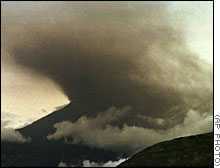
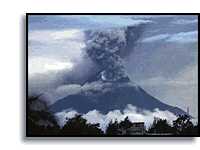
Tungurahua
火山爆发 事隔仅11天,在基多南边120公里,另一座火山 Tungurahua 又传来了强烈喷发的消息,喷出大量气体、水汽和火山灰,火山灰给附近的地面铺上了一层土。(左图,AP拍摄,取自 http://cnn.com/WORLD/americas/9910/20ecuador.volcano.ap/index.html)这种喷发活动出现已有一段时间,9月30日还曾有喷出二氧化硫近7000吨的记录。,9月30日还曾有喷出二氧化硫近7000吨的记录,但都不如10月18日这一次强烈,所以是10月18日这一次被列入了记录,不过看来这并非此次火山活动的终结,很可能还有更大的爆发,所以火山附近的斑诺斯(Banos)等几个城镇的居民仍在撤离,连动物园的动物也搬走了。10月18日厄瓜多尔首都
基多南边120公里的Tungurahua火山喷出大量气体、水汽和火山灰,火山灰给附近的地面铺上了一层土。10月23日果然大爆发,喷出的烟云形如蘑菇,高达10000米。右图取自10月26日Discovery Online(On 23 October, the Tungurahua Volcano sent out a mushroom-shaped column of ash and gas 32,800 feet (~10 km) above the volcano's crater)(以上陶世龙综合Smithsonian Institution 的 Global Volcanism Program 公布的材料及其他新闻报道)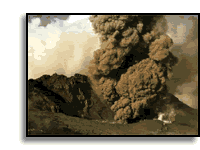
11月24日
,基多国际机场因受到皮晋查火山(Guagua Pichincha,) 爆发的威胁而关闭。爆发出现在當地時間24日下午12時40分和1時20分,火山噴出的灰塵、煙霧和气体形成的蘑菇云高達6000至1万米,火山灰籠罩了整個基多城。。这座火山在沉寂339年后,今年夏天表现出活动迹象, 10月5日、7日接连爆发后, 11月17日下午两点12分(当地时间)又一次爆发,喷起的烟柱升到5000多米的高空,使厄瓜多尔首都基多(Quito)为火山灰所笼罩。(左图,取自Discovery Online)24日的爆发也喷出大量的火山灰。所幸风向西北,而机场在火山的东南受到的影响不是特别大,但已造成对飞机其降的不安全,数十个航班被取消。这两座火山还在活动,科学家正在继续观察,1999年加拿大环球邮报作了下面的报道Under the volcanoes
Ecuador i
s keeping close watch on two jittery mountains that threaten to blow sky-highPAUL KNOX, The Globe and Mail,Thursday, December 23, 1999
Lloa, Ecuador -- Green pastures and forests sweep up the mountainside, yielding only at the summit to a jumble of rock.
The sky is brilliant blue, the clouds puffy as they linger on the slope. Lloa's few streets, near-deserted, give no hint of alarm.
But underneath this placid landscape is a bubbling, trembling mass of molten rock, water and gas that threatens to blow sky-high for the first time in more than 300 years.
This is the Guagua Pichincha volcano, 12 kilometres west of Quito, Ecuador's capital city. Inside that craggy 4,784-metre summit is a roiling caldera, or large crater, and beneath the caldera is a column of magma that is bursting to get out.
When it does -- and volcano experts here tend to say when, not if -- it could dump a thick layer of ash several centimetres deep on Quito, a city of 1.5 million people.
Minor explosions have already spread a fine carpet of grit on the city several times this year. It has forced school closings, and the international airport shut down for a week last month.
"So far, it's only been a few millimetres, but even that has caused physical and psychological damage," says Minard Hall, a volcanologist at Ecuador's Institute of Geophysics. "With several centimetres, it could shut down the city pretty well."
About 150 km to the south, the hot-spring resort town of Banos has already been shut down. A second volcano, 5,023-metre Tungurahua, has been belching fire and rock since September, forcing authorities to order 25,000 people out of their homes.
Scientists say clouds of red-hot gas and dust from Tungurahua could turn Banos houses into instant fireballs, while lava flows could block two nearby rivers and cause massive flooding.
But those uprooted are getting restless. Some are demanding to be allowed back home. Others want money to start businesses in nearby Ambato, where they are temporarily housed.
About 1,000 farmers who live on the slopes of Pichincha have also been forced to move. They, too, have had enough.
"Why should we be afraid of the volcano?" asked Maria Altamirano, a 41-year-old mother of eight from the village of San Luis who has been living in tents and temporary shelters for most of the autumn. "We've always heard the noises."
A few kilometres away, along a rutted track lined with thick foliage and clumps of pampas grass, lies the hamlet of San Jose. It has been evacuated, but residents are allowed in for a few hours' field work each day.
It's not enough, said Maria Agustina Chiluisa Leon, who tends potatoes, beans, corn and barley as well as a few cows on her family's five hectares. "We'll be left without anything to eat next year."
Ms. Chiluisa, wizened and a little stooped after 60 years and eight children, has moved four times this fall. In September she was taken to a shelter in nearby Chichigayo. She moved back home for two weeks, then to a church down the road in El Cinto.
On Dec. 11, she was transferred to Lloa -- which itself was evacuated earlier, but which authorities now say is safe enough to harbour its own people as well as those from more dangerous parts of Pichincha's slope.
Volcano threats are hardly new to Ecuador. At least 18 cones in the Andes have been active in the past 10,000 years. Among the world's cities directly threatened by volcanoes, Quito is the second largest, after Naples in southern Italy.
It is unusual for two peaks in different parts of the cordillera to threaten at the same time. And the volcano crisis is piled on to Ecuador's worst economic news in decades.
Those displaced by the threat of eruption are also coping with a 150-per-cent annual inflation rate, high unemployment and a sharply devalued currency.
Guagua (Baby) Pichincha -- reputedly named because it was born during an eruption of nearby, inactive Rucu Pichincha -- last exploded in 1660. Tungurahua also had a major eruption in that year, along with others in 1773, 1886 and 1916-18.
Dr. Hall, a San Francisco-born geologist who has lived in Ecuador for 27 years, says the volcanoes pose distinct threats because their structure, chemistry and setting are different. His metaphor is graphic: "Pichincha is constipated; Tungurahua has diarrhea."
Pichincha's magma has a higher silicon content, which makes it thicker. It surges up to the caldera, forming molten domes and sending clouds of steam and ash as high as 15 km into the air.
But underneath, trapped by the thick domes that eventually cool and harden, are layers that include more gas and water. "At some point it's possible that the more liquid and volatile parts of the magma will erupt," Dr. Hall said.
Tungurahua's magma doesn't form viscous domes. It spurts out of the caldera and tosses up glowing rocks -- a spectacular display at night.
Pichincha is also a bundle of nerves. Echosonogram monitors have picked up tens of thousands of microearthquakes since September -- roughly one every three or four minutes. "They are not felt by people but they tell us what's going on."
Tungurahua is less co-operative. "The volcano is not giving us as much scientific information that would allow us to predict with some certainty what could go on in the near future," Dr. Hall says.
That makes the institute's scientists more conservative in urging evacuations. Their nightmare is a Tungurahua eruption that sends lava and pyroclastic flows -- clouds of rock, dust and gas as hot as 700 degrees -- surging down the mountainside toward Banos and its townspeople.
"Once you see the event, there's no way to get them out in time," Dr. Hall says.
Banos was evacuated more than two months ago. Tungurahua is still biding its time, and the displaced are wondering why they had to move when no one did in 1916-18.
The answer, Dr. Hall says, is that Banos is bigger now. Houses have been built on earlier lava flows.
Nevertheless, he adds, if the mountain stays relatively quiet, the pressure to return will be too great to resist. "We just hope the volcano will give us the signs, and we correctly interpret them, to give enough warning for people to get out."
The institute wants conditions for a return, including a good alarm system and soldiers stationed in Banos with trucks that can move people out quickly.
Lava gushing out of Pichincha is expected to flow westward, away from Quito. But a heavy ash eruption could clog water pipes and sewers in the capital, sicken anyone with respiratory problems and collapse weak roofs.
The ash would also land on the hills above the city, and Quito's frequent rains could send tonnes of sludge coursing down toward the suburbs.
Quito mayor Roque Sevilla is taking the threat seriously, Dr. Hall says. He asked for and got control of disaster preparations.
Some foreign firms operating in Ecuador have sent the families of expatriate employees out of the country until the threat subsides.
But Guagua Pichincha isn't a deadly volcano. Its only victims in recent years have been two volcanologists caught in a 1993 explosion after they walked into the caldera to take rock samples after unusual activity.
On the plane to Quito this month, deputy agriculture minister Francisco Dammer told of sending crews out on one of his ranches to shake and wash volcano ash off the grass. He feared it would harm his cattle.
Don't bother, say the people on Guagua Pichincha's southwest flank who've lived all their lives with the big baby's burps and gurgles.
"The animals are more intelligent than we are," said 42-year-old Rosa Quinga. "They just knock the ashes off the grass and eat it."
Ms. Quinga's husband, Rodrigo Viracucha, is one of two "guardians" of Guagua Pichincha. In quieter times he kept track of hikers trekking to the summit. Now he peeks into the caldera and radios volcanologists to tell them what's going on.
They believe they know the volcano well enough to size up any danger, but Dr. Hall isn't so sure.
"We're suggesting he shouldn't be spending nights up there," he says. "We're constantly telling them to get the hell out."