|
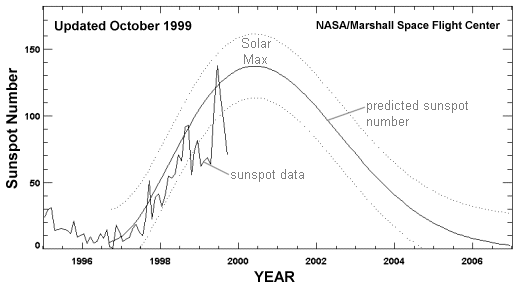
太阳黑子活动进入高峰期 |
|
|
|
(1999/12/10)太阳活动明年进入最高峰受到全世界的关注,在专门普及科学知识的发现频道网络版上有Sun Storms专页 由此即可进入浏览 |
|
(1999/08/18) 在文革中,我因在60年代初写过太阳上的风波等介绍太阳黑子的文章,提到黑子的增加表明太阳活动加强,会使气候反常,灾害增多,因而得到影射攻击罪名。但太阳上确实有黑子,而且是在周期性地增减。1998年,太阳黑子又进入高峰期,全球气候灾害造成的经济损失也达到一个高峰,是1980年的59.3倍。专家预测,这个周期中的最高峰将在2000年1-4月出现(Richard Altrock of the Air Force Research Laboratory in Sunspot, USA).1999年6月25日国际红十字会预告,一系列“超级天灾” 将要发生。亦应与黑子剧增有关,可能因其机制尚不清楚,中国气象专家对1998年中国气候异常的主要原因仅提到厄尔尼诺现象;高原积雪偏多;西太平洋副热带高压异常;亚洲中纬度环流异常。不过承长江日报陈光先生告知,在此以前出版的〈长江流域资源与环境〉杂志和《湖北省自然灾害及防御对策》中,丁一、冯利华和骆高远写的文章,已注意到太阳的影响,并据此提出1998年长江将出现洪水。相关网址:世界观察研究所:1998年的气候灾害http://www.worldwatch.org/alerts/981127.html 国际红十字会预报1999年后的“超级天灾”http://www.disasterrelief.org/Disasters/990624worlddisaster/或 http://www.disasterrelief.org/
1999年11月11日(北京时间)光明日报以美科学家说太阳将进入一个新的高峰期为标题,发表 新华社华盛顿11月10日电(记者谷利源)美国国家海洋与大气管理局9日说,从2000年开始,太阳活动将进入一个新的高峰期。 |
Science of predicting space weather making strides
Web posted at: 10:17 AM EST (1517 GMT), January 3, 2000
SAN FRANCISCO (AP) -- As the sun reaches the peak of its 11-year cycle of activity this year, scientists say they are closer to understanding the process and more able to predict accurately the severity of solar storms.
Space weather forecasts are becoming important as more people and satellites are launched into space, and the world increasingly depends on sensitive electronics that can be fried by particles and radiation emitted by the sun.
Though researchers for years have noticed solar activity increases every 11 years or so, they have been unable to accurately predict the severity of the eruptions. The current cycle is expected to peak sometime in 2000.
"One funny thing about predicting solar activity is some people actually expect you to get it right," said David Hathaway, a researcher at NASA's Marshall Space Flight Center. "We've had a checkered past in terms of making predictions."
For nearly 150 years, scientists have observed that the dark blemishes on the solar surface known as sunspots pop up with much more frequency every 11 years. More recently, the spots have been associated with increased sun eruptions.
Sunspots and solar activity are the result of the star's magnetic field lines twisting and tangling as the sun rotates. Unlike the solid Earth, the gas that makes up the sun rotates at different speeds at different latitudes.
The sun magnetically unwinds by spewing out millions of tons of particles and gasses into space, producing a coronal mass ejection or solar storm, according to the most accepted theory.
Hathaway presented a study December 16 at the fall meeting of the American Geophysical Union examining several methods of prediction and compared their forecasts of previous cycles. Three forecast techniques proved reliable, he said.
All three used the Earth's magnetic fluctuations to predict as much as six or seven years in advance the intensity of the solar cycle. Previously, the most reliable estimates could be made only after the period of high activity began.
"There's something that's happening on the sun about the time of the solar minimum that is telling us ahead of time what the next cycle is going to be like," Hathaway said.
It appears the activity in 2000 will be slightly more intense than average, he said.
Earth is protected from the radiation, particles and gasses by its atmosphere and own magnetism. For billions of years, the only visible effect has been an increase in the spectacular northern and southern lights near the planet's poles.
The electronics inside satellites are sensitive to the energized particles -- as are the cells of astronauts who venture beyond the Earth's protective fields. On Earth, power grids also are susceptible to power surges from the solar events. And radio communications can be disrupted during intense storms.
"What's kind of new about this solar cycle as opposed to other solar cycles is how we use space," said Victor Pizzo of the U.S. Space Environment Center. "Right now we have a whole slew of satellites in orbit for communications and all kinds of stuff."
Because the eruptions occur so far away, scientists usually have several days' warning before the bulk of material blows past Earth.