- Carcinoscorpius rotundicauda ("Indian" Horseshoe Crab)
- Limulus polyphemus ("American" or Atlantic Horseshoe Crab)
- Tachypleus gigas ("Chinese" Horseshoe Crab)
- Tachypleus tridentatus ("Japanese" Horseshoe Crab)
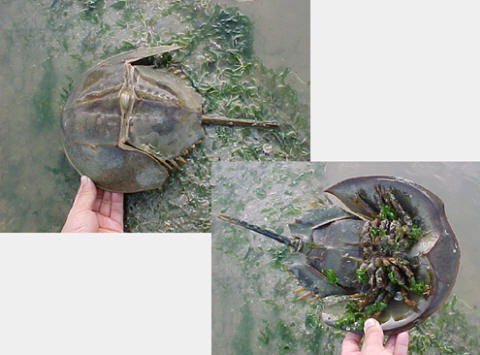
|
While the Horseshoe Crab is an arthropod like the other crabs, it is not a crustacean. Instead it is descended from the ancient trilobites whose fossils are commonly sold in museums. The closest living relatives of the Horseshoe Crab are the other Cheliceramorpha like spiders, scorpions, mites and ticks. There are four species living in the world today. One, Limulus polyphemus lives in the Atlantic while the others are found here in the Indo-Pacific region from India all the way to Japan. The four species are: |
|
|
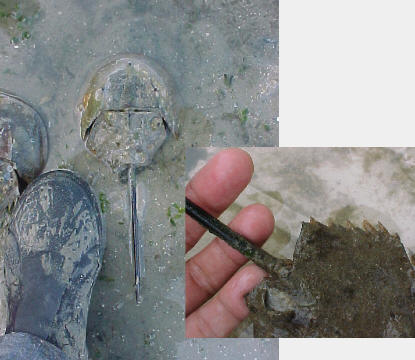 Horseshoe crabs live in shallow waters
with soft sandy or muddy bottoms (especially seagrass areas)
feeding on worms and other organisms living in the sand or mud.
They used to occur in large numbers along the coasts of Singapore
before the coasts were reclaimed.
Horseshoe crabs live in shallow waters
with soft sandy or muddy bottoms (especially seagrass areas)
feeding on worms and other organisms living in the sand or mud.
They used to occur in large numbers along the coasts of Singapore
before the coasts were reclaimed.Like the real crabs, the Horseshoe moults as it outgrows its shell. Horseshoe Crab blood is blue in colour. This is because the blood cells that carry oxygen around use hemocyanin and not hemoglobin to latch onto the oxygen. The blue color in hemocyanin is caused by the copper in it just like the red colour in hemoglobin is caused by iron. Their blood has only one type of immune defense cell: the amoebocyte. When this cell encounters endotoxins, it coagulates or clots immediately. Starting in the 1970s, the amoebocytes were extracted from Limulus polyphemus and processed into a white powder (Limulus Amoebocyte Lysate or LAL) used to detect bacterial endotoxins. Before LAL, it was slow and expensive to test whether medical equipment was really sterile. With LAL, just add water to reconsitute it then apply the LAL to the equipment to see if the LAL coagulates. This is how companies test if the medical equipment they manufacture is really sterile. |