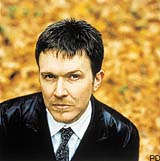
 Dead Bees on a Cake
various reviews and interviews from
1999
- In conversation with David Sylvian - JAM!
- Meetings With Remarkable Women - Exclaim
- FEATURE: Lord of the Bees - David Sylvian Flies Solo - BAM
various reviews and interviews from 1999
- In conversation with David Sylvian - JAM!
- Meetings With Remarkable Women - Exclaim
- FEATURE: Lord of the Bees - David Sylvian Flies Solo - BAM
| "The
Oregonian" (Local newspaper of Oregon, USA) March
26th By MARTY HUGHLEY One mark of musical artistry is the ability to create a
distinctive style, a sound that conveys a compelling sense of place, an atmosphere all its
own. It's not sufficient just to conjure such a sonic space, though. The artist needs to
find a way to move freely within it, to explore its depths and to draw listeners along on
the journey. In the past couple of decades, few pop musicians have been as adept at this
process of construction and discovery as David Sylvian. With his new album "Dead bees
on a cake," due in stores Tuesday, the former frontman for the new wave band Japan
calls us to back to a place of reflection and shadow, luxury and danger, calm and
adventure. "Pop," of course, can be a rather nonspecific term. Sylvian has
hardly become a chartbuster or a household name, and his work has a proudly "Dead bees on a cake" is Sylvian's first solo
album in more than a decade, but it's well worth the wait. The cast of musicians is
intriguing in itself, including Sakamoto, guitar innovators Bill Frisell and Marc Ribot,
and the tabla player and "Asian Underground" leader Talvin Singh. (There's also
a vocal cameo by Sylvian's wife, Ingrid Chavez, The album's title - taken from a line in the song "Godman" and perhaps a sidelong reference to Sylvian's previous album "Secrets of the Beehive" - is perhaps less savory than it should be. The music here follows much the same invitingly contemplative template as his '80s work. But allusions to both sweetness and commercially viable moments, such as the song "Cafe Europa." But there's a bit of menace in the dislocated blues of "Midnight Sun" and the fractured noise of "Godman." Throughout the album, judicious use of samples (from the Mahavishnu Orchestra, John Lee Hooker and John Cage, among others), sound loops and programmed drums provide shifting ground for the nimble musicians to dance upon. Atop and around this ground, you might imagine a scene that's equal parts Japanese garden, wooded glen, urban gallery and Amsterdam cafe. It's a fine place to visit, and it only exists here. (article contributed by Akiko Shigetomo)
After several detours, false starts, and frustrating delays, David Sylvian's first new solo album in 12 years, "Dead Bees On A Cake" is finally set to surface in Canada on April 6. JAM! recently got a hold of a surprisingly open and engaging Sylvian on the line from his San Francisco-area home to talk about "Dead Bees", as well as his early/mid-'90s collaboration with Robert Fripp, tour plans, and a wealth of unreleased material that will finally see the light of day on a compilation project he's now working on. Here is the full text of our conversation. JAM!: I have to admit when I first heard the title of the new album, I laughed out loud. I don't know if you meant it to be humourous. I know the idea behind it relates to the concept of the self merging with the object of desire. Is that something that's come out of the spiritual quest you've been on for the last few years? D.S.: It is. And yes, the title was meant to be humourous. I'm glad you found it amusing. You're the first person to have that response, as far as I'm aware. Yes, for sure it came out of the background to the teachings I've been involved in and obviously a notion that I've been aware of for many years; you know, having been taking quite a bit of interest in various spiritual disciplines over the years. It seems to have reached some kind of peak for me in terms of my own understanding of the concept and experience of it, so that is in some way reflected in the content of the album. I wanted to reflect it in the title, if in a somewhat oblique way, nevertheless I wanted it there. JAM!: But this is a lesson you've had to learn, that you should not try to merge with the object of your desire? D.S.: No, I still see it as a goal that's perfectly desirable, I do. JAM!: Even though the end result of the goal can be that you die? D.S.: Well, the death of the ego. But then again, there are many deaths on the road to awakening, so the death of the ego is the ultimate; the death of the separates or the notion of the separate self or the awareness of the separate self. So that these become part and parcel of the cake. They merge with it, they die into it. JAM!: Is there any sort of direct link with "Secrets Of The Beehive", or is that just a coincidence? D.S.: You could draw certain lines that would link one to the other but I've never considered them linked in that respect. It's more of a coincidence. I was very reluctant to return to the bee imagery or the metaphor but there it was. I was living with that title for some time. It just appealed to me, it became the title of the album. I had no choice. JAM!: The music on "Dead Bees On A Cake" struck me as sounding very 'lived in'. It didn't sound as though someone had gone into the recording studio for 'x' number of months and recorded 14 songs. It sounded as though it was almost sort of a herky jerky process, I suppose, and maybe that has more to do with the lyrics and the vocals than it does with the production or the sound of the music. Was this a very interrupted process for you? D.S.: It was. The writing was uninterrupted and was taken care of pretty quickly but the recording process was very drawn out. JAM!: Deliberately so? D.S.: No. I started out working with Ryuichi Sakamoto in New York and we did three weeks work together. Initially Ryuichi was co-producing the project with me, and after three weeks work we had about three days work down and it was obvious things weren't working as well as they usually are between the two of us. So we decided to call it quits. I captured some wonderful moments from the sessions in the string arrangements, the brass and some piano work of Ryuichi's but we were way behind where I'd expected to be at that point. I did a few other sessions in New York the strongest being the work with Eno, which was like an afternoon's work but an awful lot was given to me in that afternoon to work with. I then set up a second set of sessions in the real world in England and the same thing happened to me. I had a series of musicians, and the material wouldn't take shape. The musicians couldn't find their way in the work and it was completely surprising to me because this has never happened to me before and I didn't think the material was that difficult, so it was baffling. But there I was going through drummer after drummer, bass guitarists, percussionists and really coming away with very, very little. So I returned to Minneapolis where I was then living and just basically started sampling the material that I had and reconstructing the arrangements to try and put together a basis from which to get working on the album. You know, three months (and) there was very little to show for it. That was the beginning, and it kind of went on like that and I found myself just taking on roles that I hadn't really initially foreseen myself taking on: being the sole producer, taking care of engineering, becoming the maintenance guy, your own studio, you know anything that just gets down to the basic work of being creative and recording. JAM!: So did you end up having to painstakingly reconstruct or piece together songs for a variety of performances, or did you actually go back and re-record with another set of musicians? D.S.: I reconstructed the pieces through using various samples from a multitude of performances. The challenge really was to keep the whole thing feeling very organic, like there was a group of people playing together, that sonically it sounded very much a part of a whole, which was quite a challenge actually. Probably a greater challenge than actually putting the arrangements together. JAM!: Was part of the problem that the musicians couldn't sort of lay back and sound like one unit? D.S.: In part maybe. I don't really want to get into what wasn't suitable. I just felt the performances weren't ... I'll give you one example. I was working with Bill Frisell in Seattle. I obviously think Bill is an amazing guitarist. We did two days work together and he contributed a lot of work to many of the pieces. But when I got the work back home and started listening through to it, although the performances were beautiful, they didn't draw out of the pieces the emotional response that I was looking for. So I had to go back and actually replace many guitar parts with my own guitar playing, which is technically inferior, obviously, to Bill's playing. I was able to bring to the work the emotional content that I was trying to draw forth out of the composition. So I had to replace some technically proficient and beautiful work with something that was less proficient but remained truer to the piece of the music. That's something I've never really had to do much of in the past; I could rely on a key person's performance to be totally in sync with the piece of music that I was working on. Maybe as I've matured I'm looking for something far more specific and therefore I was being more demanding of the people that I was working with and when I didn't find it, it meant that I had to go back and find the resources within myself to put that on to disc. JAM!: Is it possible that the work is so personal that the only person who'd be able to elicit the emotional response you were after is yourself? D.S.: I think that's very much a big part of it, yeah. JAM!: How much of an adjustment was it going back to working not solo, in the sense of you playing everything, but without an equal collaborator? D.S.: It was an enormous relief, to be honest. You know the collaborative workouts are amazing on a whole series of levels. Regardless of the end result, you tend to learn a great deal in the process of working with these people. There were rewards but, ultimately, you find yourself unable to stand completely 100% by the work and say you know, "Yes, I stand by this work, this represents this or that aspect". There are so many compromises made along the way that I tend to find that I'm not 100% with the work. After a period of time it began to wear on me that I wasn't putting out work that I felt really strongly about. I guess I was getting to a point in time, a state of mind, where there were issues that I wanted to confront in my writing that I felt uncomfortable doing in the context of a collaboration. So, it felt time to return to the solo work. Prior to even the Sylvian/Fripp collaboration I was sort of focusing, beginning to focus on writing again and was really ready to get back by the time the Sylvian/Fripp project came to an end. JAM!: Were there other things happening in your normal life while the recording process was going on to sort of interrupt the sessions, along with the problems you'd had in the studios? D.S.: Sure, yeah, there was a whole lot going on, in that life just became so interesting and it would just draw me away from the work for months at a time. The work would be shelved for very long periods at certain points in time. My family, having two daughters and again finding the teachers that we did and traveling with the teachers and having a multitude of experiences in their company, so these things were major events in my life, key events and in some way they are documented in the album itself. The album was borne out of that environment where all these things were taking place, so it became part and parcel of this overall experience. I can't separate the writing/recording of the album from all that was going on then, and it really was the richest, most eventful period of my life to date. You know, there was a lot happening. Obviously I was learning a great deal just being with the family, being a very much close-knit family living in Minneapolis as we were. You know you have these very long winters, you lead almost a hermetically sealed existence because you don't go out very often and when you do it's just from A to B and back again, so you tend to live out of one another's pockets. Which was a great experience; the first five years of my first daughter's life, we were very much at home there with her and bringing her up, so that was amazing to have that time to commit to that relationship. And as I said again, the teachers; that was a whole other thing which brought a great richness into our lives, as well as periods of self-doubt and self-analysis which we made some discoveries about ourselves, (and) they're not always easy discoveries to make. It means that you have to go through a process of really facing these problems and working through them. Ultimately, it's greatly rewarding but at the time they can seem just so monstrously difficult to work through. JAM!: Was the sort of hermetically sealed existence in Minneapolis, was that one of the reasons you decided to pick up and move to San Francisco? D.S.: No. There are two reasons for that. Ingrid (Chavez, Sylvian's wife) was ready to move on because she had been living in Minneapolis for, I don't know, 12 years, by the time we picked up. The main reason was that this Indian holy woman Shremar came to stay with us for a period of time, and the experience of living with her for four or five days was so intense that we picked up and moved to a place to where she was living in the Napa Hills so that we could be close to her for a period of time. And when we felt that we had taken enough from that experience, we kind of picked up and moved on again, so we're down in the Valley. But that's really what drew us out here initially. JAM!: Originally I was thinking of asking what the influences have been of you living in the U.S. for the past four or five years, but I couldn't really detect any hint of the influence of the outside world in general. The album sounds very intimate, as though it was recorded in a small, dark space. It certainly doesn't sound as though it's the work of someone who has picked up and moved from one place to another. D.S.: Well, the bulk of the work was done in Minneapolis. When we did pick up and move, all I had left to do was just some finishing off a few of the pieces in terms of guitar and keyboard overdubs, but mainly all the vocals were recorded here in California. And that was a luxury because I was alone and could work entirely alone recording the vocals, which is a new experience for me. It contributed to that sense of intimacy that I think is quite palpable on the album. JAM!: Whose voice is that on "Cafe Europa"? D.S.: That's my wife's voice. JAM!: I guess in a way you ended up sampling your own work, in that in some instances you were trying to piece together songs from different performances. Did you use any (outside) samples on the album? D.S.: Oh yeah. The opening track, "I Surrender", takes its cue from a sample from the Mahavishnu Orchestra. John Lee Hooker is sampled on "Midnight Sun". John Cage on "Pollen Path". There are a few floating around in there. JAM!: What is the Mahavishnu track that you used on "I
Surrender"? D.S.: Oh my goodness, no, I don't remember. JAM!: How about the John Lee Hooker? D.S.: John Lee Hooker's is a track called "I'm Wondering". JAM!: The tracks "God Man" and "Pollen Path" seem ripe for some radical remixes. Have you thought about allowing any of the tracks to be reinterpreted by somebody else? D.S.: Yeah, "God Man". I felt that about "God Man" also. There's so much going on in there I thought, you know, somebody could draw a completely different conclusion when remixing the track. So, yeah I would like to do that. One person, I believe, is already in the process of having a bash at it. I believe we're going to hand it out to a couple of different people to see what the response is. JAM!: Did you record a lot of material during the sessions for "Dead Bees On A Cake" that didn't make the final cut, because I noticed there are a bunch of B-sides listed for the European releases of the first single. (NOTE: The B-sides are "Les Fleurs Du Mal", "Starred And Dreaming", "Whose Trip Is This?" and "Remembering Julia".) D.S.: No the pieces on the B-side of the first single are from sessions that Ingrid and I did together at home, prior to my starting work on this album. So they're kind of pieces in demo form really but, as we were never going to pursue them ... I mean, if we get back into the studio together we'll start writing new material because this new material is rather, perhaps it's 'sell-by date' has passed for us. We worked on it many years ago, maybe five years ago, and it was just actually prior to our first daughter being born. So we were writing and recording this material right up until the night she was born, in fact, and then it kind of got shelved because we got totally immersed in that experience. So I really wanted to put it out there because I think it shows, it kind of mapped out the possibilities for the future. JAM!: So you weren't necessarily working on a project together? D.S.: No, we were just writing together to see what the possibilities were, you know, just that the possibilities seemed wide open. So it's like, 'What should we do?' We just mapped out some ideas to see where it led us and what would get us excited. So that material on the B-side of the single is fairly diverse, but you know, they're quite different from one another and there were more pieces that we got involved in. So, you know that's the one collaboration that's continuing. We really wanted to continue working together, and it just seems that there are enormous possibilities there in that musical relationship. So that will be pursued. To answer the question, there were other pieces recorded, yes, in these sessions that didn't make it onto the final cut. I'm sure they'll see the light of day at some point. JAM!: Is there a real Julia in "Remembering Julia"? D.S.: Julia is a reference to Ingrid herself. JAM!: Are you going to shoot a video for "I Surrender"? D.S.: I would very much like to. It's a matter of persuading Virgin to go ahead with it. JAM!: And I guess there's the inevitable tour question. It's interesting to try to imagine how you'll perform this material on stage. D.S.: I would very much like to tour but it won't be in the short-term. I guess either later in the year or maybe this time next year, it could even be as late as that. But I would very much like to tour the material, it's just that I've concerns right now that prevent me from doing so. JAM!: The song title "Thalhiem" (from Dead Bees On A Cake) -- what does that word mean? D.S.: It means 'little village', actually. It's a place in Germany. It's a place where another holy Indian woman resides, her name is Mother Mira. The song kind of documents my experience with that teacher, but it also documents my experience with my wife so I can't actually differentiate between the two in the track. They just kind of merged into one because I experienced them with Ingrid and I experienced Mother Mira with Ingrid. I guess I've tried throughout the album not to be too dogmatic about what it is that draws me to certain conclusions and draws me to write about these experiences. As I've always done, I've tried to leave the pieces quite open to interpretation. Some of the pieces are directly about my own relationships with certain teachers and can be interpreted as a one-on-one relationship, or a personal relationship so that it enables other people to connect with the work. JAM!: Between working with Robert Fripp and finishing "Dead Bees On A Cake", did you guest on anyone else's music that we might not have gotten to hear over here? D.S.: Ummm, it's hard for me to keep track of the sequence of events. I contributed to a couple of Italian recordings ("Marco Polo I & II") and I contributed to Russell Mills' album. That came out on a small British label called Time, which has since gone bankrupt. Which is a shame because it released some very interesting recordings in its short lifespan, Russell's being one of them. I think that was all though. I don't think I contributed to anything else. (Note: Sylvian also appeared on "Ti Ho Aspettato" ("I Have Waited For You") on L'Albero Pazzo by Andrea Chimenti. Thanks to Sylvian fan Gerrit Hillebrand of Trophies: The David Sylvian Rarities Archive, for this information.) JAM!: For someone who hasn't been especially prolific in terms of album, album, album, you have a fairly extensive discography, if we start documenting all the things you've done. Do you have any other plans for any other work outside of the album and talking about the album for the next little while? D.S.: Yeah, I'm working on some new material that has just been sent to me by an L.A.-based artist. I won't mention his name because we haven't ironed out all the details, so it may not happen. I may work on Russell Mills' latest project. Russell has an interesting approach to making albums because he's really not a musician himself, but he KNOWS a lot of musicians. So he kind of just calls up and says, 'Send me some samples'. So all these really wonderful musicians from around the world send him these samples and he puts the pieces together in the studio with a couple of other talented musicians and comes up with this rather interesting, eclectic album. So I may contribute to that. Other than that I'm working on a compilation album for Virgin, which they've been bugging me for for years now. I'm looking forward to getting to grips with that at this moment in time, prior to getting on with new material. JAM!: A compilation of just your solo work or all of the collaborative work? D.S.: Solo and collaborative work. JAM!: So, post-Japan then? D.S.: Post-Japan. Just trying to draw together all the loose ends, you know so you get an overall picture of what's been done, which would include some of the collaborative work that is relatively scarce, you know something that's hard to come by, as well as the solo work and the more popular collaborations that I've been involved in. JAM!: Will there be any unreleased material? D.S.: Yeah, for sure. JAM!: Is it sort of a big fancy box, that kind of project? D.S.: I hope not, no. I'm kind of tired of those. I started out doing these box sets, with beautiful packaging and now I've had them hoisted upon me so often, you know Virgin seems to think 'well, if Sylvian releases an album we'd better package it up really nicely'. Can't we just put it out as a regular CD for heaven's sake? So, no I hope it's just like a regular release, just an overview to date. JAM!: So this is something that might come out later in the year? D.S.: It will probably come out this time next year, which would probably coincide with the tour if that is indeed when it's to take off. That would be great actually to time it with the release of the compilation. JAM!: You don't sound all that enthusiastic about the task. D.S.: Of touring? JAM!: No, of putting together this compilation. D.S.: (Laughs). No, actually there are aspects of it I really am looking forward to. I am going to re-perform a number of the pieces from the past. Then there were some really strong pieces that just don't make it on to the final albums due to budget restrictions or whatever other problems, obstacles that I've come across over the years. So there's some really beautiful material that's just never seen the light of day, and I hope to incorporate a number of those pieces on the album. So there IS reason for me to feel enthusiastic about completing the project. JAM!: Can you talk a little bit about some of that material? Are there specific pieces with titles and so forth that are recorded that just got dropped off at the last minute? D.S.: There's a piece called "Ride" from the "Beehive" sessions, which was actually the centrepiece of the album. I mean it kind of made sense of the whole for me. It just never got completed due to budget restrictions, you know I ran out of money, Virgin weren't willing to put more into it so the album had to be wrapped up as it was. So there's actually two tracks from that series of sessions, "Riot" being by far the most important track. There's an original version of "Damage" that Robert and I recorded together which has never seen the light of day, which is also very beautiful. In some cases the pieces, the tracks are finished and other cases all it needs is like a vocal to be performed and it will be ready to go. There are some nice things out there that just sit in Virgin's vaults, you know waiting to be discovered. So I really would like to draw those out. JAM!: What was the other "Beehive" track that didn't make it? D.S.: There's a piece called "Promise". (Note: The track, subtitled "The Cult Of Eurydice", is included on a just-released Japanese reissue.) That one is actually completed now, it's actually finished, so it just depends how much I can squeeze on to the album. There are other pieces. There's one piece that I recorded with a couple of Italian artists (Nicola Alesini and Pier Luigi Andreoni), a piece called "The Golden Way". which I think is a beautiful piece which I would love to get my hands on and remix and put that on the album. So there's all these disparate compositions lying around here and there that I would like to draw together and pull together for this album. But it would help create a more complete overview of what I've been up to since the band (Japan) split. JAM!: Are you tempted to go back to "Beehive" and include at least the one track that didn't get included the first time? D.S.: You know, I would love to do that. I mean if I got all this material wrapped up, at some point in the future I would love to re-release the album in the form that I'd intended. JAM!: That would be fascinating for those of us who've become so familiar with it but didn't realize that the "centrepiece" wasn't there. Well, thank you very much for your time, David, and hopefully we'll get a chance to see you in this part of the world some time in the not too distant future. D.S.: It's been a pleasure talking to you, John David Sylvian: David Sylvian is in love. That hasn't always been the state of mind for the vocalist/musician, known for his melancholic jazz-rock and atmospheric ambient work. Once detached and restless, he identified with the mythic figure Orpheus, who tempted the karmic wheel by braving the underworld. And when Sylvian reunited with the members of Japan for the Rain Tree Crow project, his self-questioning took on the symbol of the crow, long associated with death, which in occult terms signifies the initiate separated from society by his exploration of the mysteries. But in the 12 years since his last solo recording, Secrets Of The Beehive, much has happened to settle his inner turmoil. At the end of 1991, while working on a track from Ryuichi Sakamoto's Heartbeat album he met vocalist Ingrid Chavez (then one of Prince's Paisley Park artists). Within three months they were married and Sylvian moved from gloomy London to the open skies of Minneapolis, which became a retreat into nature for the lyricist who often used such obvious metaphors to describe his inner conflicts (his collected works is titled Weatherbox). Since then, two daughters have joined his newly settled lifestyle. When they are older they can share their father's current happiness when listening to his love songs to their mother, "Café Europa" and "Wanderlust" on his new, cryptically-titled album, Dead Bees On A Cake . But Sylvian's new work is not just about devotion to his beautiful wife and young family. At some point in their world-travelling romance they discovered a devotion to the Goddess, which has taken the form of their daily puja (meaning worship) of prayer chants, yoga and vegetarianism. For in the presence of Indian avatars (holy people respected as the Divine presence on earth) Mr. & Mrs. Sylvian found the peaceful space that he was trying to create with sound/art installations like Ember Glance (made with Russell Mills in 1991). At an ashram in Thalheim, Germany (in farm country between Köln and Frankfurt) Sylvian received a silent blessing, 'darshan' (meaning vision), while kneeling before a saintly psychic "Mother" Meera. This turning point in Sylvian's life was commemorated by the track "Darshan (The Road To Graceland)" on the album he did with guitarist Robert Fripp in 1993. "Bringing Down The Light," also on their revelatory-titled The First Day album, was further named after a book by Meera discussing her purpose in manifesting "paramatma-jyotis" - "the light of the Supreme Self." Now the female aspect in Sylvian's pieces such as "All My Mother's Names," "Krishna Blue" and "Thalheim," and even older ones like "Wave" and "Riverman" can be seen as references to the Divine Mother. "Absolutely, sometimes unconsciously so," said Sylvian from his new home in the Napa Hills of California. "But I've come to realise that is indeed the case. I guess that is when I recognised my teacher, Sri Sri Mata Amritanandamayi. Everything fell into place for me, in that there was this woman that embodied that power for me, and that imagery. And sometimes they cross over to a degree where I'm not even sure where one begins and another takes over. There are certain pieces on the album that are both written about Ingrid and also my experiences with other teachers relating to the Divine Mother." Part of Sylvian's daily practice, when his studio's hard drive isn't crashing or album artwork is being lost, is to recognise the divine in all things. "Another teacher brought that to me, Shree Maa, the Indian lady that sings on the penultimate track on the album ('Praise'). She encouraged us to live our lives that way, to look for the divine in one another and worship the divine in one another. Which I think is a really wonderful way to conduct a relationship. And also in your children and all beings essentially. It has become a discipline or practice to look into your loved one's eyes and find that aspect of their being." The opening track and Sakamoto-orchestrated first single, "I Surrender," is the confirmation of his redemption from his past existential crises, through devotional worship and the submission of the ego. (The album's cryptic title also refers to this - death of the ego, the bee, merging with the object of spiritual desire, the cake.) In "Krishna Blue" he sings about being unbound from the kind of restrictions mentioned in an older song about orthodox religion, "Gone To Earth." "The feeling in 'Gone To Earth' was being earthbound, being attached in many desirous ways, if you like, and then 'Krishna Blue' is talking about how she is enabling me to let go of all of those attachments. Taking away all the obsession with this or that aspect of myself and allowing me to be liberated and to move on. I guess I found that what worked best for me was a very practical discipline, on a daily basis. I like the clarity of Buddhism and I also like the devotional aspect of Hinduism. And my own practice somehow embraces both of those disciplines." Dead Bees On A Cake is not about new age goodness and born-again idealism. While tunes like "Thalheim" resemble his earlier, gently introspective tracks like "Wave," the new album also contains the blues-sampling "Midnight Sun" and off-kilter tracks like the Navajo-inspired "Pollen Path" and the next single "God Man." "I think that the shadow side of human nature should be represented, like doubt or anger or fear, things that should also be embraced and understood, and not shut away somewhere. I don't think we can attach ourselves to an art work that doesn't hold the possibility of all the aspects of human nature. I've always tried to embrace that shadow side of human nature, as well as the positive side, so as to be able to make that transformation from dark to light. Some of my pieces are very drawn out graphically in that nature. 'Let The Happiness In' is very much a kind of map, if you like, helping to create a sense of uplifting from the rather pessimistic starting point. And I hope the work allows people to find themselves within it, regardless of the state of mind with which they approach it." Dead Bees On A Cake succeeds in that regard by working on both poetic and deeper esoteric levels. This humble superstar isn't one to insist on a spiritual path for his fans, but is happy merely to express his moments of insight won along the way - lyrical and musical trophies from the "path way of the heart."
David Sylvian is talking about advertising, about how he, his wife and three children skirt consumer-aimed pressure and stay true to their spartan, spiritual lifestyle. Even the most beautiful television commercial-an art form in itself, usually-leaves the UK-bred, Sonoma-based singer cold. The visuals speed by, he sighs, "but I don't feel attracted or attached to any of that stuff that comes my way." But with a 14-year-old son in the house, how does the family resist, say, a high-pressure pitch for Sony's teen necessity, Playstation? This hits a nerve with Sylvian. He scratches his D'Artagnon goatee, pondering the predicament. "When he was younger, he was really into Playstation," he recalls. "But we found that he would just come out with certain words that shouldn't be in his vocabulary yet. I can't remember what this one awful word was ..." "Fatality?" I suggest. Sylvian claps his hands together, delighted. "Yes! 'fatality' from Mortal Kombat! And we thought, 'Wow, this is really strange coming out of the mouth of a seven-year-old; it doesn't feel right.'" So Dad and Mom (former Paisley Park poet Ingrid Chavez, whom Sylvian met while living in Minneapolis) sat Junior down for a little metaphysical chat. Wouldn't it be better, the folks reasoned, if the distracting system were shelved for a little while? "He was very good at drawing, but the whole time he had these games, he didn't draw one real picture," Sylvian continues. "So we asked him, 'What's this about? You were really creative, you had this whole thing going and now all you do is draw people being dismembered. There's something going on here, you can see that, right?'" Sylvian is suddenly aglow with fatherly pride. "And he saw it! And he gave it up! And as a result, he has a far more creative life-he just got accepted into one of the local art schools!" This illustrates one of Sylvian's underlying credos, a tenet that's guided him since the disbanding of his art-rock outfit Japan nearly two decades ago: "Stay open and true to the moment-the more conscious we are of the moment, the less likely we are to make the same mistakes." Hence, his first solo album in 12 years, Dead Bees on a Cake (Virgin), concentrates on exactly how the man is feeling now, at 40, in a moment he terms "probably the happiest, the richest, the most eventful period of my life." Over the years, he's collaborated with such stellar sidemen as Robert Fripp, Mark Isham, Bill Nelson, Can's Holger Czukay, and longtime chum Ryuichi Sakamoto (who guests on several Bees numbers). Lately, however, Sylvian has been consumed by a quest for inner peace, which led him to an Indian ascetic he calls his "teacher," and onward to meditation, painting and a dramatic change in his home-recording approach: "You have to remove everything that's extraneous to create a clarity." In doing so, he adds, he's "made an album that somehow condenses a lot of the interests and experiences from my past into accessible pop songs." After convincing a kid to waive the addicting Mortal Kombat, it's a flick of the wrist for Sylvian to communicate this newfound serenity to listeners. Bees is aching, gorgeous testimony, swathed in velvety keyboard textures, shambling rhythms and deceptively simple arrangements that underscore his reedy, Bryan Ferry-ish croon. Whereas he once relied on blatant film/literary metaphors (Gunter Grass's The Tin Drum, for instance), the composer-who refers to his songs as "pieces" and "works"-opted to break with cultural tradition this time around. "I didn't want to mislead," he explains. "I wanted to make my statements more my own." Using the innate beauty of the natural world around him, he states his case in "I Surrender": "I opened up the pathway of the heart/The flowers died embittered from the start ... Birds fly and fill the summer skies and I surrender." "Wanderlust," "Pollen Path," "The Shining of Peace"-there's such an exotic fragrance of peace wafting from the disc, it could qualify as aromatherapy. Personally, Sylvian has a similar aura. On a recent SF shopping trip (looking like an older, wiser version of that platinum-haired quasi-punk that glared from Japan's bratty Adolescent Sex debut in '78), he sat with almost regal bearing in his hotel suite, a scarf wrapped around his neck as the winter wind whipped in through an open window, a Mona Lisa-subtle smile on his lips as he spoke of all the arcane knowledge he's carefully, purposefully acquired. Knowledge, he stresses, which is available to anyone willing to seek it. "People have said to me, 'Well, isn't surrender the easiest path to take?'" he chortles. "But I've never felt that to be the case. Surrendering your will to some other being is probably the most difficult step to take, and it's not one action and it's over, like, 'Oh, I've surrendered.' You have to surrender every moment, with every breath." Learning such life lessons-coupled with his family's annual four-wheeler pilgrimage, following their guru in her summer ministering-to-the-masses treks across America-convinced Sylvian of a couple of things. "I felt I had a lot to say, and I'm at my most eloquent when I'm working within this context." But aren't there stressful, world-gets-him-down times when the concept of karate-chopping the hell out some Mortal Kombat character sounds pretty damn good? Sylvian's eyes flash for merely a microsecond. Nope. Now he's Zenlike-calm again. His Confucian reply: "It's all a matter of figuring out how your time is being spent, how it's affecting you mentally, affecting your focus. That's how we handle things in our family-we figure out the alternatives, figure out what else is out there ..."
|