(611) Sayers,Raymond (2145) - Payne,Oliver R (2029) [C06]
4NCL/Div3/SLO2-PP2 West Bromwich (9.2), 24.05.2003
[Annotations by Charlie Linford]
1.e4 e6 2.d4 d5 3.Nd2 Nf6 4.e5 Nfd7 5.c3 c5 6.Bd3 Nc6 7.Ne2 Qb6 8.Nf3 cxd4 9.cxd4 Bb4+ Oh dear. This is hardly Payne's proudest moment, exchanging his good bishop and merely so he can exchange the queens as well, and reach a simplified position against a higher rated opponent. 10.Bd2 Bxd2+ 11.Qxd2 Qb4 White is emminetly comfortable here, and either here or on move 14 he should play Rc1, preventing the development of the bad bishop. 12.Nf4 Qxd2+ 13.Kxd2 Ke7 14.Rhe1 b6 15.Rac1 Too little too late. Now the position is harder to make anything of. White was playing for tricks with Nf4 and Rhe1, hoping for ...f6 after which the pin on the e-file (and thus attack on the d5-pawn) becomes tricky to meet. 15...Bb7 16.a3 Rac8 17.b4 h6 18.g4 a6 (=) Payne has set out his stall, and, as is hardly surpirising given his dull 9th move, he is happy with a draw. White has not immediately capitalised, and can now claim only a slight advatage; to make matters worse, in the game he hits on the wrong plan (doubling rooks on the c-file and preparing b5 seems sensible). 19.h4 Na7 20.Nh5 Nc6 Payne recognises that the 'threat' on the g-pawn is nothing, and in fact will help him. 21.Nxg7?! Rhg8 22.Nh5 Rxg4 Diagram
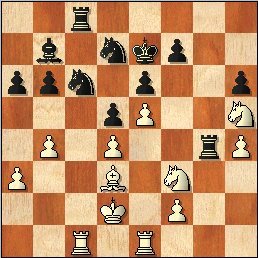
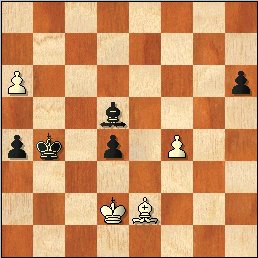
Now the h8-rook has been freed, and black can claim at least equality. The only plus of white's excursion is the weakning of the f6-square, but without a dark squared bishop (or an open f-file for his rooks) to exploit this, it is practically irrelevant. 23.Ke3 b5 Payne is attempting to re-write the definition of bad bishop, but then it would appear he was never intending to win... 24.Rc2 f6 Swapping down further. Thanks to white's 21.Nxg7?!, the generation of a backward e-pawn for black is less important than the isolated queen pawn for white, which the king has to defend from the newly activated rook. 25.Nxf6 Nxf6 26.exf6+ Kxf6 27.Rec1 White is about 15 moves too late with this plan. 27...Rgg8 28.h5 Rgf8 29.Nh2 e5 The natural follow-up to his previous play, Payne attempts to free the bishop he hemmed in earlier. 30.Ng4+ Ke6 31.Nxe5 Nxe5 32.dxe5 No doubt Payne's eyes lit up at the thought of more exchanges, but much though I have disagreed with his approach in this game, it should be noted that Payne is not a stupid player. White should be able to claim a slight pull in the bishop ending if both pairs of rooks come off, as there are more black pawns fixed on light squares than vice versa, but Payne is aware of this, and keeps one pair of rooks on to create some threats in conjunction with his centralised king. 32...Rxc2 33.Rxc2 Kxe5 34.Bg6 To prevent against 34...d4+ 35.Ke2 Bf3+ and ...Bxh5. 34...d4+ 35.Ke2 Bf3+ 36.Kd3 Rf4 37.Rc8 Bd5 38.Re8+ (=) The position is indeed drawn, but Payne suddenly decides he can play for a win. In reality black's activity and better placed pieces is balanced by his weaknesses on the queenside. 38...Be6 39.Ke2 Kd5 At this point white could seal the draw with 40.Rd8+, where black has nothing better than to repeat with 40...Ke5 41.Re8, but instead he goes pawn-hunting, which is not advisable. 40.Ra8?! Bg4+ 41.Ke1 Rf6 42.Bd3? A most bizaare decision, choosing to give away a pawn for absolutely nothing. One can only assume that white was afraid that black would infiltrate his king with 42...Kc4, but by keeping an eye on the d-pawn with 42.Rd8 white should hold the balance. 42...Bxh5 43.Rc8 Bf7 44.Rc5+ Kd6 45.a4 A pawn down, white now wakes up and takes the correct action of trying to eliminate as many of the pawns as possible. 45...bxa4 46.Ra5 Bb3 47.Bxa6 Kc7 48.Be2 Rd6 48...Rb6 is the most accurate way to continue, but ironically, as Oliver was desperately seeking a draw earlier and his opponent was frustrated with not being able to win, the roles have become reversed and the outcome stays the same: draw. 49.Bd1? And just as the draw has become probable again, Sayers throws it away again! Now Payne should be able to win. 49...Rb6 Compared to playing it last move, white no longer has Bb5 and must push the pawn, allowing the black king to infiltrate. 50.b5 Kd6 51.Kd2 Kc5 52.Be2 Kb4 52...h5, gaining a vital tempo on later lines where a pawn race will decide the winner, is probably best, but the text should still win. 53.Ra6 Rxa6 54.bxa6 Bd5 55.f4?? Diagram An incredible move that should lose on the spot. Pushing his own passed pawn with 55.a7, and thus distracting the black bishop, was almost the only way to proceed. 55...Kc5?? 55...a3! 56. Kc1 Be4! cuts the king off from the pawn, and prepares ...Kc3 and ...a2, winning trivially. 56.Kc2 (=) Possibly unable to believe his luck, Sayers offers another draw. Payne may still be able to squeeze out a win, but it has become difficult with his king taking a backward step. 56...Be4+ 57.Kb2 Kb6 58.Ka3 d3?! 58...Bc2 is the best way to win, defending both passed pawns and the d1 queening square. 59.Bd1 Kxa6? This is the move that throws away the win. There was no reason not to defend the passed pawn with 59...Bc6, and then capture on a6. One can only assume that time pressure played a part. 60.Kxa4 Now that white has swapped the passed pawns, and advanced his king sufficiently, the draw is again in sight. 60...Kb6 61.Kb4 Kc6 62.Kc4 Kd6 63.Bg4 d2 64.Kc3 Bf5 65.Bf3 d1Q 66.Bxd1 Kd5 67.Bf3+ 1/2-1/2