(331) Richmond,Robert J (2219) - Freeman,Richard CP (2066) [A42]
4NCL/Div3/MKE vs. SLO2 Telford ENG (3.2), 18.01.2003
[Annotations by Charlie Linford]
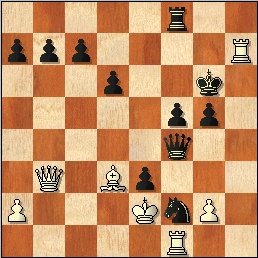
1.c4 g6 2.Nc3 Bg7 3.d4 d6 4.e4 e5 5.d5 Ne7 6.Bd3 0-0 7.Nge2 f5 The Averbakh variation, if I am not mistaken (which I could be - I'm not an advocate of these lines), and an engaging struggle lies ahead as white aims to prove that the black setup is inferior to that of a Kings Indian. 8.exf5 gxf5 9.Bg5 Nd7 10.f4 e4 11.Bc2 Nf6 12.Qd2 Bd7 13.Nd4 Ng6 All looks pretty normal to me up to here - I expect I would castle queenside here and start flinging my kingside pawns forward. Instead, white inverts the order of this plan, and in so doing heightens the tempo of the game by a long way... 14.h4!? h6 Obviously h5-h6 could not be allowed, so black must test out white's plan. 15.h5 hxg5 Bailing out here with 15...Ne7 was possible, but hardly in the spirit of the position. 16.hxg6 Ng4 17.Ne6 Each side straight-facedly ignores any oppurtunity to grab material, preferring to entrench their respective knights in the position. 17...e3 Admittedly this move isn't too difficult to find, and Fritz confirms it does not have any tactical flaws, but it is always nice to see a position where both queens are en prise at opposite ends of the board! 18.Qd1 Bxe6 19.dxe6 Bxc3+?! Diagram
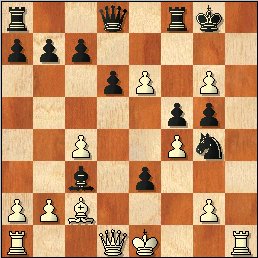
An extremely double edged move - admittedly the white pawn structure will be so appaling that a few pawns are liable to drop off here and there, but the threat of Bxf5! is accentuated by the disappearance of the black kings best friend. Objectively (as much as one can be objective about a position like this) white should probably be winning now, but he has to walk a tightrope to get to his prize. 20.bxc3 Qf6 21.e7! A good start - the queen has to abandon it's defensive duties in some way, and prefers to grab a few pawns into the bargain. 21...Qxc3+ 22.Ke2 Qxc4+ 23.Bd3 Qxf4 Merrily grabbing more pawns while the going is good - three will become four when the e-pawn captures on f8... 24.Qb3+ Kg7 25.exf8Q+ 25.exf8B+ was more stylish, but it's all a matter of taste... 25...Rxf8 26.Raf1 Nf2 27.Rh7+ Kxg6 Diagram 28.Rxc7? White slips at the last hurdle, as somewhat ironically, grabbing pawns turns out to be wrong in this case... double standards...28.Re7! was the right way, and although black will still have many tricks and traps, white should prevail. 28...Qg4+ 29.Ke1 Qb4+! A particularly difficult for a white player to forsee. As 30.Ke2 Qd2+ leads to mate in 12 (thank you Fritz), white must drop a piece and do, what else? Pawn-grabbing! 30.Qxb4 Nxd3+ 31.Ke2 Nxb4 32.Rxb7 Nxa2 33.Kxe3 Nc3 34.Rxa7 This ending is, somewhat fittingly, drawn, but care is required from white as black has all the "cheapo-chances". 34...Re8+ 35.Kd3 Nd5 36.Kd4 Nf4 37.Rf2 Re4+ 38.Kc3 Kf6 39.Kd2 d5 40.Ra8 Ne6 41.Ra6 Ke5 42.Ra8 f4 43.Re2 Getting the rooks off will all but garuantee the draw, so both sides retire to the analysis room. 1/2-1/2