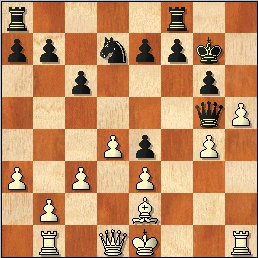
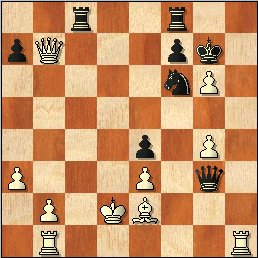
1.d4 Nf6 2.Nf3 g6 3.Nc3 d5 4.Bf4 Bg7 5.e3 c6 In comparison to the Keely game, Williams keeps his pawn breaks in reserve with a more modest setup. 6.Be2 0-0 7.h4!? An interesting idea, attempting to prove that black's early castling is incorrect, but it does not turn out well in the game. Against someone of less than 2300 strength we might have seen a different story altogether. 7...Qb6 The Welshman immediately seeks to keep the white king in the centre, or at the very least to create weaknesses on the queenside which will later leave the white king with an unpleasant choice of where to reside. 8.a3 Nbd7 9.Ne5 Nxe5 10.Bxe5 h5 11.f3 Bf5 12.Rb1 White had to be careful to remember that pawn, but now the white king will have a dangerous life in the centre. 12...Nd7 13.Bxg7 Kxg7 14.g4 (=) Another early draw offer, although in this case the game has developed rather quickly. Williams, however, is not intimidated by white's kingside gestures, and reasons that the white king will be in peril long before his monarch... 14...hxg4 15.fxg4 Be4 16.Nxe4 Naturally White wanted to remove the strong bishop, but now the central lines become more fluid, and the black queen also finds a use for the disappearance of the d5-pawn. Far be it from me to call this move a mistake, but 16.Bf3 looks more prudent with hindsight. 16...dxe4 17.h5?! This move is a culprit, however. The Welsh wizard now finds a neat way to exploit the looseness on white's kingside. 17...Qa5+ 18.c3 Qg5! Diagram