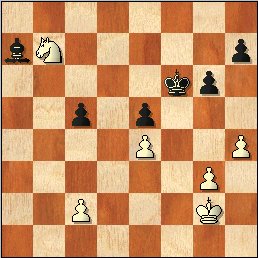
1.e4 e5 2.Nf3 d6 3.d4 Nf6 4.Nc3 Nbd7 5.Bc4 Be7 The Philidor Defence is hardly the most booky of openings, but this is the closest to what you could call a main line. Most games continue without a central exchange, and black has a solid, if slightly passive position. 6.dxe5 dxe5 7.0-0 Following this exchange, the only line of independent interest is the piece sacrifice 7.Bxf7+ Kxf7 8.Ne6+ Kg8 (Keres gives 8...Kg6!? as better for black, but this looks suspect to me - white appears to have a very reasonable investment for his piece) 9.Ne6 and so on, but this is believed satisfactory for black. 7...0-0 8.Bg5 c6 9.a4 Qc7 10.Qe2 Nc5 11.Rad1 Be6 12.b4 Bxc4 13.Qxc4 Nxa4 A pretty clean equaliser to halt any of white's queenside ambitions - 13...Ne6 was also equal. 14.Nxa4 b5 15.Qa2 bxa4 16.Bxf6 Bxf6 17.Qxa4 g6 18.Rd3 a5 19.Rc3 Rfc8 20.g3 axb4 21.Qxb4 Be7 22.Qc4 Rab8 23.Rb3 Qd6 24.Rfb1 Rxb3 25.Rxb3 Ra8 26.Kg2 Ra7 (=) A draw seems fair to me, but Wessex obviously had promotion considerations. 27.Rd3 Qc7 28.Rc3 Ra3 29.Rxa3 Bxa3 30.Qc3 Bd6 31.Ne1 f5 32.Qc4+ Kg7 33.Nf3 Qd7 34.h4 f4? 35.Ng5? Both sides are caught napping just before the first time control - 35.Qc3! would have given black some serious work to do. 35...fxg3 36.fxg3 Bb8 37.Qe6 Qxe6 38.Nxe6+ Kf6 39.Nd8 c5 40.Nb7 Ba7 Diagram