(614) Foster,James J (2081) - Winfridsson,Ola (2038) [A13]
4NCL/Div3/SLO2-PP2 West Bromwich (9.5), 24.05.2003
[Annotations by Charlie Linford]

1.c4 e6 2.e4 d5 3.Nc3 dxe4 4.Nxe4 Nf6 5.Nxf6+ Qxf6 6.Qf3 Qxf3 7.Nxf3 Not the most devestatingly theoretical opening, but Foster is not particularly known for his adherence to the main lines. 7...Nc6 8.d4 Bb4+ 9.Bd2 Bxd2+ 10.Kxd2 Ke7 Move ten, and already both sides ar moving their kings towards the centre. I have a token preference for white here, but both sides need to make a fight of the position for something to happen. 11.Rd1 Rd8 12.Kc3 a5 13.g3 Rb8 14.a4 Nb4 15.Bg2 Bd7 16.b3 c6 17.Ne5 Be8 18.Nd3 Nxd3 19.Rxd3 Again, white could probably claim a very slight advantage here due to he placements of the bishops. Black's next, however, really opens up the game. 19...b5?! Probably motivated to activating his bishop, but white appears the better placed to take advantage of the queenside opening, with his now very strong fianchettoed bishop. 20.axb5 cxb5 21.c5 Creating a passed pawn looks tempting, but 21.Ra1! would have given black real problems, activating the last piece and all but preventing ...b4 as the a-pawn would have then been indefensible. Whilst it may not be enough to win, black would have certainly had a great deal of work to do. 21...b4+ Now the white king must step back, and the weakness of the backward a-pawn cannot be exploited due to some tactical issues white must resolve. 22.Kb2 Rbc8 Threatening the c-pawn and thus tying up the white rook. 23.Rc1 Bc6 24.Bxc6 Rxc6 Now that the bishops have been exchanged, and the passed pawn is completely blockaded, the position is very much drawn. 25.Rc4 Rd5 26.f4 Diagram
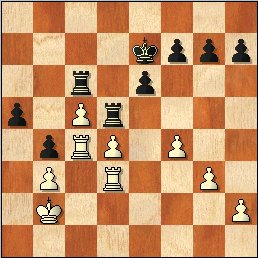
(=) A fair assesment, but black obviously thinks that his rooks are the more active. 26...f6 27.Re3 e5 Black would have to go some way to win this position, but he is also in no danger of losing. 28.Re1 A simple move like 28.h3 was probably sufficient to show that black had no real threats, but Foster decides to try and force the issue. 28...Kf7 29.Ra1? Objectively white shouldn't be able to get away with this one, as the pawn that black wins is far more important. 29...exd4 30.Rxa5 d3 31.Rc1 This much could be predicted from move 29, but here a simple move like 31...Kg6 would have left white struggling for a draw,as the white king is trapped a long way from the action. 31...Re6 This is not bad either, however. 32.Rd1 Re2+ 33.Kc1 Rc2+ 34.Kb1 Rxh2 Black has gone pawn-grabbing, but now white can stir up some trouble. There was still a good path for black, but at this point a draw looks the most likely result. 35.Rb5 Rg2?! Now white gets the pawn back with no fuss, and black has to bail out to a draw. More imaginative was 35...Rc2!?, when the d-pawn is immune after 36.Rxb4 Rdxc5!. Even here, though, the black king is so far away from the action that white must have good drawing chances. 36.Rxb4 Rxc5 Fritz wants to try 36...Rxg3!??, remaining a pawn up, but I'm sure most humans would do more than hesitate before providing white with two connected passed pawns... 37.Rxd3 Rgc2?! A simpler route to the draw was 37...Rh5, but the material is sufficiently reduced that a draw is almost impossible to prevent. 38.Rb7+ Kg6 39.Rdd7 Rg2 Fritz wants to believe that white is winning here, but slowly comes round to the fact that all lines end at (0.00) - perpetual check. 1/2-1/2

1
Hosted by www.Geocities.ws